
Daily insights for city builders, delivered every morning at 6 AM ET. I’m Brandon Donnelly — a Toronto-based real estate developer and founder of Globizen. I’ve been writing here since 2013.

Tag: sidewalk

  • Letter from Toronto on Google’s city of the future

    Politico Magazine recently published this article about Sidewalk Toronto. It’s called: Google Is Building a City of the Future in Toronto. Would Anyone Want to Live There? 

    If you’re familiar with what Sidewalk Toronto is up to, the first bit will likely cover things you already know. But later on it gets into an interesting discussion around data privacy, among other things.

    One argument is that if you strip any personal identifiers from the data you collect, then you’ve effectively eliminated the issue of privacy. 

    But what about “collective privacy?” 

    What if you could, for example, identity signs of concentrated drug usage within certain districts, communities, or even buildings? Does that start to get a little too personal?

    This is the great debate surrounding Quayside, the area that Sidewalk is focused on. The article also touches on what Quayside could mean for the future of Toronto.

    Just about all players involved believe that if Sidewalk can be successful at Quayside, it has a shot at the adjoining 800-acre Port Lands, a swath of problem space big enough to become home to a dozen new neighborhoods in a growing metropolis. Townsend, the consultant, says of the Port Lands: “That’s a city they’re going to build there. This is just the warmup, this little piece.”

    Full article, here. There’s also an audio version in case that’s your preferred consumption method. It’s about 40 minutes long if you do it that way (and don’t speed it up).
  • Meet Replica

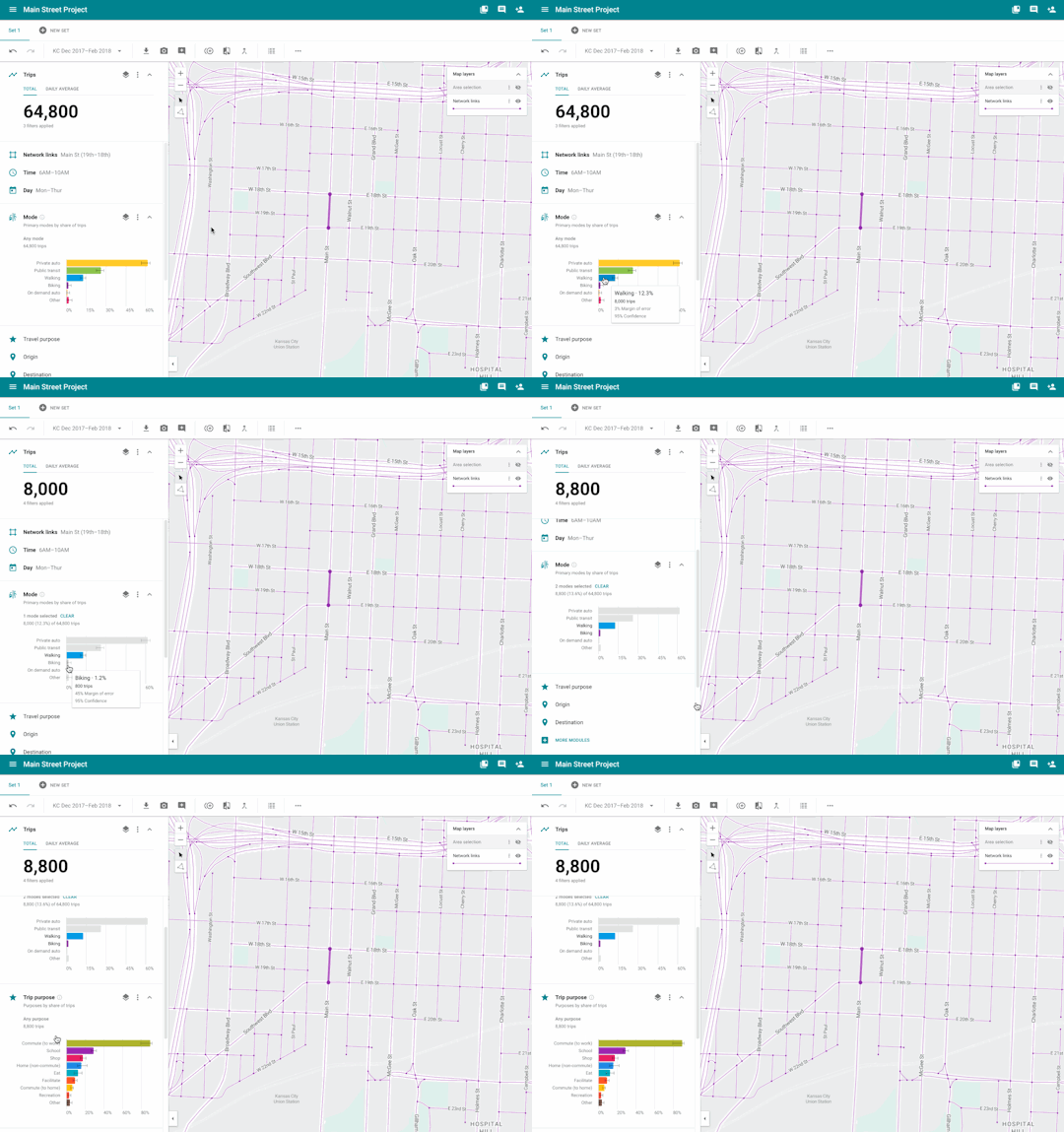
    Sidewalk Labs is currently building out a platform called Replica that will support them in their development plans here in Toronto. Replica is

    “a user-friendly modeling tool that uses anonymized mobile location data to give planning agencies a comprehensive portrait of how, when, and why people travel in urban areas.”

    Here is a preview of the Replica dashboard showing a section of Main Street in Kansas City. I hope the animated GIF shows up for you.

    The platform uses a combination of mobile location data (~5% of the population) and on-the-ground checks, typical stuff like manual traffic counts and transit boardings.

    The goal is to understand in real-time who is using a street, as well as how (driving? cycling?) and why (going to work?).

    Their introductory blog post obviously stresses the importance of personal privacy, but I am curious how they determine where people are going.

    I suppose if they pair journeys with destinations (and the durations at those destinations) they can make reasonable assumptions around the why.

    I think the benefits to all of this are clear. But does any or all of this worry you from a privacy standpoint?

  • The neighborhood of the future (part 2)

    I have been traveling since the weekend and so I am behind on my reading. One of the benefits of writing this blog every day is that I am forced to read as much as I can. I have to be a sponge.

    Right now, I am still reeling in excitement over the Sidewalk Toronto announcement and getting caught up on that reading. 

    This week Sidewalk Labs published the entire vision section of their RFP response to Waterfront Toronto. This is the response that won them the Quayside partnership. It’s 196 pages and can be downloaded here.

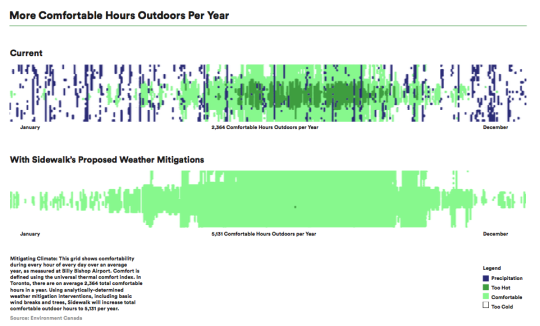
    I’m still making my way through the package, which I am obviously going to do, but I thought this was a great diagram:

    image

    As is stated in their RFP response, inclement weather affects pedestrians and cyclists more than drivers. Toronto’s most notable response has been our PATH system, which pulls both people and retail below grade, away from the elements.

    But Sidewalk’s research suggests that with the right wind, sun, and precipitation strategies, they may be able to 2x the number of comfortable outside hours per year here in Toronto. That’s what the above diagram shows.

    Of course, there is so much more in their RFP response. But I need more time to digest it all. I’ll be sure to report back to all of you once I have done that. If you don’t feel like going through all 196 pages yourself, you can watch this 4 minute YouTube video instead.

  • Making alpha-bets

    GBike by Mohamed Yahya on 500px.com

    https://500px.com/embed.js

    On Monday, Google broke the internet when it announced that it was reorganizing itself into a holding company structure called Alphabet.

    That means that Google, Inc. will now become a subsidiary, along with many other companies, of Alphabet Inc. and all shares of Google will automatically convert into the same number of shares in Alphabet.

    This is huge, but also something that was likely inevitable given the passions of the founders. Apparently Larry Page has been thinking about this move for years.

    As it stands pre-Alphabet, Google (with its main internet products) is basically a cash cow funding all of Google’s other experiments. But this muddied the waters and made it difficult for investors to clearly see how much the main internet products were making and how much the founders were spending on self-driving cars, delivery drones (Project Wing), and other new ideas.

    Now everything will be separate.

    But what’s really exciting about the reorganization is that it sets the stage for Alphabet/Google – which is arguably already one of the most important companies in the world – to become even more impactful in a wide variety of industries and disciplines, some/many not traditionally associated with tech. Each wholly owned subsidiary will have their own CEO and the founders rightly believe, I think, that this overall structure will afford them more “management scale.”

    Within Google will remain search, advertising, maps, YouTube, and the Android mobile operating system. But already Alphabet is the parent company of the following other businesses:

    • Calico, an anti-aging life extension company
    • Sidewalk, a smart cities company whose mission is to improve life in cities
    • Nest, an “internet of things” company that makes connected devices for your home
    • Fiber, a company that offers super fast internet
    • Google Ventures (venture capital) & Google Capital (private equity)
    • Google X, which is the lab developing self-driving cars and delivery drones (Project Wing)

    If you can’t tell, I’m bullish on all of this. The approach really resonates with me and I can’t wait to see what Alphabet becomes. If you’d like to read the full and official blog post announcement, click here

    Cheers to trying new things and making big bets.

  • Keeping our momentum

    This morning Kevin Marshall tweeted me a link to a blog post by Andy Weissman (partner at Union Square Ventures in New York). The post is about how small things matter—even small words.

    He starts by talking about a new sidewalk extension and curb cut at 86th Street and 3rd Avenue in Manhattan. This may seem like a pretty banal thing to talk about, but it’s in support of his argument that small things—like even a curb cut—can be used to solve bigger problems. In this case, the intersection was a dangerous one because of poor pedestrian visibility.

    But what I really like is how he describes the pulse of New York:

    “The rhythm of NYC is such that we need to keep moving and in motion; as a result, waiting to cross a street by standing at the curb is not enough, we must walk into the street to get going or keep our momentum.”

    This is great and it’s bang on. People in New York don’t stand at the curb waiting for the light to change. They impatiently push onto the street and wait for the first opportunity to cross. This may seem like a small tendency, but I think it speaks volumes about the character of New York.

    People in Toronto generally don’t do this.

    They (not me) wait patiently at the street corner even if there aren’t any cars coming. Why? Think about this the next time you’re standing on guard at the crosswalk. Don’t lose the momentum. The world rewards those who poke the box and keep moving.