Daily insights for city builders, delivered every morning at 6 AM ET. I’m Brandon Donnelly — a Toronto-based real estate developer and founder of Globizen. I’ve been writing here since 2013.

Tag: shenzhen

  • The new mobility landscape

    McKinsey published a report last month on the future of electric vehicles and what that will mean for the industry. Many countries, cities, and companies have set some sort of electrification target for 2030. The US is targeting 50% EVs by 2030. Several countries have announced a flat-out end to ICE sales by 2030. And a number of OEMs have committed to the same.

    But there are already cities, such as Oslo, which have reached EV majority. In July of this year, its passenger EV adoption figure was 66%, making Norway a global leader. What is clear is that the electrification of personal transport is well underway. Anecdotally, we are seeing that play out with the number of people now inquiring about electric charging infrastructure in our buildings (here in Toronto).

    This move to electric will have many repercussions, including a major shift in the entire supply chain (which McKinsey outlines in their report). While ICE vehicles and EVs still both have things like tires, EVs require a whole slew of new and now growing components:

    It is also going to force new public infrastructure:

    But in parallel to the electrification of personal vehicles, we are also seeing a number of other trends and shifts. The electrification of public transport (Shenzhen has already electrified its entire bus and taxi fleets). The rise of micro-mobility (things like e-scooters). The ongoing push to discourage driving in urban centers. And the continuing goal of autonomous vehicles.

    What all of this suggests to me is that the electrification of personal vehicles is only part of the story. The entire mobility landscape in our cities is changing and it will probably look a lot different by 2030.

  • 2.6 meters wide

    The width of a standard parking space in Toronto is generally 2.6m. I say generally because it depends on a few other factors, such as whether it’s “obstructed” or whether it’s being accessed off a substandard drive aisle. But for the purposes of this post, let’s agree that the width of a standard Toronto parking space is 2.6m.

    The reason I mention this is because Onexn Architects has recently completed a 2.6m wide cafe in Shenzhen called Joys. Pictured above, the 9 square meter space used to house an air conditioner repair shop.

    Now, some of you are probably looking at the photos and thinking that this maybe isn’t such a big deal. But small spaces force you to be creative.

    Look at the grey exterior paving that creates the impression that the cafe is spilling out onto the sidewalk. And look at how they used an illuminated 5 meter tall canopy to try and accentuate the space.

    In some places and in cities, a retail space like this might easily become forgotten space. But here, it was something worth designing.

    Photography by Li Jinhui via Dezeen

  • China’s homes are currently valued at $52 trillion

    The Journal published a piece this past week talking about China’s $52 trillion residential property bubble. According to a recent study by Goldman Sachs, this is the current value of all Chinese homes (built homes and developer inventory). And to put this number into perspective, it is twice that of the U.S. residential market.

    Now, I don’t know all that much about the Chinese housing market and I have no idea where prices will go next. But it is interesting to look at some of the data, particularly in light of this current pandemic. Urban home prices in China were up 4.9% year-over-year in June, and 1.9% year-to-date. Shenzhen appears to be one of, if not the hottest market. Why is that?

    At the same time, it is believed that about 21% of urban homes in China were vacant as of 2017. I don’t know what the figure is today, but this is a high number. As of last year, urban China also had a homeownership rate of about 96%. (Here is a look at how this number compares with other countries around the world.)

    What is clear is that Chinese households are going long property, and eschewing other investments such as stocks and bonds. Above is a chart showing how China compares to the US, where bonds lead, followed by stocks. Presumably it is because property is viewed as a safer and more lucrative investment in China.

    According to a report by China Guangfa and the Southwestern University of Finance and Economics, urban Chinese have on average about 78% of their wealth tied up in residential real estate. Many own multiple homes. In the U.S., this figure is about 35%. (I don’t know what the number is for Canada, but I would be interested to know.)

    Call me old fashioned, but I think it’s important to keep in mind things like rental demand and cash flow when thinking of property.

    All figures and charts from the WSJ.

  • San Francisco is the first city in the US to ban facial recognition software

    San Francisco recently became the first city in the US to ban the use of facial recognition software by city agencies. (There’s a second vote next week, but it is considered just a formality.) A similar ban is also making its way through the system in Boston.

    I thought the following quote by Aaron Peskin in the New York Times was an interesting one, because it speaks to some of the growing tensions between tech, policy, and city building:

    “I think part of San Francisco being the real and perceived headquarters for all things tech also comes with a responsibility for its local legislators,” Mr. Peskin said. “We have an outsize responsibility to regulate the excesses of technology precisely because they are headquartered here.”

    I can appreciate both sides of this argument.

    For those concerned about crime and safety, facial recognition promises more effective policing. That’s why this technology is already used at many airports, including SFO. (Because it’s under federal jurisdiction, it won’t be impacted by this ban.)

    At the same time, there are legitimate concerns related to the large-scale collection of personally identifiable data. And it is this same concern that is fueling the debates here in Toronto around what Sidewalk Labs is up to along the waterfront.

    I am not an expert on this particular topic (or many topics for that matter). But if you’re a regular reader of this blog, you will know that I believe in innovation and I believe in progress.

    However, I also believe that it is important and healthy for us to be having these debates. Because what I do know is that I wouldn’t want Toronto to become Shenzhen. I wouldn’t want to jaywalk across the street and have facial recognition software automatically send a ticket to my phone and post my photo to a “wall of shame.”

    That doesn’t sound like a very fun city.

    Photo by Chris Leipelt on Unsplash

  • Shenzhen’s solution to jaywalking

    I just finished watching this Bloomberg video on Shenzhen, called “Inside China’s High-Tech Dystopia.” The video obviously has a particular point of view, but there are parts of it that I wasn’t overly fussed about, such as the push toward increased factory automation. Jobs evolve. We used to have elevator operators. Now we don’t. Presumably those people found other empoyment.

    What stood out to me was Shenzhen’s solution to jaywalking. They use cameras, facial recognization software, and a “wall of shame” to fine and then discourage people from illegally crossing a street ever again. One guy in the video explains how he once had the fine automatically withdrawn from his WeChat account. No authorization required. And it happened within seconds following the infraction.

    That feels unsettling. (If you only want to watch the jaywalking part, skip ahead to 5:35 in the video.)

  • China has a lot of people

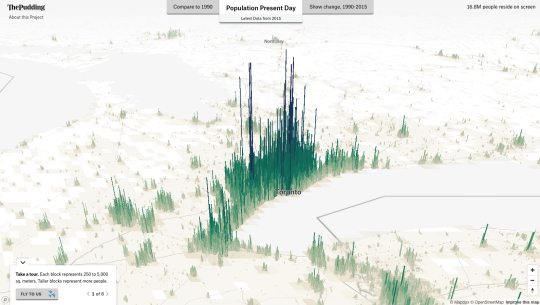
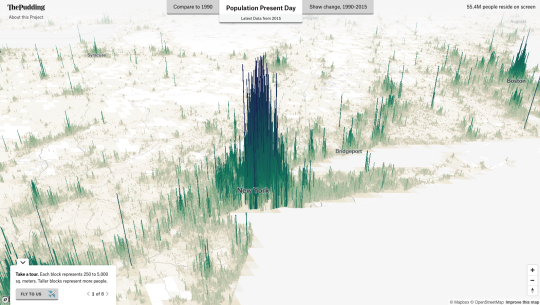
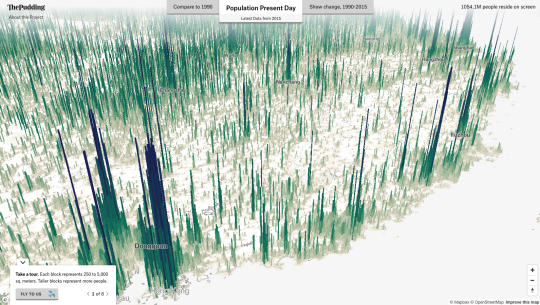
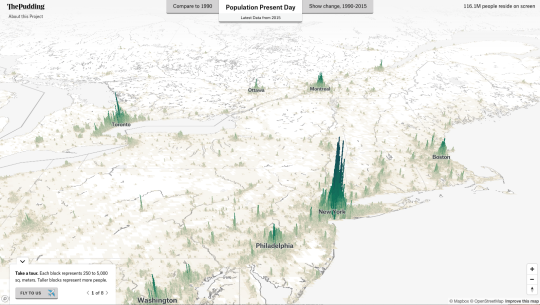
    Matt Daniels over at The Pudding recently visualized the world’s population in this spiky 3D map. You need to take a look. Better on desktop.

    The data is from 2015, but you can also compare it to and show the change from 1990.

    Here is the Greater Toronto and Hamilton region (16.8 million people reside in this screen grab):

    Here is the New York City region (55.4 million people reside in this screen grab):

    And here is China (1.054 billion people reside in this screen grab):

    I tried to capture both Shanghai and Hong Kong in this image. Guangzhou, Hong Kong, and Shenzhen are currently in the mist of forming a 40 million-person megalopolis.

    If we pan back over to the northeastern United States and Central Canada – keeping the same scale as the above image from China – it looks like this:

    These last two images say a lot. 

  • A more distributed startup geography

    The Economist recently argued that Silicon Valley’s innovation hegemony is waning and that it is a product of two factors: there appears to be more innovation happening elsewhere (good news), but that innovation in general also seems to be harder to achieve (bad news). Here is an excerpt from the article:

    Other cities are rising in relative importance as a result. The Kauffman Foundation, a non-profit group that tracks entrepreneurship, now ranks the Miami-Fort Lauderdale area first for startup activity in America, based on the density of startups and new entrepreneurs. Mr Thiel is moving to Los Angeles, which has a vibrant tech scene. Phoenix and Pittsburgh have become hubs for autonomous vehicles; New York for media startups; London for fintech; Shenzhen for hardware. None of these places can match the Valley on its own; between them, they point to a world in which innovation is more distributed.

    Part of the problem, of course, is rising costs in the Bay Area. Everything from the cost of living to the cost of operating a business. The article cites a recent survey where nearly half of all respondents said they are planning to leave the Bay Area in the next few years. This is up from 34% only two years ago.

    I don’t doubt that rising costs are causing some people to look to other cities, as well as other countries in the case of draconian visa policies. But I am suspect of the claim that we’ve heat peak “innovation” – however you want to define that.

  • Shenzhen has just electrified its entire bus fleet

    image

    This is impressive: Shenzhen recently finished converting its entire bus fleet to electric vehicles. That’s 16,359 buses and around 8,000 charging stations according to Electrek.

    It is estimated that this all-electric fleet saves 345,000 tons of fuel per year and reduces carbon emissions by 1.35 million tons.

    Shenzhen is now working on doing the same to its 12,518 taxis. Already 62.5% of them are electric-powered and the goal is 100% by 2020. 

    But let’s not forget that China still generates most of its electricity from coal. Coal represented 72% of its electricity generation in 2015. And in 2014, carbon emissions from China allegedly made up almost 30% of the world .

    Photo by Anton Strogonoff on Unsplash

  • The Silicon Valley of hardware

    I generally dislike derivative city monikers – such as the title of this blog post. But I appreciate that it quickly gets the point across.

    Fusion recently published an interesting article talking about how Shenzhen, China is quickly rising as the hardware innovation capital of the world. Rather than simply serve as the place of production for companies such as Apple, the Chinese government would like to see it serve as a place of creation. In fact, some organizations are suggesting a terminology change from  “Made in China” to “Created in China.”

    A big part of the reason for all of this is that Silicon Valley long ago moved “up the stack.” It focused itself on software and internet services, because hardware wasn’t where the margins were. It wasn’t sexy. And so production got moved over to a low cost market. But now, with the rise of IoT, drones, and many other physical products, one could argue that Shenzhen has become highly relevant in the innovation ecosystem.

    It’s also important to think about how Shenzhen fits in to the larger Pearl River Delta region. Here is an excerpt from the Fusion article:

    “Shenzhen has the geographical footprint of Los Angeles, but a population three times its size at 12 million people. It’s part of the Pearl River Delta, which also includes Hong Kong, the global financial capital and port city; Macau, the world’s largest gambling city; Guangzhou, home to one of China’s major ports, trading centers, and factories; and Dongguan, a manufacturing hub. It’s as if the tech talents of Silicon Valley, the big banks of New York, the manufacturing plants of Detroit and Pittsburgh, the casinos of Las Vegas and the shipping ports of Long Beach were all in one small part of the US, and a two hour drive from one another.”

    If you’re interested in this topic – both hardware innovation and the rapidly growing city of Shenzhen – take an hour and watch this documentary from Wired. Embedded below.

    [youtube https://www.youtube.com/watch?v=SGJ5cZnoodY?rel=0&w=560&h=315]

  • With Vancouver voting “no” to transit tax, could Hong Kong now serve as inspiration?

    https://500px.com/embed.js

    Earlier today it was announced that Metro Vancouver voted “no” to a 0.5% sales tax increase that would have been used to fund a $7.5 billion regional transportation plan. 

    Roughly 62% of respondents said “no”. And not surprisingly, the percentage of people who voted “no” increased as you moved outward towards the suburbs. But even the City of Vancouver itself sided slightly with “no” at 50.81%.

    Since I’m not that plugged into the Vancouver scene, I’m not going to comment on this issue. But hopefully you all will in the comments below. I know that a lot of you are incredibly passionate about this.

    Instead, I’d like to pose two questions. 

    Firstly, why is it that Asian transit operators seem to be so much better than North American transit operators at recovering their costs through fares? (Urban density and car ownership likely have something to do with it). And secondly, why hasn’t Hong Kong’s famous “rail plus property” transit model been exported to North America?

    For those of you unfamiliar with Hong Kong’s Mass Transit Railway Corporation, here’s how much money they make (via The Atlantic from 2013):

    The Mass Transit Railway (MTR) Corporation, which manages the subway and bus systems on Hong Kong Island and, since 2006, in the northern part of Kowloon, is considered the gold standard for transit management worldwide. In 2012, the MTR produced revenue of 36 billion Hong Kong Dollars (about U.S $5 billion)—turning a profit of $2 billion in the process. Most impressively, the farebox recovery ratio (the percentage of operational costs covered by fares) for the system was 185 percent, the world’s highest. Worldwide, these numbers are practically unheard of—the next highest urban ratio, Singapore, is a mere 125 percent.

    In addition to Hong Kong, the MTR Corporation runs individual subway lines in Beijing, Hangzhou, and Shenzhen in China, two lines in the London Underground, and the entire Melbourne and Stockholm systems. 

    And here’s how they do it (also via The Atlantic):

    Like no other system in the world, the MTR understands the monetary value of urban density—in other words, what economists call “agglomeration.” Hong Kong is one of the world’s densest cities, and businesses depend on the metro to ferry customers from one side of the territory to another. As a result, the MTR strikes a bargain with shop owners: In exchange for transporting customers, the transit agency receives a cut of the mall’s profit, signs a co-ownership agreement, or accepts a percentage of property development fees. In many cases, the MTR owns the entire mall itself. The Hong Kong metro essentially functions as part of a vertically integrated business that, through a "rail plus property” model,  controls both the means of transit and the places passengers visit upon departure.  Two of the tallest skyscrapers in Hong Kong are MTR properties, as are many of the offices, malls, and residences next to every transit station (some of which even have direct underground connections to the train). Not to mention, all of the retail within subway stations, which themselves double as large shopping complexes, is leased from MTR.

    I believe that we could do this too. So hopefully we can have a great discussion about it in the comment section below.