
Daily insights for city builders, delivered every morning at 6 AM ET. I’m Brandon Donnelly — a Toronto-based real estate developer and founder of Globizen. I’ve been writing here since 2013.

Tag: shaun hildebrand

  • Toronto’s condo market in 2021

    “If everyone is going left, look right.” –Sam Zell

    The right time to buy things is usually when other’s aren’t, which is why I’ve felt that this year was a great time to buy a centrally located condo. Cities aren’t going anywhere. This isn’t their first pandemic. Downtown demand will return as soon as urban life returns and the majority of people are back in their offices next year.

    I’ve also been predicting that the run-up in single-family home prices that we have seen this past year here in Toronto will eventually lead to a surge in demand for condos (and perhaps even for larger suites). It’s a question of relative affordability. And so it was interesting to see Shaun Hildebrand of Urbanation predicting the same thing for 2021 in this recent Toronto Star article.

    Hildebrand thinks the soaring prices of single-family homes will also push more buyers back to the condo market.

    As of November, the average price gap between condos and detached houses was $596,000. The gap between a condo and a semi-detached or townhome was about $217,000. Both of those were at their second-highest levels since the market peaked in late 2016-early 2017, he said.

    “This could really start to swing demand towards condos in the second half of the year,” said Hildebrand.

    Realosophy data shows condo sales were already up year over year prior to the holidays — 23 per cent the first week of December, 31 per cent the second week and 72 per cent the week of Dec. 14. That means 727 condos sold that week, compared to 418 in the same week last year.
  • The investment case for mid-rise condos

    Shane Dingman’s recent Globe and Mail article about “the investment case for mid-rise condos” is a good summary of why this housing type has become so popular in Toronto.

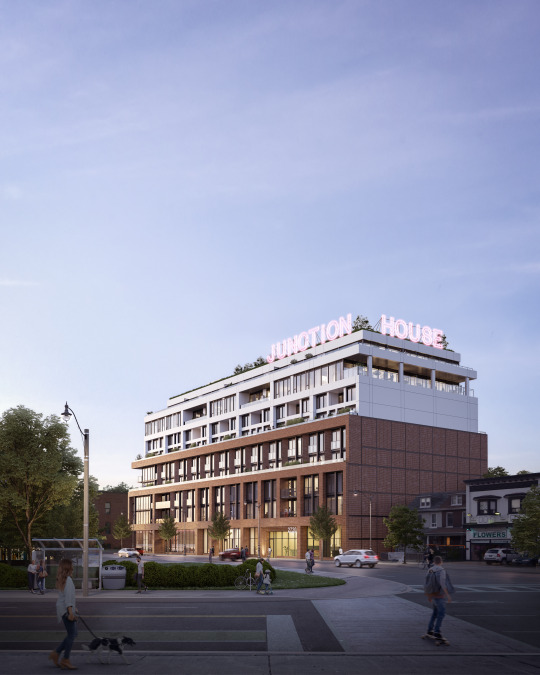
    Mid-rise buildings tend to attract more end-users because of their boutique scale. That is, they attract people who plan to move into the building once it is built, as opposed to buyers who plan to rent out their unit. We are certainly seeing this with purchasers at Junction House.

    Because of their generally smaller scale and because they are often built in mature neighborhoods with few opportunities for new construction, supply of new mid-rise housing also tends to be limited. That bodes well for future price appreciation.

    Here’s a quote from Shaun Hildebrand (President of Urbanation), taken from the above Globe article. (Sorry, it’s behind a paywall.)

    “Price growth between the two building types [mid-rise and high-rise] began to converge in 2018, and in Q1-2019, buildings under 12 storeys saw average resale prices per square foot grow 10 per cent year-over-year, compared to 6.5 per cent for buildings of 12 or more storeys,” Mr. Hildebrand said. “We may be now entering back into a period of outperformance of mid-rise buildings as the market is shifting.”

  • Reintroducing Junction House

    Today we released the above rendering for Junction House and announced that sales will begin this fall.

    144 condominium homes. A mix of 1, 2 and 3 bedroom suites, including our Two-Storey House Collection and our Laneway House Collection. Prices starting in the $400s.

    One of our partners also happened to serendipitously send me this Globe & Mail article today talking about the increasing demand for and shortage of mid-rise housing:

    “The market is substantially undersupplied in mid-rise,” said Mr. Hildebrand, who notes that mid-rise projects in the GTA [Greater Toronto Area] were just 31 of 2017’s new launches, accounting for 3,833 units (12 per cent of the total).

    Stephen Price, CEO of Graywood Developments, went on to say this in the article:

    “There’s a huge appetite for medium density in Toronto. Many don’t want to live in the downtown core, this buyer is more interested in being in a community and there is a greater propensity to buy larger more livable units.”

    Given the huge influx of inquiries we received today after the above announcement was made, I would say that feels right. And our focus at Junction House is very much on “larger and more livable.”

    If you’re at all interested in a new home at Junction House, I would encourage you to get on our priority list, here.