Daily insights for city builders, delivered every morning at 6 AM ET. I’m Brandon Donnelly — a Toronto-based real estate developer and founder of Globizen. I’ve been writing here since 2013.
I’m on an American Airlines flight right now reading the New Yorker. I’m thankful that I brought a few back issues with me because it’s distracting me from the semi-deplorable conditions found in the rear of the plane.
The TV in front of me is broken and they have run out of everything that could be considered edible. Instead of the humble wrap I wanted, I was offered a soggy box of vegetable crackers and hummus. The hummus came in a small toothpaste-like tube that squirted out some kind of watery substance. Not yet sure what it is because I stopped eating it. Thankfully the lady behind me managed to smuggle on a cheeseburger and a basket of onion rings. So I’ve been subsisting on her fumes for the last hour.
In any event, onion rings and watery hummus are not actually what I want to talk about today. Last week’s New Yorker has an essay in it all about the gig economy. One of the sub-stories is about a woman named Caitlin Connors (real name?) who rents a 3 bedroom duplex with a friend in Williamsburg, Brooklyn.
Her and her roommate’s goal is to rent out their place on Airbnb for at least a week each month. Often during this week they’ll take off traveling somewhere (net net they seem to come out ahead this way), but sometimes they’ll just decamp and stay with friends in the city.
One of their criteria when they were initially looking to rent a place was that it had to be “Airbnb-able.” That’s partially what drew them to Williamsburg. They knew that tourists would see the area as trendy and want to stay there. So far that investment thesis has proven true, as their plan allows them to cover their $4,000 per month rent.
The reason I mention all of this — the gig economy, not cheeseburgers — is because I recently attended a panel discussion about the current state of purpose-built rentals in Toronto. At the end of the discussion, somebody in the audience asked about how they’re dealing with Airbnb and each of the panelists responded in exactly the same way. Essentially: we closely monitor our buildings and crack down on it the best we can.
My view about these sorts of things — Airbnb, Uber, and so on — is that they’re not going away so we should try and figure out how to accommodate and work with them. But how exactly should that play out?
Do you get rid of the 6 month minimum lease term that is commonly applied to condo buildings in this city and let people do whatever the hell they want? Do you create rules, so that guests can, for instance, rent a room in a place but not rent an entire apartment? Or do developers need to start creating dedicated Airbnb floors and buildings? (It’s already happening in some cities.)
I believe that there are ways to manage the negative externalities potentially associated with short-term rentals. But I would love to get all of your temperatures on this. Are you a firm yes or no to Airbnb in multi-family buildings, or are you a qualified yes with the right rules and regulations in place? Would you have an issue sharing a wall with an Airbnb suite?
New York State Governor Andrew Cuomo recently signed a bill that will levy heavy fines (up to $7,500) on Airbnb hosts who do not abide by local housing regulations.
Hours after, Airbnb filed a federal lawsuit claiming “irreparable harm.”
However, they also proposed a 5 point plan that they hope will make home-sharing work in New York City and then serve as a framework for new legislation.
Here are Airbnb’s 5 points (summarized by me):
One host, one home: Just like it sounds, this would limit people to renting a single home within the five boroughs.
Require registration: State would require short-term rental hosts to register. Airbnb would be authorized to register people on behalf of the state.
Make home-sharing work for all: Landlords would be able to set specific rules for short-term rentals in their buildings and then secure a portion of the revenue for maintenance and so on. (I would imagine that the same could be done by condo corporations.)
Good neighbor rules: Platforms would be required to have dedicated 24/7 hotlines should any neighbor complaints arise as a result of home-sharing.
Taxes to support affordable housing: Airbnb would collect and remit additional taxes on behalf of hosts, which could then be used for things such as affordable housing.
It’s interesting to think about Airbnb’s evolution. It started out as air mattress rentals on the floor and nobody thought it would ever work as a business. Now it’s a huge business and governments everywhere are trying to figure out an appropriate response. Hopefully a suitable middle ground will be found.
How do you feel about Airbnb’s proposed 5 point plan? With this framework, would you be comfortable with Airbnb in your building? I know that many of you are also hosts (some of you do it for a living), so I would be curious to hear your thoughts.
Meanwhile, many Americans are making extra money renting out a small room, designing websites, selling products they design themselves at home, or even driving their own car. This on-demand, or so-called gig economy is creating exciting economies and unleashing innovation.
But it is also raising hard questions about work-place protections and what a good job will look like in the future.
So, all of these trends are real and none, none is going away. But they do not determine our destiny. The choices we make as a nation matter. And the choices we make in the years ahead will set the stage for what American life in the middle class and our economy will be like in this century.
The headlines this morning are making it seem like Hillary Clinton is taking direct aim at companies like Uber. But the transcript suggests that she’s being far more balanced than that: these new companies are creating exciting opportunities, and they are not going away, but there are still things to figure out.
That’s basically how I feel.
Take, for example, Airbnb. I think Airbnb is a great idea and company. A lot of my friends use it both as consumers and as suppliers of space.
But for many (most?) condos in Toronto, owners are strictly prohibited from renting out their units on leases that are less than six months. It’s a direct ban on short-term leasing and it’s written into the Condo Corporation’s Declaration.
And there’s good reason for that. Who wants to buy a condo only to find out that next door is being operated as a nightly hotel? Most people would even prefer that their neighbor is an owner rather than a renter.
That doesn’t mean I believe Airbnb should not exist. I think we’ll likely end up getting more transparent about how buildings (and portion of buildings) are operating, as opposed to it being a shadow economy. And that could help.
If you have any ideas for how companies like Airbnb might be better integrated into urban life, I would love to hear from you in the comment section below.
This afternoon I saw on Twitter that Toronto Police are now starting to crackdown on UberX drivers in the city. The investigation is called “Project Snowball” and they have already charged at least 11 people. The fines are anywhere from $200 to $20,000.
I get that Uber is a highly disruptive company. I’ve written about it many times before. But at the end of the day, this is not just about Uber. This is about a larger shift in the economy.
The buzz term is “sharing economy.” But one of the ways I like to think about it is like so: Facebook doesn’t produce any of its own content, and yet you could define it as a media company. Airbnb doesn’t own any rooms, and yet it is disrupting hotels. Uber doesn’t own any cars or plates, and yet it is disrupting the taxi industry.
What’s happening is that the internet and mobile phones are allowing for peer-to-peer connectivity and more decentralized forms of marketplace supply.
What does that mean?
It means that instead of having a fleet of cars or a centralized hotel building, anyone with an extra car or an extra room (and an internet connection) can plug themselves into the market. And that represents an entirely different cost structure for businesses.
It’s worth noting that prior to Uber, Travis Kalanick founded a peer-to-peer music sharing company called Scour (1998). Its closest equivalent would have been Napster. Remember Napster? This is not a new trend.
That said, I still think we’re at the early stages of this shift. I predict that many other industries will see disruptors similar to Airbnb and Uber. And so when I look at it in this context, I have a hard time believing that fining UberX drivers is the most enlightened way forward.
I believe we should instead be taking a leadership position and trying to figure out how to adapt our rules and regulations to this changing economy. Toronto is not alone in this battle. But we could certainly be the one to lead the way out.
Last week I wrote (yet another) post about Uber where I argued that leading cities will be the ones that engage with the sharing/rental economy (as opposed to try and outright ban it) and that Uber is going to continue to impact current beliefs around vehicle ownership.
As to be expected, some people agreed with me and some people didn’t:
But I also discovered following that post that there are groups, and hopefully cities, who are working to adapt to the changing realities brought about by disruptive innovation.
One of those groups is The National League of Cities – which I truthfully don’t know that much about. But they have created something called “The Sharing Economy Advisory Network.”
“Cities across the country have been struggling to respond to the rapid emergence of the Sharing Economy,” said Clarence Anthony, National League of Cities executive director. He continued, “Cities are looking for ways to update and improve their current regulatory framework to ensure that regulations like safety and health protect residents, while at the same time supporting the growth of new businesses. It is imperative for cities to learn how this industry operates and discover ways to engage in order to support these new modes of doing business and to create jobs.”
It sounds like the right kind of initiative and I wish them lots of success. I hope it’s effective and I hope that Toronto will look at how it too can properly manage these economic changes. This is going to take both the private and public sectors working together.
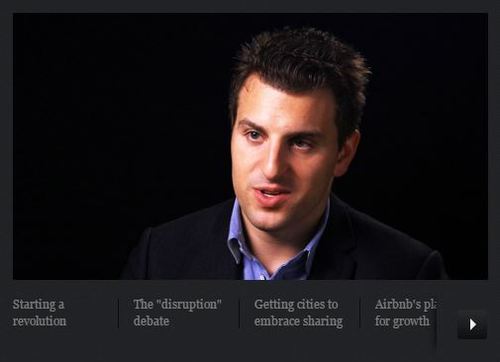
McKinsey recently put out a great interview with one of the founders of Airbnb, Brian Chesky, talking about the relationship between his company and cities. I thought it was fascinating. Click here to watch the video.
If you don’t feel like doing that, I’ve also pasted the interview transcript below and bolded some of the really interesting takeaways. Let us all know what you think in the comment section below.
It’s a currency of trust, and that used to live only with a business. Only businesses could be trusted, or people in your local community. Now, that trust has been democratized—any person can act like a brand.
Airbnb is a way that you can, when you’re traveling, book a home anywhere around the world. And by anywhere, I mean 34,000 cities in 190 countries. That’s every country but North Korea, Iran, Syria, and Cuba.
The reason we started was I was living with my roommate, Joe, in San Francisco, and I couldn’t afford to make rent. That weekend, the International Design Conference was coming to San Francisco. All the hotels were sold out. Joe had three air beds. We pulled the air beds out of the closet, we inflated them, and we called it the “Air Bed and Breakfast.”
The reason it’s grown so fast is, unlike traditional businesses, we don’t have to pour concrete. The infrastructure and the investment was already made by cities a generation ago. And so all of a sudden, all you needed was the Internet.
The ‘disruption’ debate
I never really loved the word “disruption,” because it suggests that maybe it’s the kid in a class who was disruptive, who probably didn’t add a lot to class. I think that we have a lot to add to society.
Over time, cities have gotten so big that the sense of community has gotten lost. And I think once you know everyone, that community can reemerge. And as far as our relationship with cities, we can’t succeed without a city. Or we can’t really thrive without a city. We don’t want to thrive in spite of a city. And I think if we work together, it’s going to be amazing. I think the people win. And I think if we don’t work together or if we fight, the loser isn’t really us or the city—it’s the people in that city.
Getting cities to embrace sharing
Fundamentally, the idea of the sharing economy is going to be great for cities. It means that people all over a city, in 60 seconds, can become microentrepreneurs. And they can be empowered. And they can make an income. Now, this is amazing, but it’s also complicated because there are laws that were written many decades ago—sometimes a century ago—that said, “There are laws for people and there are laws for business.” What happens when a person becomes a business? Suddenly these laws feel a little bit outdated. They’re really 20th-century laws, and we’re in a 21st-century economy.
It’s probably going to be a fair amount of work to revise some of the laws and rethink the way cities and platforms work together, but I think that work is worth it. Because what cities don’t have to do is invest billions of dollars in infrastructure to create jobs. Whereas historically, to create opportunities, cities would need massive projects and investments, these jobs only require the Internet. Now what they need to do is navigate the legal framework, which is typically outdated. We want to work with the cities. We’re not telling them that their laws are terrible. The world continues to change. Laws must continue to adapt for that world.
We want to help cities understand what our world looks like so they can modernize the laws to make sense. We’re not against regulation. We want to be regulated because to regulate us would be to recognize us.
Airbnb’s plans for growth
We want travelers to be able to book homes anywhere. Anywhere includes Asia. Asia’s a nascent market for us. Number two, we’re also looking at other use cases. Airbnb started as a way for travelers to find a budget way to vacation in a city. But now we’re starting to see people who aren’t on a budget. They want a much more high-end experience. And the third is that at the end of the day, if you’re traveling to Tokyo, you’re not traveling to Tokyo to stay in a home or a hotel. You’re traveling to Tokyo—if you’re on vacation—because you want to have an experience. And we’d love to do more to make that experience special and memorable.
The future of sharing: Your free time
I don’t think people would view the jobs created in the sharing economy as jobs. I don’t even know if they get counted as jobs when the White House has a new jobs report. They are jobs. As far as I can tell, people are working, they’re making income, and they depend on that income. Half of our hosts depend on it to pay the rent or mortgage. Maybe it’s a new kind of job. Maybe it’s like a 21st-century job. Tom Friedman talks about how in the future people may not have jobs. They’ll have income streams.
I believe that the sharing economy broadly can probably provide tens of millions of jobs or income streams for people all over the world. This is going to have a pretty big effect on the economy, mostly a good one.
The sharing economy started by democratizing and creating access to probably two of the biggest assets people have: their homes and then their cars. But I think the whole idea of ownership is changing. When my parents were young, owning things was a privilege, and there was a sense of romance to owning a house, owning a car.
Today’s generation sees that ownership also as a burden. People still want to show off, but in the future I think what they’re going to want to show off is their Instagram feed, their photos, the places they’ve gone, the experiences they’ve had. That has become the new bling. It’s not the car you have; it’s the places you go and the experiences you have. I think in the future, people will own whatever they want responsibility for. And I think what they’re going to want responsibility for the most is their reputation, their friendships, their relationships, and the experiences they’ve had.
So I think the biggest revolution will be in the biggest asset of all. The biggest asset is not a house. It’s not a car. It’s people’s time. People’s time may start with just gigs: waiting in line for you, delivering something for you. Over time, I think it’s going to move upmarket. And eventually, menial tasks become real trades, and real trades become art forms.
Somebody may say, “I cook a great brunch. I wonder if people would enjoy having brunch at my house?” And you could be able to book a brunch at someone’s house, instead of at a restaurant. That person isn’t trying to create a restaurant, they’re just allowing someone to have brunch. They build a reputation. One day, that person can be a Michelin-rated chef in their house.
If you’ve ever ridden a busy Toronto streetcar, you’ll know this story:
You’re waiting outside in the cold for a streetcar. When one–actually 4–finally arrive all bunched up together, they’re so packed with people that you’re not actually able to get on. You try one anyways and the driver makes an announcement for everyone to “move back” so that more people can onboard via the front door. After a few minutes of people shuffling to try and get further back, you’re finally able to squeeze on–even if you are virtually sitting on the driver’s lap. You then travel about 2 blocks before the streetcar stops and the same thing repeats. The result is an absolutely infuriating mobility experience that usually makes walking the preferred choice. Who said that downtown already has enough subways?
Over the weekend, I was watching this TED talk with Charlie Rose interviewing Larry Page of Google. One question that Rose asks Page is about why he’s so fascinated with transportation and mobility. That is, why is Google so committed to driverless cars? Page then talks about his experience of waiting for buses when he was a student at the University of Michigan and how he would think about all the inefficiencies in the system. He also talks about how half of the urban fabric of Los Angeles is made up of roads and parking lots and that this is a terrible outcome of the mobility choices made in that city.
I’ve said before that transportation is one of the biggest challenges facing Toronto today. And I truly believe that. But that’s probably the case in most, if not all big cities. Getting people around a city efficiently is such a fundamental need. It stimulates economic growth and it improves quality of life. And those are typically the reasons why people choose to live in cities: to make money and to have a better life.
Now, I’m a big proponent of public transportation, but I’m also excited by the advances being made outside of mass transit. With driverless cars, electric cars, networks such as Uber and Hailo, and the emergence of the sharing economy, you could easily imagine a bunch of different ways in which mobility could be improved in our cities. Take, for my example, my own driving patterns. I probably drive my car 2, maybe 3 hours per week these days. That translates into a weekly utilization rate of roughly 1.2%! (2 hours / 168 hours week). That’s terribly inefficient. We can do better. And I think we will.
I was browsing my Tumblr feed this morning and I found a link to an interview with Marc Andreessen posted by Fred Wilson.
I liked Marc’s response to a question relating to people’s love of cars and so I decided to post it to Facebook. I then received an email notification from Fred Wilson’s AVC blog titled “The New Freedom.” Turns out that he liked the quote as well. With so much love for this quote, I figured it was worth reposting here.
The interviewer started a question to Marc with, “But people love their cars.” This is his response:
“Ask a kid. Take teenagers 20 years ago and ask them would they rather have a car or a computer? And the answer would have been 100% of the time they’d rather have a car, because a car represents freedom, right?
Today, ask kids if they’d rather have a smartphone or a car if they had to pick and 100% would say smartphones. Because smartphones represent freedom. There’s a huge social behavior reorientation that’s already happening. And you can see it through that. And I’m not saying nobody can own cars. If people want to own cars, they can own cars. But there is a new generation coming where freedom is defined by “I can do anything I want, whenever I want. If I want a ride, I get a ride, but I don’t have to worry. I don’t have to make car payments. I don’t have to worry about insurance. I have complete flexibility.” That is freedom too.”
This ties in well with the return to city centers and downtowns. When people live in walkable neighbourhoods, cars can be more of a liability (car payments, insurance, parking, and so on). In fact, I think of them as a liability all around. Banks think of them as an asset, but I like my assets to increase in value.
The other interesting point that Marc makes about cars is that supply and demand are not very well matched using the current model. If you only use your car to drive to and from work, it sits idle 90% of the time. This is where the sharing economy comes into play: How can people better optimize that 90%?
My smartphone certainly doesn’t sit idle 90% of the time.