Daily insights for city builders, delivered every morning at 6 AM ET. I’m Brandon Donnelly — a Toronto-based real estate developer and founder of Globizen. I’ve been writing here since 2013.
Here are a couple of cut-up snippets from a recent post by Seth Godin titled: “Waste and the new luxury.”
Luxury goods are built on a foundation of waste.
The front lawn is a luxury good, a sign that you don’t need to graze your cows on every square inch, and that you’re willing to waste the lawn.
There’s a new luxury that’s occurring, though, one that’s based on efficiency.
A luxury that’s based on investing in renewables, in resources that might be seen as endless, in smart design, in the satisfaction of knowing that others are benefitting, not paying, for the experience or the object you’re buying.
Here is a good follow-up to yesterday’s post about Ian Schrager and Edition Hotels. It’s a short post by Seth Godin that I’m going to reblog here in full:
The gulf between “risky” and “feels risky” is huge. And it’s getting bigger.
It turns out that value creation lives in this gap. The things that most people won’t do (because it feels risky) that are in fact not risky at all.
If your compass for forward motion involves avoiding things that feel risky, it pays to get significantly better informed about what actually is risky.
I like this distinction, a lot.
I’m traveling for work right now, which is why you may be noticing shorter than usual posts. But stay tuned because I’ll be making a big announcement later this week on the blog.
A few days ago, Seth Godin published a terrific blog post called the rationality paradox. It’s not very long (like most of his posts) and I like it a lot (particularly the bold part), and so I’m reblogging it in full here:
If you see yourself as an engineer, a scientist, or even a person of logic, then it’s entirely possible that you work to make rational decisions, decisions that lead to the outcomes you seek.
The paradox is that you might also believe that you do this all the time, and that others do it too.
But a rational analysis shows that this is far from true. Almost every choice we make is subconscious. We’re glitch-ridden, superstitious creatures of habit. We are swayed by social forces that are almost always greater than our attraction to symbolic logic would indicate. We prioritize the urgent and most of the decisions we make don’t even feel like decisions. They’re mostly habits combined with a deep desire to go along with the people we identify with.
Every time you assume that others will be swayed by your logical argument, you’ve most likely made a significant, irrational mistake.
Your actions and your symbols and your tribe dwarf the words you use to make your argument.
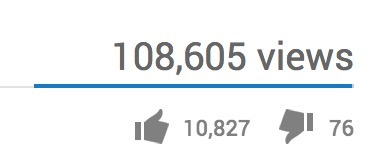
A few weeks ago Seth Godin wrote a post on his blog called: What 99% looks like. He used the example of a Turkish vlogger who had posted an interview with him to YouTube that received the following view count, up votes and down votes:
The point he wanted to make was that many of us will instinctively focus on that one number: 76. We will say to ourselves that 76 people hated our video, our work, so much so that they felt compelled to give it a decisive thumbs down.
His message was clear: “Ignore it. Shun the non-believers and ship your work.” 76 people out of 108,605 views is not even 1%. And 76 out of (10,827 + 76) interactions is still not even 1%. You could easily say that this video has a greater than 99% approval rating.
I love this message, because there will always be naysayers, especially if you’re doing something interesting and unique. In fact, having naysayers is probably a good litmus test to make sure that you are indeed doing something interesting and unique.
But here’s the thing.
The YouTube metrics above make for a rather transparent platform. You can see that the video received 108,605 views and that 10,827 + 76 people felt so strongly about it that they wanted to leave a mark by way of a thumbs up or thumbs down. But most importantly, you can see that way more liked the video than hated it.
But what if it wasn’t clear that over 10,000 people were fans of your work? What if all you saw was how many people hated it? And what if those voices were amplified? That would be pretty discouraging, considering that many of us are already focusing on that number to begin with.
I can think of many instances where the fog is thick and we don’t have full visibility. That’s where it gets even tougher, but more critical, to “shun the non-believers.” There may be people out there who truly love your work and what you’re trying to do. You just may not know it, yet.
No matter what business you’re in, it’s worth giving some thought to this. What do you offer?
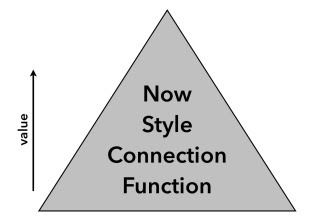
At the bottom of the triangle is function. A hotel room functions as a place
to sleep. A smartphone functions as a device to make calls, send text messages,
and download some apps. A condominium functions as a place to live, eat, sleep, have sex, and so on. But all functions being equal, most of us will buy whatever product is the cheapest.
That is until there’s an emotional connection. I love the
way Seth frames it: “Where do people like me do things like this?” It is about defining
who you are. Am I the kind of person who buys A or am I the kind of person who buys
B? If I care deeply about the environment and B promises to respect that, I am
likely to buy B.
But then, moving even further up the triangle, if two items offer the same function and the
same emotional connection, many of us will go for the one that appears sexier, shinier (the new iPhone 7 is very shiny), and more
stylish. It just deepens the connection.
Finally, at the very top of the triangle is now. This is
about scarcity. What’s hot right now?
Think of that new restaurant that just opened downtown that you haven’t been
able to get a table at. It’s now and you want to Instagram the food so badly so
that you can show everyone you were there. You want to be now.
The point of all of this is that we consume things for
reasons that go well beyond simple function. That’s just the start of it all.
One could argue that all of this is simply smoke and mirrors, but that’s a
topic for another blog post. This is our reality.
To relate this topic back to architecture and real estate, I
am curious how many of you have made a housing decision that you believe went
beyond function. How much of it was based on connection and style?
Not surprisingly, for me, architecture and design matter a
great deal.
Earlier this summer I was driving around the city with my
father and he was pointing out to me all of the new build single family homes
that were sprouting up. He then asked me what I thought of them. I responded: “They’re
shit.”
What I was really saying with that glib remark was that
those homes – no matter how expensive – didn’t reflect my own belief system
about the world. Sure they served their function, but they didn’t offer the
connection and style that “people like me” like to praise. To borrow once again
from Seth: we are all part of a certain tribe.
What tribe do you belong to? And does your housing choice
reflect that?
I have lots to say whenever someone asks me this and I’ve written a few of those things down, here. Obviously I believe that there’s tremendous value in writing your own blog and reading the blogs of others.
It’s for these reasons that I really enjoyed one of Seth Godin’s posts this week called: Read more blogs. The post is about using an RSS reader (Feedly) to keep track of blogs (which I do), but it was the lead-in that caught my attention:
Other than writing a daily blog (a practice that’s free, and priceless), reading more blogs is one of the best ways to become smarter, more effective and more engaged in what’s going on. The last great online bargain.
Good blogs aren’t focused on the vapid race for clicks that other forms of social media encourage. Instead, they patiently inform and challenge, using your time with respect.
He then ends by arguing that we shouldn’t sit idle while powerful gatekeepers like Google and Facebook “push us toward ad-filled noisy media.”
The reality of many personal blogs is that they don’t live and die on clicks like other online media. It’s a labor of love and that makes it a unique place on the internet. I clearly like this place and, if you’re a reader of this blog, I suspect you might too.
Over the weekend I received a marketing email from a real estate company advertising their new mobile app. I didn’t download it.
Nowadays, every company and brand seems to have a mobile app. If you don’t already have one for your organization, I bet many of you have thought about creating one. This is natural given how profound the shift to mobile has been.
But I can’t help but feel like we are overestimating the kind of attention that many of these apps will receive. App usage is highly concentrated. We’ll spend hours on Instagram, but almost every other app in existence gets ignored.
I love how marketer Seth Godin puts it: “the two scarce elements of our economy are trust and attention.” Attention is not scalable. Each of us have a finite amount of attention to give. And there’s lots of competition for it.
At the same time – to borrow Godin’s thought process – a lot of people will sacrifice trust for the sake of attention. We overpromise because we become desperate. I mean, if you think about it, every company or organization is trying to figure out how to get you to pay attention to them.
But I’d like to think that trust can also help you garner attention. Once I trust someone or some organization, I’m more likely to give them the time of day. They’ve earned it. And I feel like that’s where things are headed in today’s information economy.
Trust and attention. Think about it. They’re pretty powerful things, no matter how you spend your days.
If you’re somebody who has a lot of ideas, it can be pretty easy to get overwhelmed and/or distracted by all of the possibilities. It’s also worse when you’re an optimist and you believe it can all be done. I am definitely guilty of this. It is one of my weaknesses.
We all have a finite amount of time to work with and so saying no to the stuff that isn’t core is critical. I believe I am getting better at this, but every now and then I find myself having to do some pruning. And once I do that, boy does it feel great.
Seth Godin has a fantastic blog post on this topic that I love called, No is essential. Here it is in its entirety (it’s a short post):
“If you believe that you must keep your promises, overdeliver and treat every commitment as though it’s an opportunity for a transformation, the only way you can do this is to turn down most opportunities.
No I can’t meet with you, no I can’t sell it to you at this price, no I can’t do this job justice, no I can’t come to your party, no I can’t help you. I’m sorry, but no, I can’t. Not if I want to do the very things that people value my work for.
No is the foundation that we can build our yes on.”
To drive the point home even further, let’s shift gears and talk about wine. (For all of you fellow wine drinkers.)
In viticulture, overall yield – usually measured in hectoliters per hectare of vineyard – is often seen as an important indicator of quality. The idea being that low yields produce better wines because the flavors get concentrated over fewer grapes.
Part of what drives this is the leaf to fruit ratio. Too much fruit and not enough leaves, means the grapes won’t ripen properly.
The parallel to this conversation is that leaves are much like time. There’s only so much of it. And while many of us are constantly trying to maximum yield – I know I am – there are limits to the kind and quality of grapes we can produce when we do that.
I know this in principle. And more and more, I know this in practice. I am learning to say no.
Today I had lunch at Webers Hamburgers so that I could see what all the fuss is about. Here’s my check-in.
For those of you who don’t know Webers, it’s a burger place on the side of the highway in Orillia, Ontario. It opened in 1963 with the goal of targeting cottage goers and has since become an “institution” in the region.
I don’t think I’ve ever been, so I figured I had to give it a try.
Before going, I decided to ask around to see what people thought of the burgers. And in almost all of the cases, I got the same response: “You can get better burgers in the city. But you have to go. It’s an institution. It’s tradition.”
And that ended up being a very accurate description.
Were the burger goods? Yes. Were they mind blowing? No. In fact, they’re pretty basic burgers. You have a choice of 3 different toppings and 2 different condiments. That’s it. Want mayo? Sorry, they don’t do that.
But in the end, it’s not really about the burgers.
While there, I was reminded of a blog post by Seth Godin called, “Am I supposed to like this?” His opening line is the following: “If we think we are, we probably will.” And it’s all about how we make judgments well before we think we do (and how marketers invest in that).
What matters a great deal is how we’re “supposed to” feel about something. If a wine is expensive, we’re “supposed to” to think it tastes better and our mind usually makes that a self-fulfilling prophecy.
And in this case, Webers has become symbolic of summer and good times at the cottage. You’re “supposed to” stop there whenever you go to the cottage. It’s tradition.