
Apple’s self-driving system and/or car project has been in the news again recently. Last month, Bloomberg reported that the company was hoping to start production by as early as 2024. But this week, projections were revised and we’re probably looking at least 5 years. The details are pretty limited at this stage, as is typical of Apple (although Hyundai has been saying things). It’s also not clear whether the company is set on developing both an electric vehicle and a self-driving system, or just the latter. But the company has been hiring lots of engineers to work on the project, including a bunch of ex-Tesla employees. Supposedly, Apple now has “several hundred engineers” working on this initiative, most of whom are focused on the self-driving system part. Who really knows how and when this all unfolds, but I would bet that software is going to continue eating the world.
Tag: self driving vehicles
-
A moral compass for autonomous vehicles
One of the challenges that self-driving vehicles present is not about technology per se, it is about ethics. The typical example scenario is this one: If a pedestrian were to step out in front of an autonomous vehicle illegally, should the car be programmed to hit the pedestrian or veer off the road at the risk of potentially harming its passengers?
I believe that self-driving vehicles will ultimately result in fewer accidents. Statistically they will be safer. But self-driving vehicles, particularly early on, are going to get a lot of attention when they do get into accidents, even if they are still safer as a whole. And that’s because they will make for good headlines.
Safety and statistics aside, in turns out that the answer to the above moral question could depend on where you’re from. Nature recently published what they are calling the largest ever survey of “machine ethics.” And out of this survey they discovered some pretty distinct regional variations across the 130 different countries that responded.
The responses were able to be grouped into 3 main buckets: Western, Eastern, and Southern. Here is the moral compass that was published in Nature:
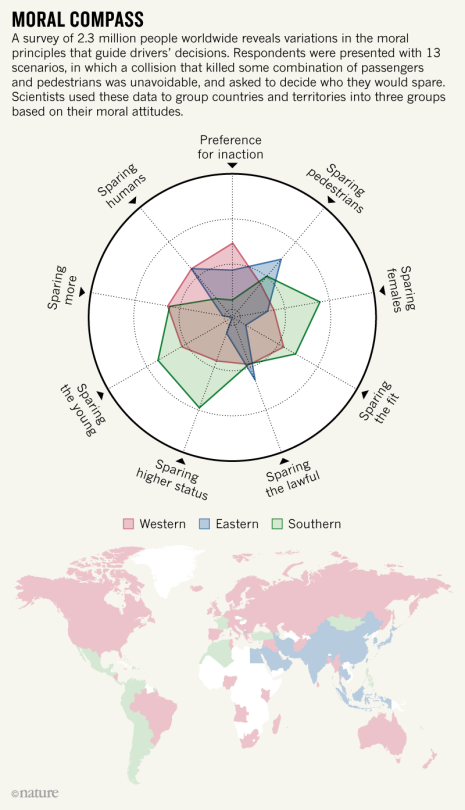
And here are a few examples. In North America and in some European countries where Christianity has historically dominated, there was a preference to sacrifice older lives for younger ones. So that would guide how one might program the car for the case in which a pedestrian steps out in front.
In countries with strong government institutions, such as Japan and Finland, people were more likely to say that the pedestrian – who, remember, stepped out onto the road illegally – should be hit. Whereas countries with a high level of income inequality, often chose to kill poorer people in order to save richer people. Colombia, for example, responded this way.
Also interesting is the ethical paradox that this discussion raises. Throughout the survey, many people responded by saying that, in our example here, the pedestrian should be saved at the expense of the passengers. But they also responded by saying that they would never ever buy a car that would do this. Their safety comes first in the buying decision. And I can see that.
There’s an argument that these are fairly low probability scenarios. I mean, the last time you swerved your car, you probably weren’t driving on the edge of a cliff where any deviation from the path meant you would tumble to your death. But I still think that these are infinitely interesting questions that will need to be answered. And perhaps the answer will depend on which city you’re in.
-
The neighborhood of the future
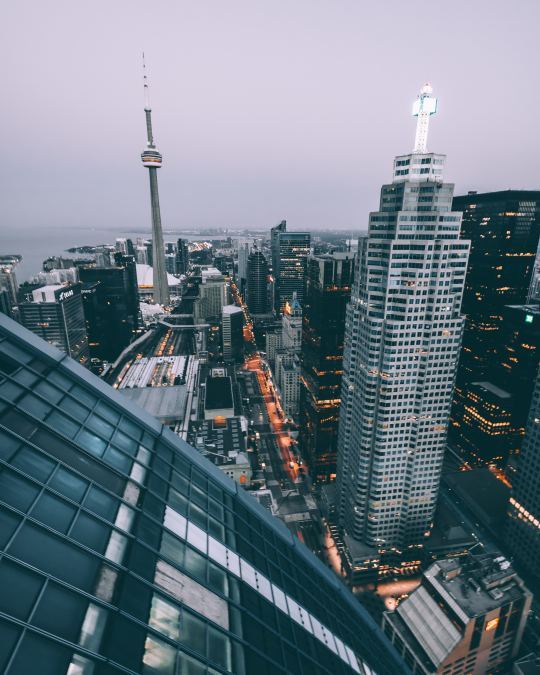
Daniel Doctoroff (chairman and CEO of Sidewalk Labs and former deputy mayor of New York City) and Eric Schmidt (executive chairman of Alphabet and former CEO of Google) recently contributed a piece to the Globe and Mail about “why Toronto is the ideal place to build a neighborhood of the future.”
It’s about the partnership they working on with Waterfront Toronto. I wrote about that announcement, here.
Here is an excerpt from the Globe article:
“The eastern waterfront will be a place where residents, companies, startups and local organizations can advance new ideas for improving city life. It’s where a self-driving test shuttle will take its first steps toward becoming a next-generation transit system that’s cheaper, safer and more convenient than private car-ownership. It’s where new insights into advanced construction methods will start to reveal a path toward more affordable housing development. It’s where explorations into renewable energy and sustainable building designs will show promise toward becoming a climate-positive blueprint for cities around the world.”
These are some of the first details that I have heard about their vision for Toronto’s eastern waterfront.
Some of you are probably worried – after reading the above excerpt – that by focusing on self-driving vehicles, we are setting ourselves up to repeat our previous mistakes. But if self-driving vehicles are destined to become a reality (and it certainly feels that way), it is critical that we understand their impact and how they might best dovetail with the public transit systems we already have in place.
I am thrilled that all of this will be happening right here on our doorstep.
-
The death of Big Oil
Designing a building for 5+ years into the future can be tricky. The pace of change in the world today is astounding.
Last month Seth Miller published a Medium article called: This is how Big Oil will die. His argument is that the cost of running an electric self-driving vehicle will be so low – simpler technology and no labor cost – that the personal vehicle as we know it will come to an end. People are inevitably going to give up their cars, which will result in a peaking of oil consumption.
We’ve talked about this future many times before on the blog. But Miller’s argument ties it back to oil and also comes with a set of predictions taken from a report prepared by the consulting company RethinkX:
– Self-driving cars will launch around 2021.
– A private ride will be priced at 16¢ per mile, falling to 10¢ over time.
– A shared ride will be priced at 5¢ per mile, falling to 3¢ over time.
– By 2022, oil use will have peaked.
– By 2023, used car prices will crash as people give up their vehicles. New car sales for individuals will drop to nearly zero.
– By 2030, gasoline use for cars will have dropped to near zero, and total crude oil use will have dropped by 30% compared to today.If all of these predictions prove to be true, then what should we be doing today to prepare our cities for this future?
-
Slot-based intersections
If you don’t follow the work of MIT’s Senseable City Lab, I highly recommend that you start.
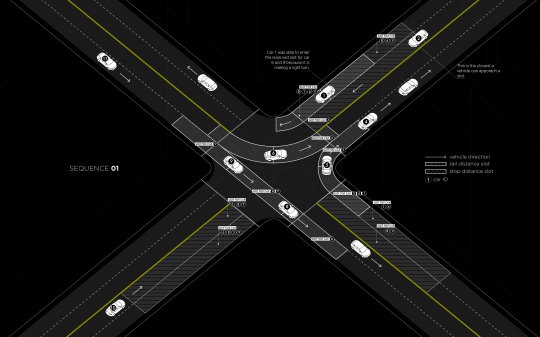
Earlier this year, researchers from the Massachusetts Institute of Technology, the Swiss Institute of Technology, and the Italian National Research Council developed something that they call “slot-based intersections.” In a world where cars have sensors and drive themselves, it is intended as a more efficient alternative to traditional intersections. Goodbye traffic lights.
Much like air-traffic control, the way the system works is by assigning individualized time slots to each car for when they may enter an intersection. For example, in the diagram below (Sequence 01) the car approaching from the bottom left (#10) has a “stop distance slot” in front of it reserved for 3 of the cars that are currently in the intersection. The two that are traveling perpendicular to it and the car currently turning left into the same lane as #10 (on the other side of the intersection). The car in the midst of turning right (#5) is exempt because there’s no possibility of collision.
In Sequence 02 (below) you can see that car #10 is now turning left, which means it has its own time slot in the intersection. Other approaching cars now have a “stop distance slot” dependent on car #10.
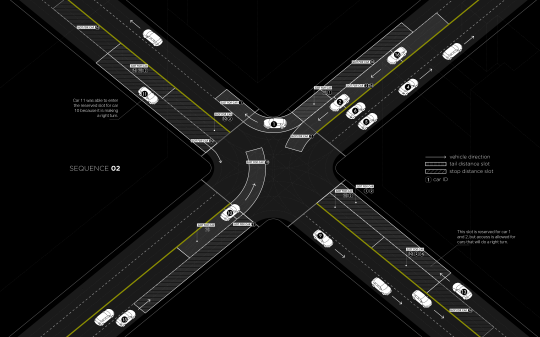
In all cases, cars making a right turn are able to move freely, provided they will not interfere with any other cars.
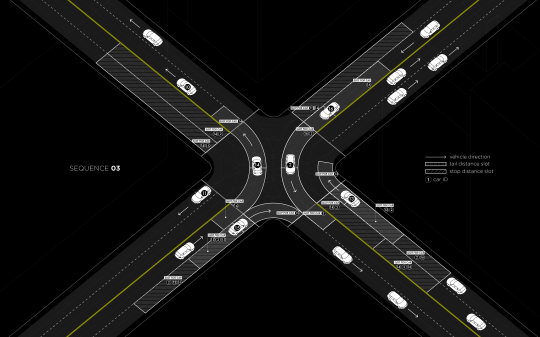
The researchers estimate that real-time slot allocation might double the number of vehicles that a traditional traffic-light intersection can handle today and, in some cases, it might completely eliminate stop and go traffic.
Often when I write about self-driving vehicles I hear people tell me that cars are still cars. It doesn’t matter whether they are self-driving or not. The same inefficiencies apply. They are not the solution to urban gridlock. Elon Musk was also criticized (following his Master Plan) for not properly understanding urban geography.
But self-driving cars will create new efficiencies. I am not saying that they are a silver bullet, but I am saying that they will help a great deal. I don’t think that anyone truly understands the extent of these efficiencies, but there are a myriad of possibilities. This Senseable City Lab project is a perfect example.
What I am grappling with right now is the relationship between self-driving vehicles and traditional forms of public transit. Until we get a handle on the efficiencies and overall impact, it’s hard to ascertain how these different forms of mobility will work together. My gut tells me that the lines are bound to get blurry and that self-driving “cars” will feel less and less like the cars we know today.
Below is a video that was published along with the research. If you can’t see it, click here.
[youtube https://www.youtube.com/watch?v=4CZc3erc_l4?rel=0&w=560&h=315]