Daily insights for city builders, delivered every morning at 6 AM ET. I’m Brandon Donnelly — a Toronto-based real estate developer and founder of Globizen. I’ve been writing here since 2013.
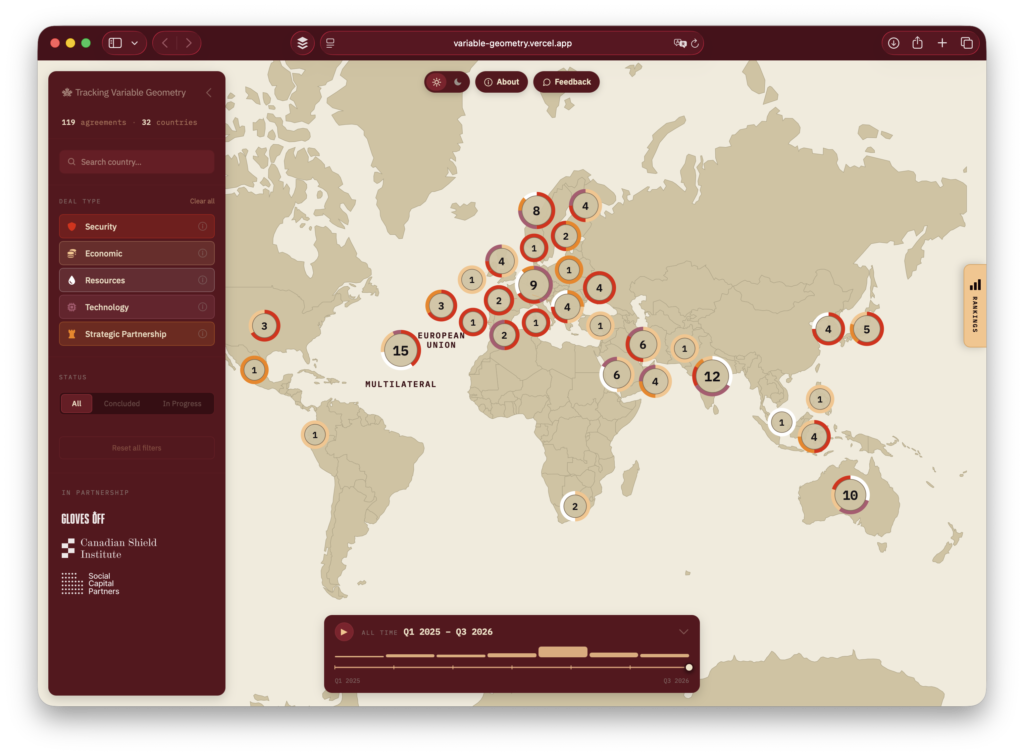
Here is an interesting map that tracks every important agreement Canada has signed (or is expected to sign) with other countries since March 2025. It is called the Variable Geometry Map, which is in direct response to what Prime Minister Carney outlined in his Davos speech at the beginning of the year: “To help solve global problems, we are pursuing variable geometry. In other words, different coalitions for different issues, based on common values and interests.”
The agreements are bucketed into five deal types: strategic partnership, economic, security, resources, and technology. They’re all listed in this Google Sheet if you’d like to do an audit. All in all, there are 119 agreements (82 of which have already been signed), spanning 31 countries if you exclude the United States. I like this strategy at a high level, but of course, signing agreements is only one thing. The proof will be in what these ultimately do for Canada.
This, it turns out, is an important question, because there’s a strong correlation between trust in government and overall prosperity (the above chart is via NZZ). The extreme examples of distrust are somewhat intuitive. If, for example, you don’t believe that your government will uphold property rights, why would you ever want to risk investing in property?
Trust is central to both stability and development. If citizens have trust in their system, they will be more likely to push for growth-promoting reforms. Moreover, they will be more confident that politicians will actually implement such reforms, and that sacrifices made today will pay off in the future. If this trust is lost, democracies become unstable, and autocratic tendencies are more likely to prevail.However, trust is also important for the transition from an autocracy geared solely toward the extraction of resources and wealth into a progressive democracy. A politically dominant class that governs autocratically will make concessions voluntarily and refrain from repression only if it trusts that it too will benefit from the institutional changes over the long term, and that it will not later be deprived of all opportunities.
All of this forms part of the work of economists Daron Acemoglu, Simon Johnson and James A. Robinson, who were awarded the Nobel Prize in Economics earlier this year. Their research explains why wealth is so unevenly distributed across the world. It’s a problem of institutions. But it’s also highly relevant to countries that are already rich.
Distrust is on the rise in countries like the UK (57%), France, (51%), Germany (49%), and Italy (47%). The outliers among OECD countries are places like Luxembourg and Switzerland. Only 25% of Swiss people express distrust in the government. That’s a good thing for overall prosperity and it shows in their GDP. So how can we be more like the Swiss?
Radical transparency when it comes to decision making and more of a direct democracy (versus a representative democracy) are two places to start, according to the research. People, it seems, trust their government more when they themselves make more of the decisions.
One of the first things that I noticed when I visited Rio de Janeiro a few years ago was the clear fixation on safety and security. There are gates and cameras everywhere. And the guidance you tend to receive from the locals usually resolves around how to stay safe. Don’t wander around at night. Be careful when you take out your phone. Be mindful of certain areas. You know, those sorts of things.
Of course, you never really know how dangerous a city is because it’s one of those things that’s impractical to test. You’re not going to wander around dark places just to see what the probability of being robbed is. The more sensible thing to do is simply believe what people are telling you and you observe the cues scattered around the built environment.
The result is a general sense of anxiety. You’re not quite sure if all the gates and cameras are truly necessary, but their mere presence makes you believe that they might be. I mean, why else would they be so pervasive? Or, could it be that people are overshooting with their investments in safety and security because, well, fear and paranoia are strong motivators?
I was reminded of all of this as I read through Ed Chartlon’s recent book review of, Panic City: Crime and Fear Industries in Johannesburg. The title of his review is Anxious Urbanisms, and I think that’s a good way of describing some of these phenomenons. It’s an urbanism of uncertainty. I haven’t read the book (yet), but it’s an interesting topic.
So I will leave you all with this excerpt from the review:
Ultimately, what we might take from Panic City, then, is less a comprehensive sociology of crime in the city and more a method of affective analysis. What the book provides is a sense of the ways in which the emotional sphere organises space, how feelings like anxiety or fear or panic, currently widely distributed across the world, materialise themselves, architecturally and politically. If immunity is anything like security, Murray offers us a cautionary tale. For wherever uncertainty thrives, so does the tendency towards paranoid thinking—which is to say, a contagion of a different sort, one that licences regimes of suspicion, self-protection and individual security, and all at the eventual cost of collective wellbeing and interdependence.
This is a city metric I haven’t seen before. City Observatory recently looked at the number of police officers (public) and security guards (private) per capita across American cities. They also ask a bunch of interesting questions. Why do some cities have far fewer police officers? Is high security an indicator for “anti-social capital?” (Social norms aren’t encouraging people to behave.) And do some cities simply have more cops because it is perceived to be necessary?
Here is what they found:
The average is about 3.3 police officers per 1,000. And in each case, city is defined as the metro area. The study relies on census data and, if we’re being precise, the data represents where people live as opposed to where they work. So some cities could be reporting a lower number simply because police officers tend to live outside of the metro area — perhaps because of housing costs. Either way, it’s interesting to consider why some cities spend a lot more on security than others and why Miami has so many security guards.
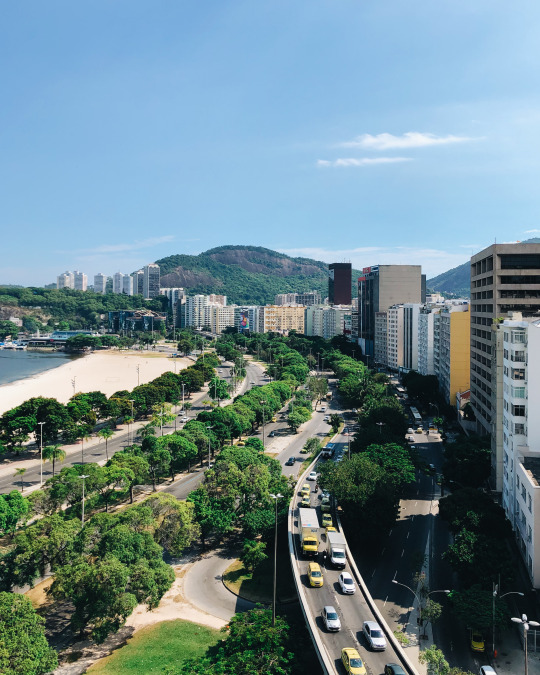
I just arrived in Rio de Janeiro, which is where I’ll be for the next ten days. Here is a photo looking south from the rooftop of our hotel (more photos to follow on Instagram):
Today was a fairly relaxed day after many hours of travel. But tomorrow the architecture and design tour begins.
I am still trying to get a feel for the city. The first thing people tell you after you arrive is to be careful. Don’t go out at night. And take Ubers.
Uber is a significant advantage in a place like Rio where few people seem to speak English and you may be concerned about somebody taking you for a ride.
Not only was the Uber from GIG about R$80 less expensive than a taxi (I was probably quoted the gringo rate), but you also get perfect information in terms of where you are going.
This emphasis on safety and security is, of course, highly evident as you walk around the city. Lots of gates and lots of cameras.
It’s perhaps a bit ironic to see so many places sealed off from the outside when you consider how great the climate is and how friendly the people are.
Here is an eye-opening article from data scientist Vicki Boykis outlining the number of ways in which Facebook collects data about its users. It’s called: What should you think about when using Facebook?
One of the more surprising tidbits from Boykis’ article is that Facebook collects keystrokes. That means if you start typing a status update but never actually post it, that information is still fair game.
Facebook previously used this data for a study on self-censorship. That sounds like like a fascinating study, but I’m sure the thought is also scaring many of you if you care about privacy.
Here is a quote from the article that gets at the core of what is going on:
“The fundamental purpose of most people at Facebook working on data is to influence and alter people’s moods and behaviour. They are doing it all the time to make you like stories more, to click on more ads, to spend more time on the site.”
A worthwhile read. And in case you didn’t already know, if you go to Settings -> Download a copy of your Facebook data, you can get a pretty good dump of your activity, including every private message you’ve ever sent on the platform.
The project was completed using a platform called Fundrise, which I’ve written about before here on Architect This City. Their vision is to completely democratize real estate investment by removing middlepeople and outdated regulations that restrict who and how people can invest in real estate.
To accomplish this, the founders of Fundrise went out in 2011 and bought the building located at 1351 H Street NE for $825,000. The goal was for it to act as their proof of concept.
They then spent a significant amount of time and money figuring out how to make it legal for small and local investors to participate in the project (as opposed to just accredited investors). It was ultimately done through a “local public offering” filed with the SEC.
So how does it work?
In the case of 1351 H Street NE, they first went out to the local community and asked them what they wanted to see. That’s how they ended up with a unique retail store / restaurant. It’s what the community wanted.
Once this was established, they went out and issued 3,250 shares and crowdfunded $325,000 from 175 local investors. This was for an ownership share in both the building and the future business. The average investment amount was $2,000, but people were able to invest as little as $100.
This is an incredible accomplishment. It takes real estate investment and development to a local level and really empowers small entrepreneurs to start businesses that may have been previously unfundable by traditional sources.
I don’t know what you think, but I think this is the beginning of a powerful transformation. Many of the structures that are currently in place were formed at a time when it wouldn’t have been practical to crowdsource ideas and crowdfund money. But now that is very possible. It was just done.