Daily insights for city builders, delivered every morning at 6 AM ET. I’m Brandon Donnelly — a Toronto-based real estate developer and founder of Globizen. I’ve been writing here since 2013.

Tag: second home

  • The rise of global citizens

    Leisure travel, according to Resonance, is growing:

    In fact, spending on leisure travel and recreation has outpaced the overall growth in consumer spending over the last decade, and inflation-adjusted spending on leisure activities as a share of overall consumer spending grew from 9.5% in 2013 to nearly 13% by 2022. This means that the travel and tourism industry is getting a growing share of a growing pie, which bodes well for the long-term future of those hotels and destinations that cater primarily to leisure travelers.

    And so are blended trips (trips that combine business and leisure). Though the way people are going about it has evolved:

    What used to involve adding a day or two on the weekend to a weekday business trip has shifted to the mixing of business and pleasure throughout the week. With a greater percentage of the workforce in the U.S, Canada and the U.K. only going into the office 2-3 days per week, workers from these countries are free to blend their travel for up to a week. And with as much as a quarter of professionals in the U.S. now working remotely, a whole new class of nomadic travelers has emerged who are able to travel anywhere, anytime—as long as their accommodations have adequate high-speed internet and appropriate workspaces.

    At the same time, cities are really clamping down on short-term rentals, which is a common way people do blended trips. Resonance believes this will create new opportunities:

    But while increased regulation and enforcement of the sector will wipe out the businesses of many “professional” hosts and investors, it’s also creating new opportunities for cities and developers to create new neighborhood-oriented hotels that satiate travelers’ desire for local experiences while also being additive to the quality of life of local residents.

    It might be the case that these two things are inversely correlated. More people are traveling for fun and for work, and so now cities are trying to manage that demand; more travel leads to more regulation. Whatever the case, I do agree that this is an important consumption trend.

    My working theory is this: if money wasn’t an object, a lot of people would love to have homes all around the world and live in multiple places. I certainly would. And the list of places is already in my phone. But since this isn’t practical for most, we have Airbnbs, neighborhood-oriented hotels, Soho House global memberships, and the ability to buy fractions of second homes.

    These solutions all respond, at least partially, to our desires for new experiences and for a deeper attachment to places. But now that tech is expanding the reach of cities, these desires are becoming further untethered. And so my view is that there’s going to be a lot of opportunity in the world of “making people feel like they’re global citizens.”

  • 1/21st of a second home

    I don’t know for exactly how long, but for a very long time people have been trying to solve this real estate problem: “I have a desire to own a home, or multiple homes, around the world. However, I don’t know how often I’d actually use it/them, and this desire is both expensive and a pain in the ass.”

    And so unless you have a lot of money and can make the pain in the ass part go away, there seems to exist an ongoing need to make fulfilling this desire both cheaper and easier. Perhaps the most common ways are through a timeshare property or through some kind of fractional ownership structure, where you own a share of a property.

    Some companies are even “tokenizing” this second structure on blockchains. I have read about one company that is buying vacation homes and then issuing 365 corresponding tokens. Each token represents 1 day of occupancy (and actual title ownership apparently). In theory this sounds kind of neat, but you’re also buying a second home with potentially 364 other strangers.

    So here’s another approach that I just learned about. The UK-based company, August, has devised a model that works like this:

    • August starts with “homeowner curation.” Meaning, they start by vetting homeowners to make sure that they’re not weird or something.
    • Once they have a suitable collection of homeowners, August sets up a new real estate entity that all of the homeowners must then fund equally.
    • This entity, by way of August, goes out and buys 5 properties, and each homeowner receives an equal share of the ownership. (Typically, they target 16-21 groups per entity.)
    • August renovates the 5 properties, gets them ready for occupancy, and then manages them on ongoing basis. This includes bookings.
    • Finally, each homeowner gets an average of 8-10 weeks per year across all of their homes.

    In terms of the homes themselves, their pied-à-terre collection includes homes in Paris, Rome, Cannes, Barcelona, and London. They are typically between 70-100 square meters with 2 bedrooms and 1-2 bathrooms. And the average price/value is supposedly around €1,250,000 (post-renovation?), with the entry price of a share starting at €340,000.

    I’m not sure if this share figure is based on 21 homeowners, but if it is, then that’s €7,140,000 of equity being raised in order to buy somewhere around €6,250,000 of real estate. Is the spread their margin for setting this all up? There’s also an annual fee per owner (€8,600), which presumably covers operating costs and the ongoing management of the properties.

    A model like this naturally provokes a lot of questions. What happens if somebody wants to sell? Does the next buyer need to be similarly vetted for overall weirdness? And how liquid is 1/21st of a 5-property apartment portfolio? I don’t know these answers, but intuitively these shares have got to be less liquid than a 100% sale.

    However, as a solution to the problem of “I have a desire to own homes across Europe but I’m not quite rich enough to make it truly carefree”, this seems like a pretty clever solution.

  • Second home and investor mortgage applications accounted for 14.1% of all applications in February

    As a follow-up to my recent post about the rise of the second home, here is a chart (via the WSJ) showing second home and investor mortgage applications as a share of all applications in the US. In February of this year (2021), second home and investment properties accounted for 14.1% of all applications. This is a record number going back to January 2010.

    What’s also interesting about this chart is that, but for COVID, it shows a general decline over the last decade. I’m not sure what the split is between vacation and investment properties, but can we conclude that pre-COVID Americans were becoming less interested or perhaps less able to own a second home? And could the reason be that instead of owning a second home, more people simply started relocating permanently?

    There is also an obvious seasonality to these applications. Each of the above valleys tend to correspond to the spring and summer months. It’s almost as if every fall/winter we start thinking to ourselves, “Right, winter. Let’s look for a place somewhere else.” Is it that, or are there other forces at work here?

  • The rise of the second home

    Real estate brokerage firm Redfin recently did an analysis of “mortgage-rate lock data” taken from the analytics firm Optimal Blue. A mortgage-rate lock is an agreement between a lender and a borrower guaranteeing a particular interest rate for a particular period of time.

    What’s potentially interesting about this data is that (1) approximately 80% of mortgage-rate locks apparently result in an actual home purchase and (2) buyers must specify whether they’re applying to secure a rate for a primary home, a second home, or an investment property. So there’s a high degree of intent that goes along with these applications.

    What Redfin found when they looked at the data is that the growth in demand for second homes is exceeding that of primary homes by quite a wide margin. They argue that this is largely a result of people now working remotely.

    But this rise in demand — at least according to the above data — appears to have started in the second half of 2019. So I think a few more data points would be helpful in understanding what’s really going on. Is what we’re seeing more about acceleration than about causation? And what does this look like a year from now?

    Chart: Redfin

  • True North by Alain Carle Architecte

    I just recently discovered the work of Montréal-based firm, Alain Carle Architecte. If you aren’t familiar with their work, do yourself a favor and check it out here. They are apparently known for their secondary homes across the country.

    The project that caught my attention was their True North home in Cornwall, Ontario. Here are two photos by renowned architecture and design photographer Adrien Williams (also of Montréal).

    imageimage

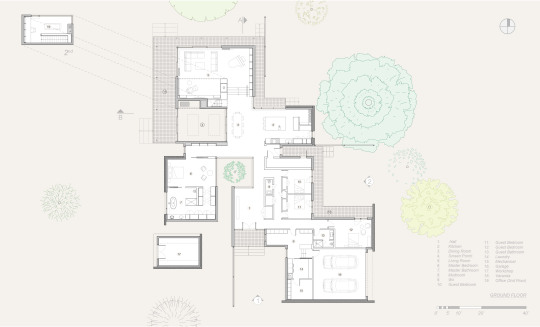
    And here is a plan via Dezeen.

    image

    The concrete and black metal cladding against the snow is pure magic. I also love the way they employed black screens to create a gradient across the landscape and frame some of the outdoor spaces. You really see that in the plan.

    The shadows these screens cast on the concrete are also quite beautiful.

  • Jets and real estate

    Jackson Hole Airport (JAC) has one runway. It is 6,300 feet long by 150 feet wide and it was originally constructed in 1959. In 1965, the first of many proposals was put forward to lengthen the runway to 8,000 feet so that jets could fly into the airport. But it was never adopted. Subsequent proposals were made in 1992 and 1999, but they were again highly contentious and similarly never adopted. The runway remains 6,300 feet long.

    However in the early 1980s jets began using the existing runway and the area started to boom. According to this old New York Times article from 2002, the town’s growth exactly parallels the introduction of jet service at JAC. The town doubled from 9,000 people in 1980 to 18,000 people in 2000. Its per capita income also shot up from a steady $20,000 in 1984 to more than $67,000 in 2011 – making Teton County one of the richest in the US.

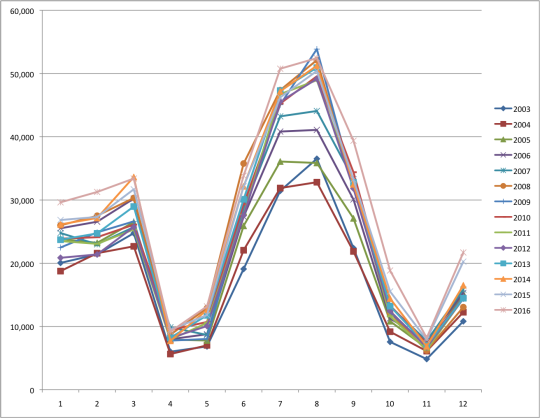
    Tourism destinations and second home markets like Jackson Hole are heavily dependent on access. In 2003, a total of 211,788 passengers flew through JAC airport and, in 2016, it was over 340,000 people. But second home markets are also the first to get hit during macroeconomics shocks. Following the 2008 financial crisis, passenger volumes at JAC didn’t recover until 2014.

    If you look at air traffic throughout the year you’ll also see that it is highly seasonal. Below is a chart showing monthly passenger volumes at JAC from 2003 to 2016 (data from the Bureau of Transportation Statistics). Some of you may be surprised to see that more people visit Jackson Hole in the summer, compared to the winter. But what’s perhaps even more conspicuous is the sharp drop off during the swing seasons.

    image

    I am thinking about all of this not only because I just got back from Jackson Hole, but also because I am very interested in the demand drivers that fuel the real estate in many of these mountain towns. It’s easy to get it wrong. Unlike major urban centers – which often operate under a perpetual supply deficit – you can’t just build and necessarily expect people to come.

    Revelstoke Mountain Resort, for instance, first opened in 2007 with grand aspirations of building one of the largest ski resorts in North America. But they got crushed in 2008 and have never fully recovered – at least relative to their original plans. Maybe the answer is a bigger airport.