Daily insights for city builders, delivered every morning at 6 AM ET. I’m Brandon Donnelly — a Toronto-based real estate developer and founder of Globizen. I’ve been writing here since 2013.

Tag: sea level rise

  • The Citadel effect

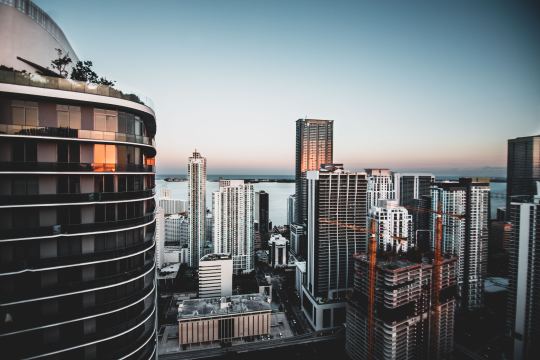
    Last year, the formerly Chicago-based hedge fund Citadel announced that it would be moving its global headquarters to Miami. (Though to be clear, the company still has an office in Chicago.) Today, the Miami housing market is feeling the effects:

    “They’ve been buying here aggressively,” said Michael Martinez, a real estate agent with Sotheby’s in Miami, who recently brokered the sale of a $5mn home in Coconut Grove, a quiet salubrious suburb, to a Citadel employee. Most of the luxury homes he has sold in recent months have been to hedge fund buyers, half of them from Griffin’s firm, he estimates. “The Citadel migration is definitely occurring.”

    But it’s not just Citadel.

    According to another agent quoted in the article, there are many other “hedge fund buyers” active in the market, and many/most of them are buying all cash. In desirable suburbs like Coral Gables and Coconut Grove, homes between $3-7mm now account for about 40% of all listings.

    I remember visiting family in Miami in and around the GFC of 2007-2008. It was at this time that I really fell in love with the place. You could see how it was using art and culture to carve its identify. It was (and still is) this really exciting and sexy place.

    But it was also reeling from the GFC. I remember seeing listings for large and newish 2-bedroom waterfront condos for ~US$150k in some areas. If I had any money, this likely would have been a smart move given how Miami has grown since then.

    So I think this story is less about the Citadel effect and more about Miami’s continued rise as a global city and global financial center. Notwithstanding the whole climate risk thing, this city region has some pretty powerful tailwinds.

    Photo by Ryan Parker on Unsplash

  • Sea-level rise projections in the Florida Keys

    Monroe County, Florida, which is the county that includes the Florida Keys, held a public meeting at the end of last month to discuss what they are going to do to respond to climate change. The agenda can be found over here. According to this article in Grist, it was a seven-hour public meeting and the overall tone was something along the lines of this:

    “The water is coming and we can’t stop it,” said Michelle Coldiron, mayor of Monroe County, which encompasses the Keys. “Some homes will have to be elevated, some will have to be bought out. It’s very difficult to have these conversations with homeowners, because this is where they live. It can get very emotional.”

    In attendance at the public meeting was a scientist from the National Oceanic and Atmospheric Administration (NOAA), who outlined that they are expecting an additional 17 inches of sea level rise by 2040. This is the “intermediate high” scenario based on the below chart.

    Which is why the county is looking to spend $1.8 billion over the next 25 years to raise some 150 miles of roads and deploy a bunch of other fixes that include things like new drains, pumping stations, and vegetation — all of which are of course intended to mitigate the impacts of sea level rise.

    One problem, which shouldn’t be all that surprising, is that the county doesn’t have the money to pay for all of this. And as the quote at the beginning of this post suggests, part of “this” includes buying out many of the homes. Presumably these are the higher risk homes where there are no clear alternatives.

    This is a problematic situation. Because as time goes on, one would expect the tax base here to start to decreasing. Both as homes get bought out and as overall housing demand weakens. There are also financing and insurance considerations. Already the Keys have some of if not the highest insurance premiums in Florida.

    As I understand it, the Florida Keys are one of the most vulnerable areas in North America when it comes to sea level rise. And so unfortunately, the public meeting that took place two weeks ago could very well be considered a leading indicator for what’s to come.

  • The re-allocation of capital (and predictions for this decade)

    I have stayed at two hotels over the last month where I did not need to interact with a human as part of the check in process. And in one of those two instances I didn’t even need to interact with a computer at the hotel.

    My room key was issued to me through an app and I used that (and Bluetooth) to open my hotel room door (after the app, of course, notified me that my room was ready).

    This is prediction #2 in Fred Wilson’s annual roundup of what is going to happen next in the world. Automation is reducing the costs associated with operating many businesses. Who is going to be the beneficiary of this consumer surplus?

    The other prediction that should interest most of you — because the impacts would be widespread — is this one here regarding climate change:

    The looming climate crisis will be to this century what the two world wars were to the previous one. It will require countries and institutions to re-allocate capital from other endeavors to fight against a warming planet. This is the decade we will begin to see this re-allocation of capital. We will see carbon taxed like the vice that it is in most countries around the world this decade, including in the US. We will see real estate values collapse in some of the most affected regions and we will see real estate values increase in regions that benefit from the warming climate. We will see massive capital investments made in protecting critical regions and infrastructure. We will see nuclear power make a resurgence around the world, particularly smaller reactors that are easier to build and safer to operate. We will see installed solar power worldwide go from ~650GW currently to over 20,000GW by the end of this decade. All of these things and many more will cause the capital markets to focus on and fund the climate issue to the detriment of many other sectors.

    For the rest of Fred’s predictions, click here. These are always great reads.

  • Making cities resilient to climate change

    This past fall, Goldman Sachs published an important report about “making cities resilient to climate change.” In it, they remind us that the scientific consensus is that the world has already warmed from the pre-industrial era (and will likely continue to do so) and that a great many of us live near water (and will likely be impacted going forward).

    About 40% of the world’s population lives within 100 kilometers of a coast, and about 10% of the world’s population lives in a coastal settlement that is less than 10m above sea level. Above is a list of some of those cities, along with their average elevation in meters. The cities with single digit elevations include Bangkok, Miami, Alexandria, and Amsterdam.

    Goldman’s prediction is that this need for “urban adaption” could lead to one of the largest infrastructure build-outs in history. And that cities all around the world should already be thinking about how they will finance and equitably execute on greater resilience (assuming they aren’t already).

    Click here to download a full copy of the report. The diagrams showing the average change in global mean surface temperatures against the pre-industrial period are something you should all look at it. The 2015-2019 change is pictured above.

    Charts: Goldman Sachs

  • Indonesia announces new capital city on the island of Borneo

    On Monday, Indonesia’s president, Joko Widodo, announced a plan to build a new capital city on the island of Borneo. The plan is in response to Jakarta’s formidable environmental challenges. It suffers from some of the worst air quality in the world and is struggling with a severe subsidence problem, which, I understand, is partially (or largely) a result of climate change and the unregulated extraction of groundwater.

    About 40% of the city now sits below sea level and the worst affected areas are supposedly sinking at up to 20cm per year. This gives Jakarta the dubious distinction of being the fastest sinking big city. On top of this, it is also one of the biggest cities in the world in terms of population. The Jakarta megalopolis has over 30 million people, placing it 2nd after Tokyo according to this list.

    Here’s a short video from the BBC that will give you some visuals to go along with the above. These are the sorts of urban challenges that will make you forget all about separated bike lanes and 45 degree angular planes. And they are not entirely unique to Jakarta. If you can’t see the video below, click here.

  • A new way to grow islands

    MIT’s Self Assembly Lab and Invena (which is an organization based out of the Maldives) are trying to invent a system of underwater devices that naturally harness wave energy to restore and/or create new beaches, sandbars, and islands. The hope is that this line of thinking could be scaled up and eventually used a response to sea level rise, as well as other coastal challenges.

    Here’s a short video explaining the initiative:

    With over 40% of the world’s population supposedly living in a coastal area, this is a problem that will need to be addressed. Already we are seeing these concerns start to rear their head in the real estate markets of some particularly vulnerable cities. The team installed their first field experiment in the Maldives this past February and a second one is expected in Q4-2019.

    For more information on the “Growing Islands” project, click here.

  • Future of the American city

    image

    The Knight Foundation has just announced $1 million in support to the Harvard Graduate School of Design for a multi-year, multi-city, and applied research effort that they are calling the Future of the American City. The program will start in Miami and Miami Beach, but the plan is to expand to Boston, Detroit, and Los Angeles.

    As part of this initiative, the GSD will embed faculty and urban researchers into the local community, as well as organize three design studios that will build on each other every year. In the case of Miami and Miami Beach, the 3 themes that will be explored are urban mobility, affordability, and climate change. As you know, these two cities are center ice for the problem of sea level rise.

    This sounds very similar to a design studio that I took at Penn, which was centered around water and housing issues in Bangladesh. It was a multi-year research studio (5 years in this case) and we visited and got paired up with locals in Dhaka during the course of the studio. I think these types of programs are a great way to ground the research in reality. 

    And as a fan of Miami and Miami Beach, I am curious to see what the teams come up with over the next 3 years.

    Photo by Blake Connally on Unsplash

  • Random thoughts about climate change

    One of the things that I have been wondering lately with all of the devastation caused by hurricanes Harvey and Irma is if we need to be viewing these catastrophic incidents as the result of climate change or if we’re being too quick to apply the availability heuristic.

    The latter being: “Look at all of these horrible hurricanes. Climate change must really be here and happening right now.”

    Albert Wenger is covering this topic on his blog right now through his “Uncertainty Wednesday” series and has also written similar posts in the past. The current series is still ongoing, but a few things stood out to me as I was going through the archives. I’ll mention 3 of them today.

    Firstly, it’s important to understand the difference between weather and climate. Weather is what’s happening at any given moment. Climate, on the other hand, is the statistics of weather. Albert proposes the following definition for climate, which I like:

    “Climate is the probability distribution of possible weather events.”

    Secondly, the data is clear: We have gotten far better at forecasting weather over the years. Accuracy has greatly improved. 

    But we’re still pretty bad at it, particularly over longer periods of time. According this graph, we’re about 97.5% accurate for 3 day forecasts, but only about 40% accurate for 10 day forecasts. So by “longer periods of time”, I’m really talking about forecasts that go out beyond one week. That’s not very far into the future.

    Thirdly, Albert has this post from last year where he talks about the flooding we saw on the U.S. east coast and also the slowing down of the Gulf Stream

    This is fascinating, and also frightening, because the Gulf Stream is a vital ocean current. Among other things, it warms western and northern Europe – likely making it warmer than it otherwise would be – and, according to some models, it lowers the sea level along the U.S. east coast by as much as 3 feet

    The frightening part is that as the Gulf Stream slows it also stops pulling away the same amount of water from the coast, which is arguably why mean sea level is increasing.

    I say “arguably”, but the data clearly suggests an acceleration in the rate of rise. Here are two charts that Albert prepared. And there’s more: The U.S. east coast may also have it worse in terms of sea level rise precisely because of this phenomenon.

    This is an interesting and, of course, important topic. This post obviously doesn’t do it justice, but I am trying to learn as much as I can. Writing always helps with that.

    Photo by Joseph Barrientos on Unsplash

  • The politics of flooding

    Do you believe that human action has caused and is causing negative outcomes with respect to the environment?

    The New York Times published a feature piece this week on the flooding of the US east coast. 

    Associated with the article is a fantastic infographic that shows all of the NOAA (National Oceanic and Atmospheric Administration) tide gauges up and down the eastern seaboard. It then zooms in to a few locations and shows mean sea level rise (in inches) since 1950 and the number of days of “nuisance flooding.”

    Here’s a sample screenshot:

    If you don’t feel like reading the full article, at least check out the infographic. The increase in nuisance flooding for some cities – such as Wilmington, N.C. (shown above) and Annapolis, MD – is astounding.

    What’s frustrating about the whole climate change debate is that it remains not only a debate, but an ideological debate. Here’s a quote from the article that stood out for me:

    “I’m a Republican, but I also realize, by any objective analysis, the sea level is rising,” said Jason Buelterman, the mayor of tiny Tybee Island, one of the first Georgia communities to adopt a detailed climate plan.

    In other words: I’m not supposed to think this way, but I do.

    Politics.

  • What sea level rise is doing to the urban landscape of cities

    Resiliency is an important topic in urbanist circles these days.

    New York is working on a 10 mile “Dryline” to protect itself from future storms similar to Hurricane Sandy. And Miami Beach – one of the most vulnerable cities in the U.S. to sea level rise – is frantically building pump stations and raising its seawalls, streets, and sidewalks.

    Here’s what the city’s public works director had to say via a Curbed article published about a week ago:

    Miami Beach is planning to spend upwards of $500 million over the next five years on the pump stations and street-raising projects. “We are quite certain we are going to buy ourselves another 30 years, and we are hoping we are going to buy ourselves another 50 years,” Carpenter said.

    According to Wired, sea levels off the coast of South Beach have risen by 3.7 inches since 1996. But over the last 5 years the high tide levels have had an average increase of about 1.27 inches per year!

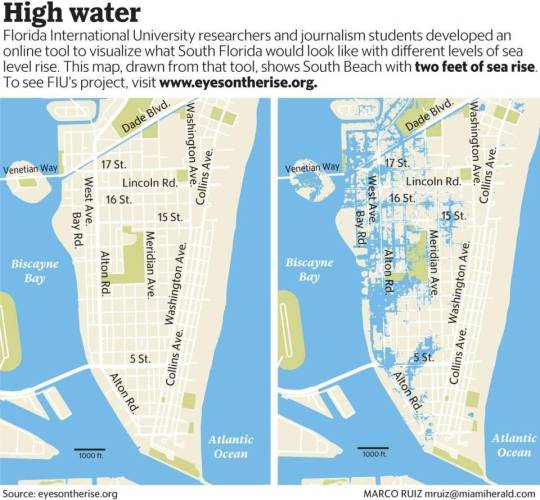
    This matters a great deal because of what South Beach would look like if sea levels increased by 2 feet (via the Miami Herald):

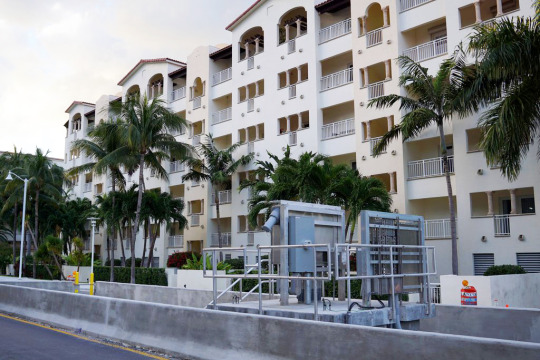
    It’s for this reason that Miami Beach has been working to alter its street elevations and install pumps – as many as 80 of them over the next 5 years – that quickly drain stormwater into Biscayne Bay. (The drains are equipped with backflow preventers so that the water leaves but doesn’t come back into the island.)

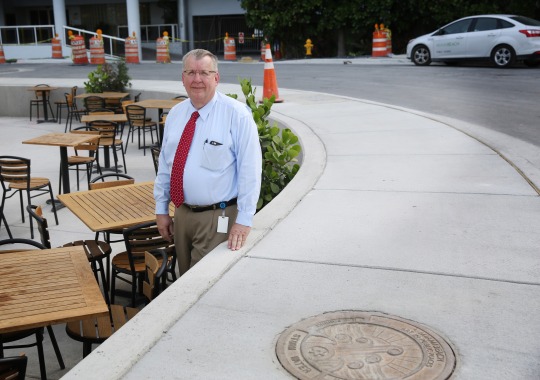
    Here’s an example of a raised street and sidewalk (via the Miami Herald):

    And here’s an example of a pump station (via Curbed):

    All of this strikes me as necessary work for Miami Beach. But I also think it’s important to keep in mind that all of this is patch work – regardless of how necessary it is right now. 

    The bigger question is: what are we doing to stop sea level rise? That’s the only way we’re going to get to true, urban, resiliency.