Daily insights for city builders, delivered every morning at 6 AM ET. I’m Brandon Donnelly — a Toronto-based real estate developer and founder of Globizen. I’ve been writing here since 2013.

Tag: school of cities

  • 25 years of transit-oriented development

    When we build next to transit, we often call this transit-oriented development. 

    What’s interesting about this moniker is that it implies we’re doing something a little special — something out of the ordinary. And I guess that makes sense because, in many cities, it is often out of the ordinary. 

    That’s why you don’t hear people at real estate conferences saying, “check out this new cutting edge car-oriented development that our firm is developing.” That doesn’t need to be specified.

    But at the end of the day, I’m not sure how special transit-oriented development really is; it’s basically just urban development. Meaning, you put density on top of and next to transit stations and then more people take transit. That’s how this works.

    On that note, here is an interesting study from the School of Cities that looked at Toronto’s transit network and how the populations around each station have changed (or not changed) between 1996 and 2021 (census data). 

    If you look at the various transit lines, you’ll see that, in some cases, like downtown, we have added a lot of new transit-oriented development. This is good. Populations increased. 

    But in many/most other cases, populations remained flat; or worse, they declined. This is a serious problem, and it shows how land use restrictions are forcing us to underutilize our existing transit assets.

    Maybe what we need to do is stop thinking about transit-oriented development as something special, and instead remind ourselves that this is standard operating procedure. It’s just what you do next to transit.

    Thanks to Sam Kulendran for sharing the above study with me.
  • US cities with the most corporate HQs

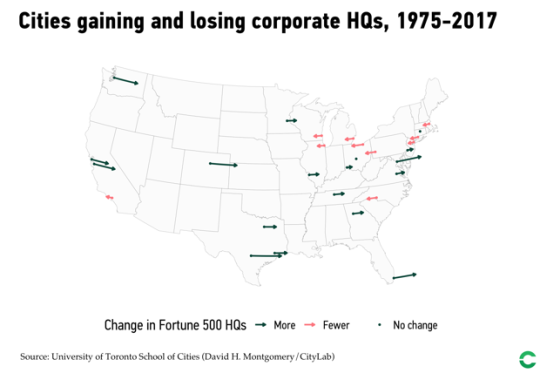
    The University of Toronto School of Cities recently looked at the changing economic geography of Fortune 500 companies across the US from 1975 to 2017. Here is a diagram of the results taken from CityLab:

    New York sits at the top with 70 corporate headquarters as of 2017. But the San Francisco Bay Area is now the second largest center with 35 headquarters – a testament to tech.

    The study does, however, omit service firms, as these weren’t tracked in Fortune’s list back in 1975.

    Also noteworthy is the specialization that has taken place across specific cities and regions. Here is another excerpt from CityLab:

    America’s headquarters geography reflects the substantial variation and specialization of the U.S. economy. New York leads in finance and business services, consumer services, and goods and materials. But Houston leads in energy, San Jose in tech, and Chicago in retail and wholesale. Chicago also ranks second in consumer services, and goods and materials, and Dallas takes third in energy. Other cities like Nashville and Minneapolis take third in consumer services, and goods and materials, respectively.

    The full article can be found, here.

  • New School of Cities

    The University of Toronto just announced a new School of Cities. It will begin operations on July 1 of this year (2018) and bring together researchers from various disciplines to address the world’s most critical urban challenges. 

    Insert stat here about the percentage of the population that will live in an urban area by 2050.

    There are more than 220 faculty members across 40 different academic divisions at the University of Toronto who are doing urban-focused work. The School of Cities is intended to bring those minds together.

    So far there are plans for a “global cities summit” and an “urban lab” that will also bring students, faculty, industry, and government together. The intent is for the School to act as a city builder both locally (Greater Toronto Area) and globally.

    This once again goes to show just how important we are all taking urban issues today. But I am sure this blog audience didn’t need to be reminded of that.

    If you would like to sign up for updates from the School of Cities, you can do that here.

    Photo by Jorge Vasconez on Unsplash