Daily insights for city builders, delivered every morning at 6 AM ET. I’m Brandon Donnelly — a Toronto-based real estate developer and founder of Globizen. I’ve been writing here since 2013.

Tag: san francisco bay area

  • Housing supply in Tokyo

    It has been well documented that Tokyo tends to build a lot of housing. And the argument goes that this has helped to maintain a certain level of housing affordability. The city is constantly building and rebuilding. It also has different views about housing. Now, we could, of course, debate how much of its relative affordability is a direct result of supply but, regardless, there seems to be a lot of it. In 2014, the city of Tokyo saw 142,417 housing starts, according to this recent FT article. This is compared to ~5,000 units across the Bay Area (2015 data), 83,657 units for the state of California, and 137,010 units for all of England.

    If you’re wondering how Toronto is doing, here are the latest numbers:

  • The new decentralized workforce

    A few weeks ago the WSJ published an article about Toronto’s growing tech talent pool, arguing that its base now rivals the top US cities, but that it may not be an entirely good thing for the city’s ecosystem. I wrote about it here.

    This morning venture capitalist Fred Wilson published a post on his blog talking about the necessity of scaling tech companies in lower cost locations. It’s a good follow-up to the above article/post.

    Here’s an excerpt from Fred:

    Last week I heard some shocking numbers about salary levels for certain kinds of engineers in the bay area. I checked them out with a few of our bay area portfolio companies and they were more or less corroborated.

    The tight technical labor markets in the bay area, NYC, and a number of other regions in the US are making it hard to scale software businesses without burning massive amounts of cash.

    He goes on to argue that (startup) companies now need to think about scaling in other/remote locations sooner than they ever have before — basically as soon as the company hits about 50 engineers (or 100-200 employees).

    Many companies are now working with a distributed workforce. Supposedly 2/3 of the global workforce now spends at least one day of the week working remotely. I almost never work from home, but I do get how this is possible.

    So what is happening is that engineering talent is spilling over into secondary markets out of necessity. There’s an economic imperative to colonize. But I would imagine that, at least initially, most of the economic benefits accrue to the colonizer.

    Photo by NASA on Unsplash

  • Software developers are half of the homebuyers in San Francisco

    A couple of months ago I wrote about the relationship between IPOs and home prices. It was in response to the current wave of tech companies — most of which are headquartered in San Francisco — that have gone public or are expected to go public this year (2019). What impact will this have on the city’s housing market?

    I cited this academic study on the topic, which already discovered a “positive and significant association between local house price changes and firms going public.” But today I stumbled upon another interesting study by a San Francisco real estate agent, name Deniz Kahramaner, who happens to also be a Stanford-trained data scientist.

    What Kahramaner wanted to figure out was, who tends to buy residential real estate in San Francisco?

    So he started with title data and then scraped the internet to try and match up individual buyer names with specific companies and industries. Since not everyone has some sort of public profile and because real estate is sometimes held within a company, he was only able to traceback about 55% of home purchases in San Francisco last year.

    Still, the data looks pretty clear. About half of the homes bought in 2018 were by individuals whose employment has roots in “software.” The next biggest buyer segment was “finance.”

    The other interesting thing about this data set is that it shows where people have been buying (at least last year). Historically, the north end of the city has been the wealthiest, but the above data shows things moving in a southeasterly direction. Though, it remains to be seen what all of this will look like when the dust settles after this current crop of tech IPOs.

    Chart: The Atlantic

  • US cities with the most corporate HQs

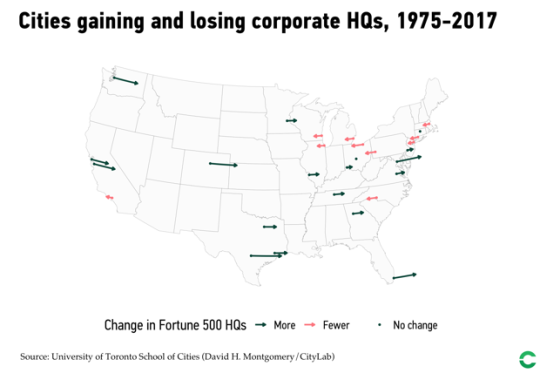
    The University of Toronto School of Cities recently looked at the changing economic geography of Fortune 500 companies across the US from 1975 to 2017. Here is a diagram of the results taken from CityLab:

    New York sits at the top with 70 corporate headquarters as of 2017. But the San Francisco Bay Area is now the second largest center with 35 headquarters – a testament to tech.

    The study does, however, omit service firms, as these weren’t tracked in Fortune’s list back in 1975.

    Also noteworthy is the specialization that has taken place across specific cities and regions. Here is another excerpt from CityLab:

    America’s headquarters geography reflects the substantial variation and specialization of the U.S. economy. New York leads in finance and business services, consumer services, and goods and materials. But Houston leads in energy, San Jose in tech, and Chicago in retail and wholesale. Chicago also ranks second in consumer services, and goods and materials, and Dallas takes third in energy. Other cities like Nashville and Minneapolis take third in consumer services, and goods and materials, respectively.

    The full article can be found, here.

  • Is San Francisco losing its openness?

    Sam Altman has an interesting post up on his blog talking about what he feels is a changing cultural environment in San Francisco (which is where he is based). His argument is that heresies are good for innovation and for moving the world forward. We need people to question established norms. But for that to happen we need environments and cities that encourage it, or at the very least allow it.

    Here’s an excerpt:

    Restricting speech leads to restricting ideas and therefore restricted innovation—the most successful societies have generally been the most open ones.  Usually mainstream ideas are right and heterodox ideas are wrong, but the true and unpopular ideas are what drive the world forward.  Also, smart people tend to have an allergic reaction to the restriction of ideas, and I’m now seeing many of the smartest people I know move elsewhere.

    In San Francisco he is starting to feel that it is becoming increasingly difficult to have wacky ideas and to work on wacky startups. And for this reason, people are starting to leave the city in search of more open cultures. Openness used to be a hallmark of San Francisco. It was once the epicenter of counterculture. Has that changed?

    Here is a final excerpt:

    I don’t know who Satoshi is, but I’m skeptical that he, she, or they would have been able to come up with the idea for bitcoin immersed in the current culture of San Francisco—it would have seemed too crazy and too dangerous, with too many ways to go wrong.  If SpaceX started in San Francisco in 2017, I assume they would have been attacked for focusing on problems of the 1%, or for doing something the government had already decided was too hard.  I can picture Galileo looking up at the sky and whispering “E pur si muove” here today.

    Click here to read the full post.

  • The U.S. cities that gained the most workers over the last 12 months

    One of the great things about social media is that it gives us access to data that previously didn’t exist or was difficult to collect.

    Take, for example, LinkedIn’s monthly report on employment trends called the Workforce Report. They look at which industries are hiring, where people are moving for jobs, and so on. Click here for the June 2017 edition. 

    Note that architecture/engineering hiring appears to be up nationally, which is usually a positive leading indicator.

    I’ll leave you all to go through the report, but I did want to pull out a few of their maps and one of their takeaways. Below are maps of the cities that lost the most workers and gained the most workers over the last 12 months.
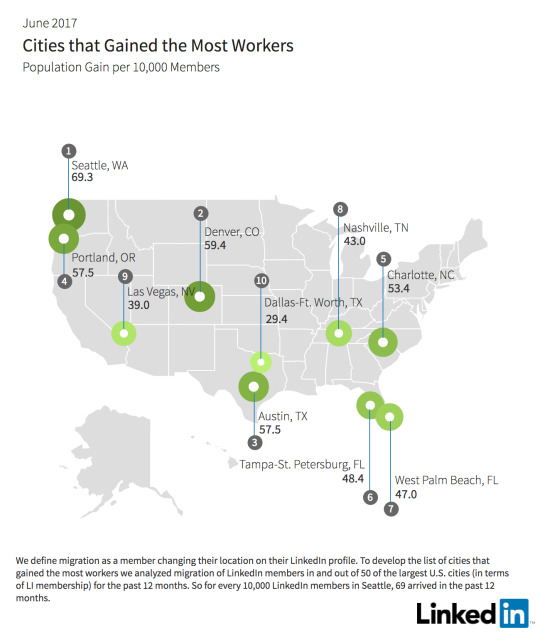
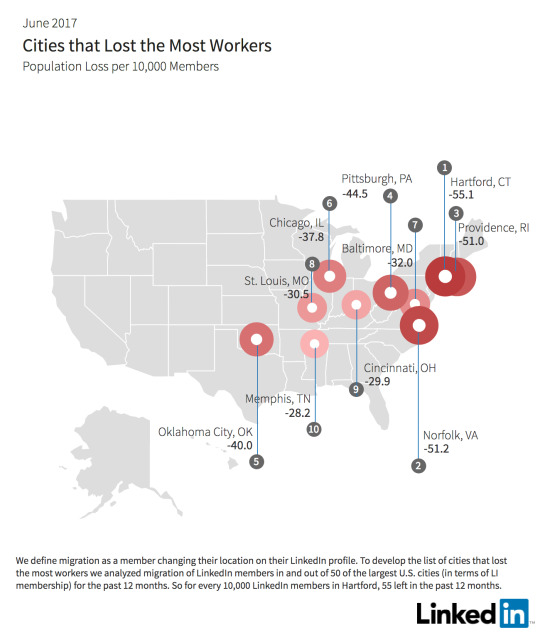
    The established trend of people moving from colder northern cities to warmer amenity-rich cities seem to play out here.

    That said, one of their “key insights” is that fewer workers today are moving to the San Francisco Bay Area. Since February 2017, there has been a 17% decline in the net number of workers.

    They blame housing affordability (ahem, lack of supply). People are simply turning to other great cities like Seattle, Portland, Denver, and Austin. They’re growing and cheaper.

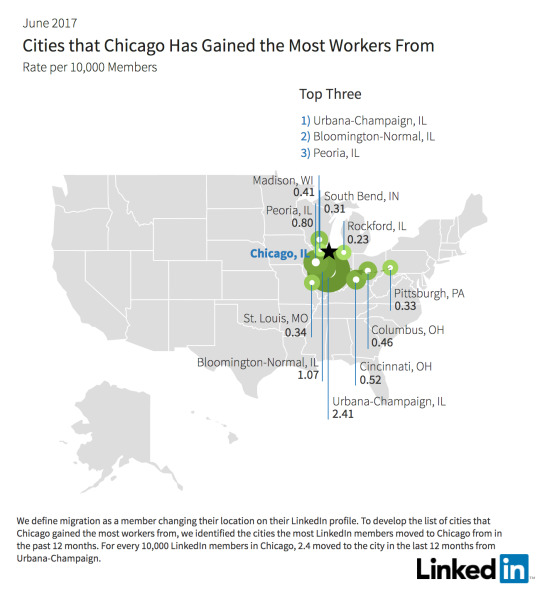
    One of the other cool things about the report is that you can drill down into individual cities to see where people are moving from. I looked up Miami and Chicago just to do a quick comparison. 
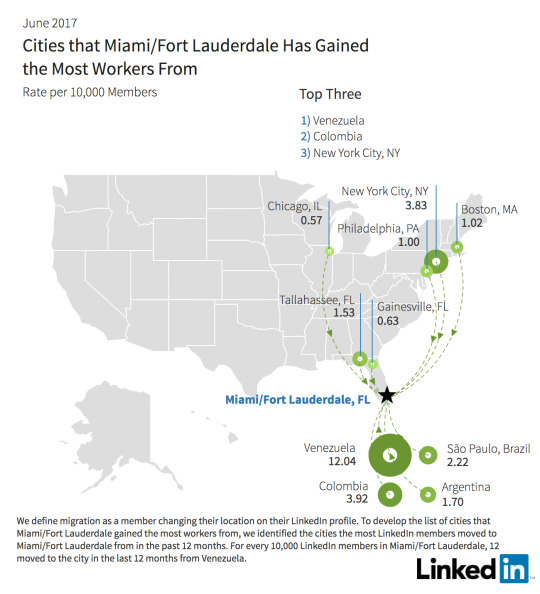
    Not surprisingly, Miami is seeing a significant contingent from South America. What’s interesting about this random comparison is how international Miami is and how regional Chicago is in terms of their draws.

    I would love to see similar data for Canada. This is valuable stuff.

  • Transit Flow

    This is a map of the Bay Area Rapid Transit network:

    And this is an elegant visualization by Ray Luong of ridership levels over the course of one day: February 4, 2016. If you can’t see the embedded video below, click here.

    [youtube https://www.youtube.com/watch?v=owGgbAS7Wq8?rel=0&w=560&h=315]

    Note how the lines speed up as they go through the Transbay Tube connecting San Francisco and Oakland. That’s actually what happens. Within the 10 km-long tube, the trains reach ~130 km/h, which is more than twice as fast as the average speed throughout the rest of the network.