Daily insights for city builders, delivered every morning at 6 AM ET. I’m Brandon Donnelly — a Toronto-based real estate developer and founder of Globizen. I’ve been writing here since 2013.

Tag: salt lake city

  • Q2 2021 rental market update for the Greater Toronto Area

    The Greater Toronto Area builds a lot more condominiums than purpose-built rental units. This isn’t the case everywhere though. I was recently reading an article about Salt Lake City and how developers there don’t want to build condominiums. It’s mostly rental housing. There’s simply too much risk and liability with condominiums. I guess this is one of the reasons why real estate is often said to be a local business.

    In any event, because of this dynamic in Toronto, condominium rentals are often used to measure the health of the overall rental market. There are simply more recent comparables to point to when you’re trying to figure out what is “market.” The Toronto Regional Real Estate Board recently published its Q2-2021 rental market report and here is what they found when it comes to condominium apartment rental transactions in the Greater Toronto Area:

    Q2-2021 – 14,920 transactions

    Q1-2021 – 13,168 transactions

    Q2-2020 – 7,300 transactions

    What this report tells us is that rental demand is returning. Transactions and rents are up compared to the first quarter of this year and certainly compared to Q2 of last year (2020), which was the low point of this pandemic. We are not yet back to where we were in Q1-2020 when the city was firing on all cylinders, but I have no doubt that we will get there and ultimately surpass those figures.

    For the full rental market report, click here.

    Photo by Narciso Arellano on Unsplash

  • Unicorns overwhelmingly originate in big cities

    In the world of startups, a unicorn is used to refer to a company with a market cap greater than $1 billion. A decacorn, the latest benchmark, is what it sounds like in that it’s a company with a market cap greater than $10 billion.

    While unicorn status is just one measure, valuations are an important yardstick for cities and countries. How many big new companies are you creating? That is a critical question because, presumably, these big new companies are going to create a bunch of new jobs and generate a lot of new wealth for people.

    This recent blog post by Elad Gil is a great summary of what’s happening in the world from this perspective. The raw data is also available if you’d like to dig deeper.

    Here are the number of new unicorns since October 2020 by city:

    Silicon Valley, not surprisingly, continues to dominate, followed by New York.

    Here is a breakdown for the United States as a whole:

    Miami and Austin have been in the news a lot over the past year and their startup scenes may very well be on the rise relative to other US cities. But it’s interesting to see other smaller cities on this list, like Salt Lake City, who are, at least right now, holding their own.

    I found this last set of two charts particularly interesting:

    They are showing unicorn count (first) and unicorn market cap (second) as a percentage of their respective countries. For example, Silicon Valley is sitting at about 47% and 51%, respectively. So about half of all unicorns in the US have originated from this geography.

    But for most other cities on this list, the percentage is much higher and, in many cases, it is 100%. (Silicon Valley is perhaps relatively low because the US has lots of other big and important cities.) For me, this shows the continued dominance of cities. If you’re building the next great unicorn or decacorn, the data tells us that you’re probably doing it in a big city somewhere. And I don’t see that changing anytime soon.

  • A modernist utopia at Summit Powder Mountain

    About 60 miles north of Salt Lake City is the largest ski resort in America, called Summit Powder Mountain. It’s some 10,000 acres. But beyond just being big, there is also a fascinating story and philosophy behind the mountain.

    It was started by four partners — Elliott Bisnow (of Bisnow events), Brett Leve, Jeff Rosenthal and Jeremy Schwartz — who partnered up with Learn Capital in 2013 to buy the mountain from a distressed seller for $40 million.

    The four guys were already running a successful invitation-only event series for entrepreneurs and creative types called the Summit Series, and big part of their vision for the mountain was to recreate this same ethos.

    The idea was to create a community focused on relationship-building, entrepreneurship, innovation, environmental sustainability, and good design. Put differently: a kind of utopia for rich people.

    So far, about 80% of the home buyers at Summit Powder Mountain are members of the Summit Series.

    All of this has translated into some pretty cool mountain architecture (see above). In fact, people who buy vacant lots within the community are effectively banned from building the kind of faux chalet stuff that permeates a lot of (or most?) mountain towns.

    Here is a taste of some of the homes that have already been built.

    Image: Paul Bundy for the Wall Street Journal

  • US cities with the highest millennial homeownership rates

    Across the 50 largest metro areas in the US, about 31.9% of millennials — those aged 18 to 34 — owned a home as of 2017. And according to recent census data (via the Redfin), only 5 of these cities had a millennial homeownership rate higher than 35%. They are as follows:

    The top spot goes to Salt Lake City, which sits at just over 40%. It also has the highest share of businesses owned by millennials at 8.4%. Not surprisingly, the cities on this list all have relatively affordable home prices, with Detroit being the most affordable.

    I think you could interpret this list as a bit of a leading indicator for US cities on the rise. Affordability, and walkability, may be the draws today, but as millennials lay down roots, start businesses and earn more money, I am sure we’ll see these cities transform even further.

  • U.S. street grids compared

    I like this comparison of street grids that Daniel Nairn prepared back in 2010:

    There’s huge variation here. On the one end you have cities like Carson City, Portland, and Providence, which have small blocks (180′ x 180′ and 200′ x 200′). And on the other end you have cities like Salt Lake City, which have massive blocks (660′ x 660′). 

    This variation creates very different experiences for both pedestrians and drivers. It is widely understood that small blocks are better for walking, which is perhaps why Salt Lake City is known as a driving city. (I just learned that they have “crosswalk flags” to help pedestrians safely cross the street. What does that tell you?)

    In the case of New York – with its irregular rectangular blocks – it is arguably one of the reasons why the avenues (short side of the rectangle) have such a different feel than the streets (long side of the rectangle). Walking north-south is more enjoyable than walking east-west.

    All of this is even more interesting in the context of the point I made in this post: once these urban grids get laid out, they’re pretty sticky. That has far reaching implications.

  • The rise of tech outposts

    What happens when wages and real estate prices become too high in a city? Companies start growing in lower cost locations. We’ve all seen this before. 

    Fred Wilson recently blogged about this “spillover effect”, citing a New York Times article talking about the growth of tech offices in Phoenix. As someone who sits on the board of many technology companies, he was noticing a thematic trend:

    “A big theme of board meetings I’ve been in over the past year is the crazy high cost of talent in the big tech centers (SF, NYC, LA, Boston, Seattle) and the need to grow headcount in lower cost locations.”

    We talk a lot about housing prices on this blog, and so I think it’s useful to see how this, along with high wages, also impacts companies. The two are interrelated.

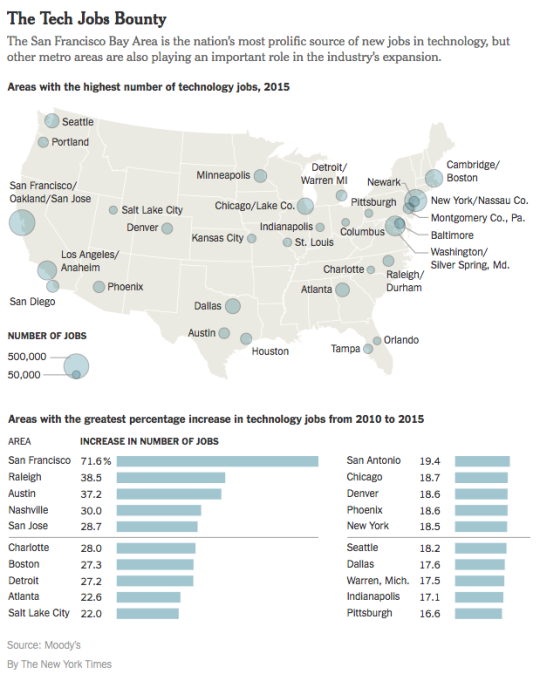
    Below is a chart from the NY Times article showing the US cities with the highest number of technology jobs and the most growth from 2010 to 2015. 

    San Francisco is in a league of its own. But overall, the growth is in tech and many cities are adding lots of technology jobs. Look at Detroit and Boston right beside each other (Detroit obviously has a smaller starting base). And look at how Miami is nowhere to be found.

    Of course, one interesting question is whether these new outposts – such as Phoenix – can truly come into their own and carve out a niche:

    “We don’t want to be San Francisco’s back office — we need more creators here,” said Scott Salkin, a founder and the chief executive of Allbound, which is based in Phoenix, makes sales software and has offices down the hall from Gainsight’s.

    Even with the high cost of living, it’s hard to supplant the coastal hegemony. That’s where people go to chase riches. As comedian Daniel Tosh likes to say, “the middle of the country is for people who gave up on their dreams.”

    Though for some, living in a place like Denver or Salt Lake City and snowboarding every weekend is a better outcome than living in a studio apartment and commuting an hour to work.

  • Weird as a competitive advantage

    image

    Joe Cortright of City Observatory recently reposted an article that he wrote back in 2010 called, Keeping it Weird: The Secret to Portland’s Economic Success.

    In it he talks about a “weirdness index” that he developed for CEOs for Cities that measured and ranked 50 American cities across 60 different behavioural indicators. San Francisco and Salt Lake City come out as the weirdest, and Portland ranked 11th out of 50. The most “normal” part of the US was the Midwest. Normal meaning behaviours that are most similar to the national average.

    He then goes on to talk about weird as a competitive advantage. Here are a few snippets:

    When it comes to economic success in today’s economy, the key is to differentiate yourself from your competitors. Harvard Business School’s Michael Porter counsels businesses that “competitive strategy is about being different.” And the late, great urbanist Jane Jacobs told us, “The greatest asset that a city can have is something that’s different from every other place.”


    True entrepreneurship is about deviant behavior: starting a business that makes a product that no one else has thought of or thinks there’s a market for. Entrepreneurs and open-minded, experimental customers go hand-in-hand.


    We shouldn’t do things just to be different, but we should never be dissuaded from trying something simply because it is different or would make us different from other places.

    What this all comes down to is the simple fact that what is weird today, might very well become the norm tomorrow. But you need to be open enough to allow that to happen if you want to be the place that generates those news ideas.

    Could you have imagined that selfies would become as ubiquitous as they have? That would have been pretty hard to predict. It used to be the case that people were afraid to use their real name on the internet. Now we share our entire life online, including our faces.

    Image: Flickr