Daily insights for city builders, delivered every morning at 6 AM ET. I’m Brandon Donnelly — a Toronto-based real estate developer and founder of Globizen. I’ve been writing here since 2013.

Tag: safety

  • Montréal is making yet another case for pedestrian-only streets

    There are parts of Toronto that are pedestrian only. There’s the Distillery District, some small laneways in Yorkville, the Toronto Islands (though this is a bit of a unique situation), and various other pockets around the city.

    There are also streets that we temporarily open up to only pedestrians, such as Market Street and King Street, and areas, such as Kensington Market, that we have been rigorously considering pedestrianizing for as long as I can remember.

    What is clear is that pedestrian-only streets are controversial. Motorists fear that it will make driving in the city even more inconvenient. And businesses fear that it will limit their customer base.

    While it is true that not all streets can and should be pedestrianized, there are countless examples of streets and areas that appear to be thriving because of it.

    Take, for example, Montréal.

    Since 2021, the city has been pedestrianizing a stretch of 30 blocks along Mont-Royal Avenue during the summer months. And according to Mayor Valérie Plante, the commercial vacancy rate for the street has dropped from 14.5% in 2018 to 5.6% in 2023:

    Maybe you don’t want to infer causality here, but at the very least, it seems to suggest that the street isn’t dying and bereft of human activity. This year, pedestrianization is also planned to be extended further into the fall.

    This won’t necessarily be the outcome for all streets, but I do agree with this recent Globe and Mail article that, oftentimes, the reasons for not pedestrianizing are “a question of philosophy, not geography.” Because there’s lots of research and data to support doing this.

    If any of you are business owners along Mont-Royal, I’d love to hear about your experiences and how you think, for better or for worse, it has changed the area. Leave a comment below or drop me a line.

  • Anxious urbanism

    One of the first things that I noticed when I visited Rio de Janeiro a few years ago was the clear fixation on safety and security. There are gates and cameras everywhere. And the guidance you tend to receive from the locals usually resolves around how to stay safe. Don’t wander around at night. Be careful when you take out your phone. Be mindful of certain areas. You know, those sorts of things.

    Of course, you never really know how dangerous a city is because it’s one of those things that’s impractical to test. You’re not going to wander around dark places just to see what the probability of being robbed is. The more sensible thing to do is simply believe what people are telling you and you observe the cues scattered around the built environment.

    The result is a general sense of anxiety. You’re not quite sure if all the gates and cameras are truly necessary, but their mere presence makes you believe that they might be. I mean, why else would they be so pervasive? Or, could it be that people are overshooting with their investments in safety and security because, well, fear and paranoia are strong motivators?

    I was reminded of all of this as I read through Ed Chartlon’s recent book review of, Panic City: Crime and Fear Industries in Johannesburg. The title of his review is Anxious Urbanisms, and I think that’s a good way of describing some of these phenomenons. It’s an urbanism of uncertainty. I haven’t read the book (yet), but it’s an interesting topic.

    So I will leave you all with this excerpt from the review:

    Ultimately, what we might take from Panic City, then, is less a comprehensive sociology of crime in the city and more a method of affective analysis. What the book provides is a sense of the ways in which the emotional sphere organises space, how feelings like anxiety or fear or panic, currently widely distributed across the world, materialise themselves, architecturally and politically. If immunity is anything like security, Murray offers us a cautionary tale. For wherever uncertainty thrives, so does the tendency towards paranoid thinking—which is to say, a contagion of a different sort, one that licences regimes of suspicion, self-protection and individual security, and all at the eventual cost of collective wellbeing and interdependence. 

  • Safety and security per capita

    This is a city metric I haven’t seen before. City Observatory recently looked at the number of police officers (public) and security guards (private) per capita across American cities. They also ask a bunch of interesting questions. Why do some cities have far fewer police officers? Is high security an indicator for “anti-social capital?” (Social norms aren’t encouraging people to behave.) And do some cities simply have more cops because it is perceived to be necessary?

    Here is what they found:

    The average is about 3.3 police officers per 1,000. And in each case, city is defined as the metro area. The study relies on census data and, if we’re being precise, the data represents where people live as opposed to where they work. So some cities could be reporting a lower number simply because police officers tend to live outside of the metro area — perhaps because of housing costs. Either way, it’s interesting to consider why some cities spend a lot more on security than others and why Miami has so many security guards.

    Chart: City Observatory

  • The construction hard hat turns 100

    I learned today that the hard hat will celebrate its 100th anniversary this year.

    Patented in 1919, the hard hat was invented by a man named Edward W. Bullard (though his father had already been making protective leather caps for the mining industry). Edward had just returned to the United States after World War I and he began to wonder why construction workers weren’t wearing helmets like the one he had been wearing overseas. So he decided to make one.

    Edward’s first product was called the Hard Boiled Hat, and it was made out of steamed canvas and leather. Similar to today, an early version of the hat featured a “suspension system,” which created an air cavity between head and helmet and cushioned any blows to the head. This overarching design approach hasn’t really changed all that much over the years, but Bullard’s hats did go from canvas to aluminum (1938) and then to plastic (1950). Plastic is, of course, cheaper to produce.

    Supposedly, the first designated “Hard Hat Area” in the US was the Golden Gate Bridge site, which started construction in 1933. This should give you a sense of the hard hat’s adoption curve. It seemingly took well over a decade for construction sites to start mandating their usage, and even then it doesn’t appear to have been ubiquitous.

    The company — which was founded in 1898 in San Francisco — is now in its fifth generation of family ownership, according to the New York Times.

    Photo by Guilherme Cunha on Unsplash

  • Oi Rio

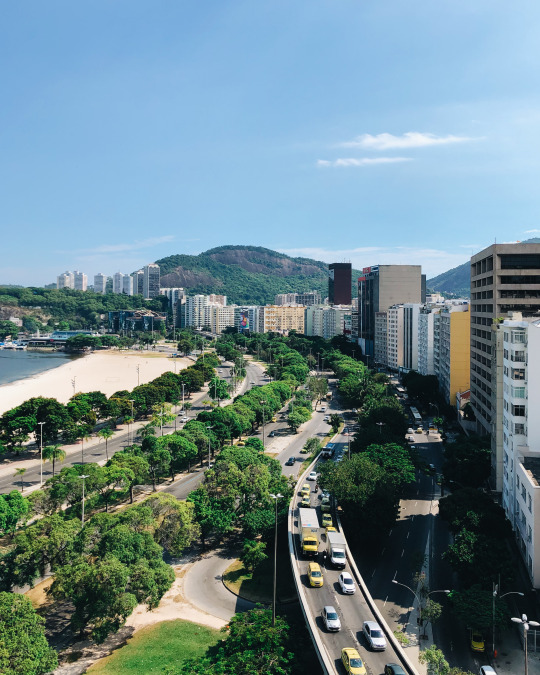
    I just arrived in Rio de Janeiro, which is where I’ll be for the next ten days. Here is a photo looking south from the rooftop of our hotel (more photos to follow on Instagram):

    image

    Today was a fairly relaxed day after many hours of travel. But tomorrow the architecture and design tour begins. 

    I am still trying to get a feel for the city. The first thing people tell you after you arrive is to be careful. Don’t go out at night. And take Ubers. 

    Uber is a significant advantage in a place like Rio where few people seem to speak English and you may be concerned about somebody taking you for a ride.

    Not only was the Uber from GIG about R$80 less expensive than a taxi (I was probably quoted the gringo rate), but you also get perfect information in terms of where you are going.

    This emphasis on safety and security is, of course, highly evident as you walk around the city. Lots of gates and lots of cameras.

    It’s perhaps a bit ironic to see so many places sealed off from the outside when you consider how great the climate is and how friendly the people are.