Daily insights for city builders, delivered every morning at 6 AM ET. I’m Brandon Donnelly — a Toronto-based real estate developer and founder of Globizen. I’ve been writing here since 2013.

Tag: ryerson university

  • Ground-related housing vs. apartment permits across the Greater Golden Horseshoe

    Here are two charts from a recent blog post by Ryerson University’s Centre for Urban Research and Land Development. The charts compare residential building permits issued for ground-related housing vs. apartment suites.

    Over the last two quarters (Q4 2020 and Q1 2021), the Greater Golden Horseshoe (GGH) issued a record (all-time record?) number of permits: 39,734 housing units. This represents a 56% year-over-year increase.

    The biggest contributor to this increase is, not surprisingly, apartment units. These permits saw a 73.6% year-over-year increase. There’s simply no other way to deliver this amount of new housing — at least in the context of the GGH. You have to go up.

    But given the price increases that we have seen across the region for ground-related housing, Ryerson’s CUR concludes that there must be a strong home buyer preference that is simply not being met by the amount of low-rise supply we are delivering.

    Notwithstanding this potential mismatch, I don’t see things changing anytime soon.

  • Intraprovincial migration across the Greater Toronto Area

    This is a chart from a recent blog post by Ryerson University’s Centre for Urban Research and Land Development. It shows net intraprovincial migration across the regions of the Greater Toronto Area. And what you are seeing here is people moving from expensive and built-up areas like the City of Toronto and the Region of Peel to lower cost areas further outside of the city.

    This is interesting for a couple of reasons. One, it’s very much a natural market outcome. Many people tend to “vote with their feet” and look for greater housing affordability. And two, this is a trend that existed prior to COVID-19. It is not the death of cities. In the words of Ryerson’s CUR, it’s about people looking for more affordable lower-density housing.

    But to what extent is “lower density” the key deciding factor? In other words, how much of this is consumer preference and how much of this is people being forced out by a lack of infill housing supply?

  • Ride hailing in Toronto

    Earlier this year, the University of Toronto Transportation Research Institute (UTTRI) published this report on the impacts of ride hailing services in the City of Toronto.

    And then today, the Ryerson City Building Institute leveraged it to opine on how “on-demand tech” might improve transit going forward. That’s how I discovered it.

    What is clear from the report is that ride-hailing services — which they refer to as Private Transportation Companies (PTC) — are driven by two dominant use cases: 1) going out at night and 2) commuting to and from work.

    Friday and Saturday nights are by far the busiest periods for PTC travel, with the peak usually happening around midnight on Sunday morning. About 13,100 trips per hour, mostly concentrated in the core.

    Overall, it is estimated that Toronto does about 176,000 daily PTC trips (as of March 2019). That places it behind New York and Chicago in terms of the size of the market. But Toronto also didn’t complete its first PTC until 2014. Here’s a comparison chart:

    Another diagram that I found interesting was the proportion of shared ride trips by neighborhood. It shows that much of the inner suburbs are hailing shared rides — sometimes as high as 45% of all trips. This is interesting because it is people effectively gaming the system.

    Because the population densities are lower in the suburbs than in the core, you’re a lot less likely to get paired with other riders when you select that option. So what tends to happen is that you end up getting a private ride for the price of shared ride. I know I’ve played the odds before.

    If you’d like to download a full copy of the report, click here.

  • Toronto’s great streets

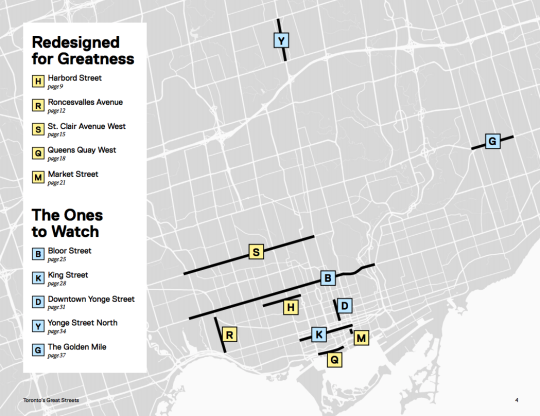
    Last week the Ryerson City Building Institute published a terrific report on Toronto’s Great Streets. It profiles five streets in the city that have been “redesigned for greatness.” They are:

    • Harbord Street (continuous bike lanes)
    • Roncesvalles Avenue (placemaking and people)
    • St. Clair Avenue West (dedicated streetcar lane)
    • Queens Quay West (public waterfront promenade)
    • Market Street (prioritized for people and patios)

    But what exactly makes a street a great one? The report describes it in this way: “They all play a key role in making the surrounding neighborhood a great place to live, work, and visit.”

    This relates closely to what the City of Toronto calls a “complete street”, which is an approach to accommodating multiple kinds of users, enhancing the local context, and determining which trade-offs to make.

    And there will always be trade-offs. I am fairly certain that all of these street redesigns were contentious at the time when they were proposed. Because at the end of the day they will never be all things to everyone.

    I remember the St. Clair West fight vividly because I moved to the neighborhood in 2009 and the dedicated streetcar lane didn’t fully open until 2010. From 2005 to 2017, streetcar ridership grew 23%. But drivers have remained grouchy.

    I now walk Market Street every single day and I agree that it’s one of the most beautiful and functional streets in the city. But the bollards are constantly getting beat up by drivers attempting to parallel park and the retail vacancy rate has not been 0% like is suggested in the report.

    Queens Quay West is also a magnificent street. It was a giant step forward in terms of the quality of the public realm in this region and I spend a lot of time there. But it’s of course not perfect. All of us have seen the reports of cars ending up in odd locations, including underground, along the waterfront.

    Riding your bike there can also feel like a challenging game of Frogger with all of the pedestrians that now obliviously meander back and forth across the cycling trail. I suggest riding with a good blow horn. The report rightly mentions the lack of delineation between these users.

    But cities are a living laboratory and none of these streets should now be considered static. We are fortunate to be in a position to critique levels of greatness. If anything, the map at the top of this post tells me that we need to create more greatness across the other areas of this city.

  • Revisiting road pricing

    Following the Toronto Transit Commission’s approval of a 10-cent fare hike, Cherise Burda of the Ryerson City Building Institute penned an article titled: It’s time for Toronto to consider road tolls.

    I am a big supporter of road pricing and I have written a lot on this topic over the years. There’s even a guest post by Darren Davis on this blog – he is a transport planner with Auckland Transport. 

    I don’t have much to add right now, but I did want to help promote Cherise’s post and I did want to link back to all of my previous posts (including Darren’s). Click here for a list of posts tagged with “road pricing.”

    There’s a mental model in Toronto, and many other cities, that remains centered around subsidized roads and artificially low residential property taxes. Because, well, that’s the dream.

    Nobody wants to pay more for anything – I get it. But I think we can all agree that this region has not solved the traffic/mobility problem. In fact, it’s one of our biggest weaknesses. 

    So what are we going to do about it? I reckon the answer is something other than the status quo.

  • School of Real Estate

    I’ve been getting a lot of (email) questions lately about what to study in order to become a real estate developer. So I thought I would reblog this post that talks about exactly that. I wrote it over a year ago and I almost forgot it existed.

    At the same time, I’m reminded of something: I think these questions really speak to the fact that there’s a significant opportunity (particularly in Canada) in terms of real estate development education. 

    Oftentimes when I get these questions, I end up recommending the Master of Science in Real Estate Development (MSRED) at ColumbiaMIT, and USC. Why don’t we have something similar (and better) in Canada? We are falling behind.

    I have raised this with some Universities here in Toronto, but the response I got was that they felt the real estate courses being offered as part of their existing MBA programs were more than sufficient. I think we can do a lot better.

    One professor suggested that I line up a big donor and work with them to spearhead the creation of the (Insert Donor Name Here) School of Real Estate. I think that’s a great idea, but not something I have the capacity for right now.

    Hopefully somebody else out there is of the same mind.

    Post Update: 3 days ago the Schulich School of Business (York University) announced a one-year full time Master of Real Estate and Infrastructure (MREI) program – the first of its kind in Canada. 

    This is great news. 

    Now I would love to see the University of Toronto and Ryerson University (as well as others) step up and leverage their respective architecture schools. Schulich is already out of the gate on this one.

  • The year of the laneway

    Earlier this week, Metro News published an article saying that it’s going to be a big year for laneways in Toronto:

    “2016 is going to be the year where the evolution of our laneways lands at the forefront of our public realm strategy,” said Downtown Yonge BIA chair Mark Garner, who’s heading up the revitalization of O’Keefe Lane near Ryerson University.

    In addition to the Downtown Yonge BIA, much of this is being spearheaded by the non-profit group, The Laneway Project. This year they are expected to unveil plans for the revitalization of 3 laneways in the city – one of which is right in my backyard.

    I have a lot of respect for what The Laneway Project, the Downtown Yonge BIA, and others are doing in support of rethinking our laneways. And so today I just wanted to publicly thank them for their efforts. Thank you 🙂

  • #DensityCreep

    The Toronto Star published an article today called: Midtowners battle the rise of the midrise. It’s about a group called The Density Creep Neighborhood Alliance, which was formed in order to fight a 4 storey stacked townhouse project that is currently going through the rezoning process.

    Here’s a snippet from the article:

    “I’m really concerned about my property value going down,” says Lisa Goodwin, 49, a stay-at-home mother of two who has lived in a four-bedroom dwelling on Keewatin Ave. for 19 years. “Right now all the houses are $1.1 to, say, $2.2 (million) but they’re looking at putting in places that are only $500,000.”

    Not surprisingly, social media took hold of this and #DensityCreep quickly started trending on Twitter. BuzzFeed ran a piece called, Toronto Real Estate Is So Preposterous People Are Protesting Condos That “Only” Cost $500K. And somebody even bought densitycreep.com (their site is .ca) and redirected it to NIMBY on Wikipedia.

    There’s so much I could say about this. But you all already know what I’m thinking. So I’ll end with this quote from the article:

    “The simple fact of the matter is that the creation of a more sustainable, equitable, and affordable city requires the development of midrise and other more dense housing options along major roads, subways, and streetcar lines in already built up areas,” says Christopher De Sousa, director of the School of Urban Planning and Regional Planning at Ryerson University.

    We have work to do.

  • When the crowd builds a city

    I’ve been following and checking out Kickstarter pretty much since the beginning. But it wasn’t until last night that I backed my first project. 

    After doing that, I immediately started thinking about urban projects that might be able to also get crowdfunded using Kickstarter. How could it be used for city building? A Kickstarter project, after all, just has to be something with a defined scope and a clear end goal.

    Not surprisingly, this has already been happening for many years now.

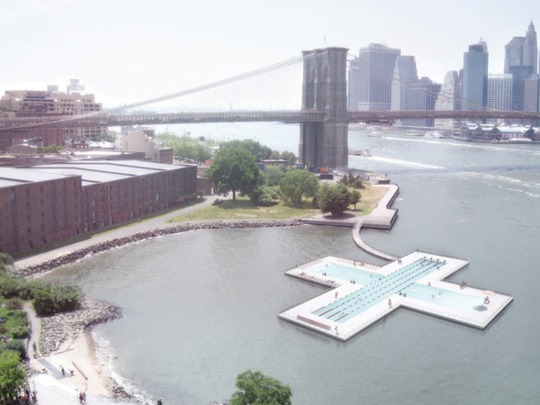
    A great example is +Pool in New York, which is an initiative to build a publicly accessible floating pool that also filters river water. The project launched in June 2011 and by July 2011 they had raised $41,648 USD to build and test different filtration techniques.
    image

    Today, the project is still moving ahead and they are now offering up the opportunity to buy and have your name engraved on tiles within the pool. If I lived in New York, I would be all over this.

    But what’s powerful here is the ability for crowd-based platforms (like Kickstarter) to both get radical new ideas off the ground and to empower local communities to affect change. Here’s a quote from PSFK:

    It’s very difficult to get funding for these ‘out there’ ideas that regular systems might not support. Creators have to take risks and be imaginative, as well as put their ideas out there and let the public decide. There are no traditional guidelines on crowd-sourced platforms—they’re much more meritocratic. You can think in big scope and that changes what gets made and who can access it. Anybody with a couple of doubles can voice what they want to be built, and in that way we see the entire community having a huge say in the design world.

    And when I see projects and platforms like this, I can’t help but wonder if (when) city building is going to become even more decentralized. 

    Last night I was also at an event – being put on by Ryerson University’s City Building Institute – called Bridging Divides: What Can Cities Do? And one of the suggestions that came up was that Toronto needs more local and granular community councils (there are currently 4) in order to bridge some of the divides that are happening in our city.

    But in a world where it’s possible for each and every person in a city to not only have a say but to quickly say it from their smartphones, why can’t we go even more local? Instead of 4, 10, or 90 community councils, why can’t we have everyone more engaged?

    I think we’re headed in that direction.

  • A new vision of Yonge Street

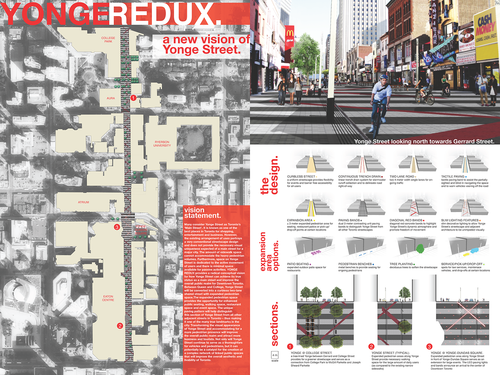
    Back in April I wrote about a competition for young people to reimagine public space in Toronto. It was called NXT City. Well that prize has been awarded and the winner was Richard Valenzona for his vision–called Yonge-Redux–of a new and reimagined Yonge Street. To download the PDF of his entry (the image shown above), click here.

    The proposal encompasses a stretch of Yonge Street that runs from Queen Street in the south, to College Street in the north. It would capture the Toronto Eaton Centre (mall), Yonge-Dundas Square, Ryerson University’s expanded Yonge Street footprint, and the massive mixed-use developments happening in the College Park area (see Aura Tower). To quickly simplify, the proposal is essentially about enhancing the urban experience, prioritizing pedestrians, and reducing the flow of cars to two lanes.

    Overall, I think it’s a wonderful proposal and I’m not surprised it won NXT City. This type of intervention is on so many of our minds. In fact, it’s somewhat surprising that we’ve been as slow as we have to improve our main street. There are so many anchor institutions, such as the Eaton Centre and Ryerson University, that plug into this section of Yonge Street. It makes a lot of sense.

    But as I said in my original post, one of the most exciting things about the NXT City Prize is that it has always been about execution. This is not just an academic exercise–or at least that’s the hope. This exercise is about spurring real change in the city and I genuinely hope that they’re successful in doing so. Because then I can turn around and say: Take that Melbourne 🙂

    Kudos to Richard Valenzona, Mackenzie Keast, as well as everyone else involved in NXT City, for making this initiative a reality and for doing your part to make Toronto even more awesome.