Daily insights for city builders, delivered every morning at 6 AM ET. I’m Brandon Donnelly — a Toronto-based real estate developer and founder of Globizen. I’ve been writing here since 2013.

Tag: rust belt

  • The biggest challenge in revitalizing the Rust Belt

    image

    Jason Segedy, who is the Director of Planning and Urban Development for the city of Akron, Ohio, recently penned a two-part series in the American Conservative about urban revitalization in the Rust Belt. Part two is specifically about the importance of new housing in “cities left for dead.”

    As I was reading through the piece, my first thought was that it would be a good follow-up to yesterday’s post on “winner-take-all-urbanism.” The contrast between alpha cities like San Francisco and Rust Belt cities like Akron is stark.

    The former city can’t build housing fast enough. And the latter city was forced to implement a citywide, 15 year, 100% residential property tax abatement program just to induce new investment. Any and all new housing is eligible.

    But as I got further down the article, I was struck by something else. I was surprised to hear Segedy say that, rather than market forces, community opposition is “perhaps the biggest challenge of all” when it comes to delivering new housing in these markets.

    Here is a longish excerpt that I would encourage you to read:

    Although you might think that people living in neighborhoods with a large number of abandoned houses and vacant lots would be thrilled to see new houses being built, you might be surprised to learn how often this is not the case. Sometimes neighbors prefer to have the vacant lot remain as green space. Sometimes they worry that the new housing will not be expensive enough, and will bring their property values down. Other times, they worry that the new housing will be too expensive, and will bring their property values (and taxes) up.

    When it comes to new housing, everyone is a critic. I have heard people complain that housing which they will never live in is too dense; that housing which they will never purchase is too expensive; that housing which they will never be inconvenienced by will generate too much traffic; and that housing which they will never look at is not architecturally appealing.

    After 23 years as an urban planner, I can honestly report to you that, contrary to popular belief, most people are strongly in favor of heavy-handed and draconian government regulation of private property—as long as it is someone else’s private property, and not their own.

    Residents and community activists who are opposed to new housing often demonize the real estate development profession as being “greedy”, overlooking the fact that their own home was developed by a developer, built by a builder, and sold by a realtor—most likely for a profit. This isn’t to argue that every development professional is a white knight, but it is important to remember that the vast majority of people who work in the real estate and construction sectors are not the enemy of neighborhoods. Without them, there would be no neighborhoods.

    According to Segedy, Akron has lost 32% of its peak population. Cleveland has lost 58%. And Detroit has lost 64%, leaving almost 1/3 of its land parcels vacant. (These are 2017 figures.) Surprisingly, this doesn’t appear to change how many people feel about new development. 

    No more new housing. We’re full. Unless, of course, that housing is for me.

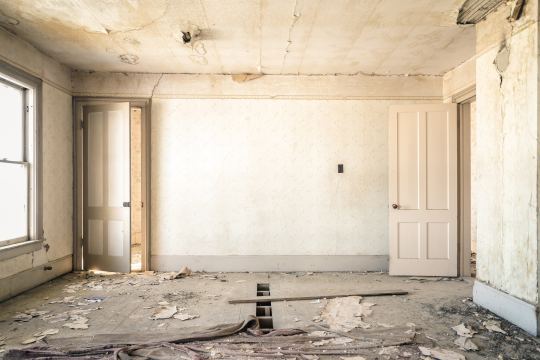
    Photo by Nolan Issac on Unsplash

  • Hypervacancy in America’s legacy cities

    I was reading Aaron Renn’s post this morning on America’s vacant housing challenge and I was reminded of the stark contrast between what we are experiencing here in Toronto and what the US is experiencing in a lot of its coastal cities, compared to what is happening in many legacy cities in the US. The former industrial centers. In this latter case, the discussion is around neighborhoods reaching a tipping point in terms of vacant homes and then spiralling out of control. Below is an excerpt from a study that Renn cites in his post. It is from the Lincoln Institute of Land Policy and it’s called “The Empty House Next Door.” The above chart should also tell you a lot about the magnitude of this problem.

    Hypervacancy has been rising steadily in legacy cities since the 1990s. Although only one out of sixteen census tracts in Cleveland was hypervacant in 1990, by 2010, one out of two tracts in that city had reached hypervacancy. When vacancies rise above approximately 20 percent of an area’s total properties, the number of vacant buildings and lots may continue to grow indefinitely. Although vacancies rarely reach 100 percent—because even the most distressed neighbor- hood may have a few long-term owners—the market effectively ceases to function. Houses sell, if they sell at all, only to investors at rock bottom prices while the neighborhoods become areas of concentrated poverty, unemployment, and health problems.

  • Two thoughts on reviving post-industrial cities

    image

    Yesterday Adam Radwanski of the Globe and Mail published an interesting article called, Rust Belt revival: Lessons for southwest Ontario from America’s industrial heartland

    The article talks about some of the things that the Rust Belt is doing to revitalize their cities and the lessons that many cities in Ontario – which are facing similar fates – could learn from. It’s worth a read.

    I’m not going to summarize his article, other than to say that some of the key points were around tax increment financing, tax incentives, University connections, a DIY/entrepreneurial culture, and the American tradition of philanthropy – which Radwanski points out is probably the least imitable for Canada.

    And it’s this last point that I would like to focus on first. The US has a deep history of people getting rich and then giving back – certainly more so than in Canada in my opinion.

    If you think about the resurgence of cities such as Detroit, you’d be hard pressed not to think of people like Dan Gilbert. He has become the poster boy for Detroit’s resurgence by moving his companies to downtown and buying up most of the office buildings. If and when Detroit comes back (I think it’s a when), Gilbert will easily be one of the biggest beneficiaries.

    Now, you could argue that this is made possible because of greater income inequality, but there’s something to be said about powerful individuals acting on intrinsic passion. Gilbert is investing in Detroit because he personally wants to see his home city come back. And that’s hard to replace.

    The second point I would like to focus on has to do with this snippet:

    With oil’s current slide, Canada really can’t afford for it to remain a drag – and in fact there is some expectation that Ontario will instead reclaim its old role as the leader of Canada’s economic growth. Its premier, Kathleen Wynne, recently expressed optimism that plummeting oil prices and a sinking dollar will prove a boon to manufacturing. “I don’t wish for low oil prices and a low dollar for Alberta,” she said earlier this month. “But at the same time, we want our manufacturing sector to rebound. So if that [low oil price] helps, then that’s a good thing.”

    I don’t know what context this was said in, but I continue to feel strongly that we cannot rely on low oil prices and a low Canadian dollar for Ontario’s competitiveness. That is a terrible business model, and an unsustainable one. We need to figure out ways to create value and grow the economy without relying on currency differentials and other macroeconomic factors. Radwanski is right to point that out in his article.

    So let’s hope we don’t let any short term benefits go to our head. There’s lots of exciting work to be done.

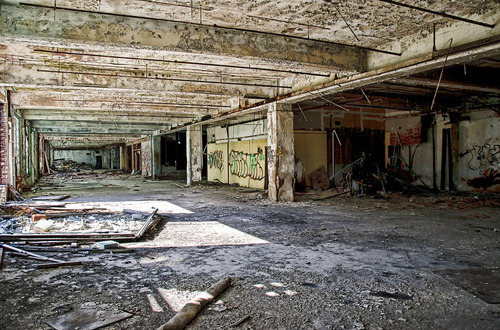
    Image: Old Detroit auto factory via Flickr