
Daily insights for city builders, delivered every morning at 6 AM ET. I’m Brandon Donnelly — a Toronto-based real estate developer and founder of Globizen. I’ve been writing here since 2013.

Tag: robotaxi

  • I’d actually like a Tesla bicycle

    I watched Tesla’s We, Robot event last night. As many of you know, Elon and his team showcased a Cybercab, Robovan, and a humanoid robot that dances funny, all of which will be available in the market for purchase at some unknowable date in the future. What was obvious is that Elon himself has no clear idea of when this will be.

    What I will say, though, is that the designs look cool. The Cybercab looks like a Porsche and a Cybertruck had a love child, and the Robovan looks like an Art Deco rendition of what the future is supposed to be like. I first wondered why they’d create a robotaxi with only two seats. But thinking about it now, most Uber rides probably only have 1-2 passengers.

    Despite these pretty designs, the overwhelming reaction to the event seems to be one of disappointment. We’ve heard what was said before. Public transportation is bad (I disagree). Autonomy will free up your time and remove unnecessary parking spaces from our cities (allowing for more public space). And soon you’ll be able to put your under-utilized car to work and earn extra cash.

    Cool, but when?

    Waymo and Uber are not, as far as I know, hosting similarly flashy events. But as far as I can tell, they’re making meaningful progress in advancing toward full autonomy. As of June of this year, Waymo had already logged over 22 million rider-only miles. And in September, they announced a partnership that would bring AVs to Austin and Atlanta by way of the Uber app.

    At this point in the hype cycle, I don’t think anyone is interested in hearing promises about what the future of autonomy will be like, especially without any firm dates. They want to know: Are we there yet? So I think it’s no surprise that people, including investors, weren’t all that pumped up by the event.

    On a more important note, Tesla had bicycles with brightly illuminated wheels circulating around their event set (at Warner Bros.) to presumably demonstrate that their Cybercabs can successfully navigate around moving objects (when brightly illuminated). If you missed them, look at the 29 second mark in the below video:

    I can’t be the only one who thought: “What are those? Now, that’s what I want!” So I’ve asked Elon when they’ll be available and when I can buy one. I’ll keep you all posted on his response.
  • Waymo’s robotaxis now make 50,000 paid trips every week

    A few days ago, Waymo announced (on X) that its robotaxis are now doing more than 50,000 paid trips every week across Phoenix, San Francisco, and Los Angeles.

    This means that the company is getting an average of 300 bookings every hour or five bookings every minute. And if you add in Austin, where it’s currently offering a limited number of rides, the company has completed a total of over one million rider-only trips.

    In the announcement, Waymo also went on to say that “fully autonomous ride-hailing is a reality and a preferred mobility option for people navigating their cities every day.” All of this is something.

    But perhaps the most important takeaway, right now, is that the company continues to claim — by way of a study from Swiss Re — that its robotaxis are already significantly safer than human-driven vehicles.

    I don’t personally know if this is true, but it’s not hard to believe. I mean, human drivers suck. And assuming it is true, we should all want more robotaxis on the road, because statistically, we would be significantly safer.

    The problem, though, is that autonomous vehicles suffer from a perception bias. We’re all looking for them to fail. If a robotaxi gets into an accident, it’s news. But if a human driver gets into an accident, it’s standard operating procedure. It’ll be interesting to see how and when this flips.

  • Cruise expands autonomous taxi service in San Francisco

    Cruise, which I wrote about earlier this year, has just announced that its autonomous taxi service will soon be available to the general public 24 hours a day, across all of San Francisco. Initially the service was only available between 11PM and 5AM (when traffic volumes are lower), and in certain parts of the city. It was also free to use. In total, the company now has about 300 AVs operating across San Francisco, Austin, and Phoenix. And it has been charging for rides since June of this year.

    If you’re curious about what it’s like to ride in one of these, check out the above video.

  • Current state of autonomous vehicles

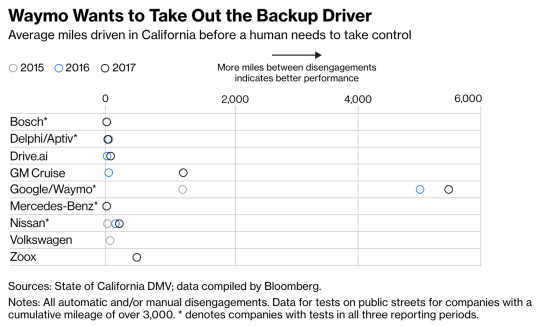
    This is an interesting piece by Bloomberg summarizing the current state of autonomous vehicles and in particular the (supposed) dominance of Waymo (Alphabet’s self-driving vehicle arm). Many believe they will be the first real entrant into the market.

    The company is currently running an “Early Rider” program in 25 cities. But its Phoenix trials are the furthest along, which isn’t at all surprising given the city’s car orientation and suburban fabric. Already Waymo has started offering passenger rides without a backup driver in the car.

    Overall, the company has come forward with four main business priorities:

    • Ride hailing
    • Trucking
    • Personal vehicles
    • Public transit

    But I still think that we’ll see a blurring of these priorities, if not outright cannibalization, as the cost per mile plummets. I mean, why own a personal vehicle if it is flat out easier and cheaper to just hail a robotaxi? 

    Here is an excerpt from the article talking about pricing:

    Tasha Keeney, an analyst at ARK Invest, says that Waymo could choose to offer an autonomous ride-hailing service today at around 70 cents a mile—a quarter of the cost for Uber passengers in San Francisco. Over time, she says, robotaxis should get even cheaper—down to 35 cents a mile by 2020, especially if Waymo’s technology proves sturdy enough to need few human safety monitors overseeing the autonomous vehicles remotely. “You could see software-like margins,” Keeney says.

    I can’t wait to be driven around for cents on the dollar. Click here to read the full article.