Daily insights for city builders, delivered every morning at 6 AM ET. I’m Brandon Donnelly — a Toronto-based real estate developer and founder of Globizen. I’ve been writing here since 2013.

Tag: riverside

  • An interactive map of industrial space in southern California

    Here is an interactive map, created by the Robert Redford Conservancy for Southern California Sustainability, showing the approximately 1,573,777,062 square feet of industrial space that can be found in Los Angeles, Riverside, and San Bernardino.

    The map allows you to zoom in on specific parcels to see things like site area, warehouse size, and year built. You can also play around with different map radii to create a rollup of warehouse space within a specific area, which includes an estimate of daily truck traffic and CO2 produced.

    The Guardian also used this data to create the following chart, which is helpful in showing the dominance of certain cities, as well as how much of this industrial space has been built since 2010:

    The point of this interactive map, this data, and the accompanying articles is to highlight just how disruptive all of this new industrial space is to these southern California communities and to the environment in general. But I think it is also an important reminder that, whether we like it or not, our online activities have real-world physical implications.

    Online shopping requires warehouses and logistics. Online food delivery requires (ghost) kitchens. And online activity, in general, requires the storage of unprecedented amounts of data. All of these “back-end spaces” take up room, even if they’re mostly easy to ignore when we’re just looking at our phones.

    This is our new “phygital” world and, yes, it is changing the landscape of our cities. Now our task is to figure out how to do this in a way that respects communities and respects the environment.
  • The best party in town!

    Friend: Ever go to Jilly’s?

    Me: No, actually.

    Friend: Same.

    Me: What about you? [Addressed to random guy in elevator]

    Random guy in elevator: I’m from Portland. I don’t know what you’re talking about.

    I went to check out the new Broadview Hotel last night in Riverdale, Toronto. (Riverside if we’re being pedantic.)

    Originally built in 1891 and most recently a boarding house with strip club at grade (Jilly’s – the best party in town!), the building was acquired in 2014 by developer Streetcar and turned into a “58-room boutique hotel and charismatic gathering spot.” The soft opening was July 27, 2017.

    Official website here. Lots of interior photos here.

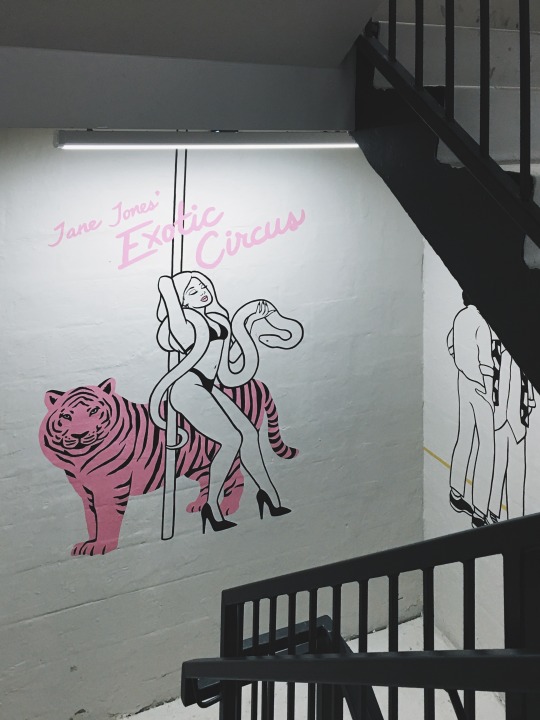
    Besides the pink neon above the lobby bar (which is obviously great), I really like what they did in the stairwells. Credit to Supermilk Studio. Here’s a photo I snapped last night while trying to find the WC:

    Each floor is painted with murals that pay tribute to the building’s history, from the early days of Dingman’s Hall to its most recent iteration as Jilly’s.

    Interestingly enough, the building originally served as an important social hub for the community, though it did not initially house a hotel. On the ground floor was a bank (see, there’s a long tradition of this) and above it were offices and grand meeting halls.

    It wasn’t until the original developer sold the building that it was converted to a hotel and granted a liquor license. It’s worth noting that this conversion is said to have faced stiff community opposition. A hotel that serves alcohol to people? Not in my 1906 backyard.

    With the reopening of the new Broadview Hotel this summer, you could argue that east of the Don River is once again regaining its grand gathering spot. And the feeling I got when I stepped foot inside the hotel last night was that it was time. The demand was latent and, yes, condos wouldn’t have cut it.

    At the same time, this is obviously bigger than the east side. There are many who don’t know this building’s infamous history. Jilly’s? What’s that? Time to go for a walk in the stairwells.

  • This river I step in is not the river I stand in

    image

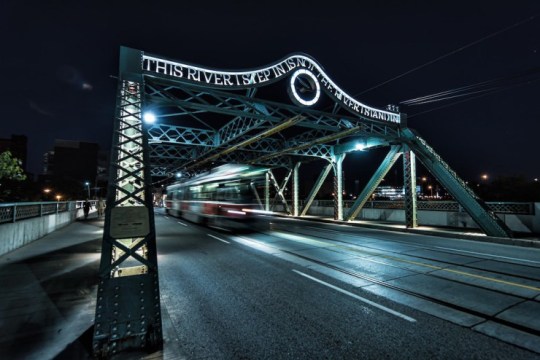
    I was over at the Riverside Bridge yesterday taking photos and I was reminded of Eldon Garnet’s installation called, TIME: AND A CLOCK (1995). 

    The work spans a few physical sites, but perhaps the most well known component is the line of text on the west side of the bridge, which reads in 18″ high letters: “This river I step in is not the river I stand in.” (Photo above from Garnet’s website.)

    If you’re from Toronto, you may be already be familiar with this installation. But I love the message and I think it’s an important one. So I thought I would reiterate it here on the blog. 

    The text is derived from the thinking of the Greek philosopher Heraclitus. Its meaning is a simple one: change is fundamental to the universe. 

    Neighborhoods change. Cities change. Industries change. We change. The river you first step into, is not the same river that you’ll be standing in. That initial river has come and gone, replaced by a new river. In the words of Heraclitus, “No man ever steps in the same river twice.”

    As people, organizations and cities age, there can be a tendency to resist change. I believe in fighting that tendency. 

    Because that’s how established rich companies get destroyed by young poor companies. They – the incumbents – underestimate the importance of change. They forget that the river is constantly flowing.

  • Where should Toronto’s relief subway line go?

    Those of you from Toronto might be aware that the city is currently assessing the possibility of a “relief subway line” that would connect the downtown core back up to the Bloor-Danforth subway line in the form of a stretched out “U”.

    The reason this line is being called a “relief line” is that – in addition to providing local service all across downtown and its “shoulders” – it would also relieve much of the pressure that the Yonge-Bloor interchange is facing today. Instead of always having to connect at that location, passengers coming from the east and west would be able to do so sooner as a result of this new subway line (bypassing Yonge-Bloor).

    For those of you who are regular readers of ATC, you might know that I’m a big supporter of this relief line. I believe it should be our number one transit priority. It’s going to cut through areas of the city that have some of the highest population and employment densities, and so it’s an area where I think subway makes sense. The ridership would be there.

    Many people at the city also seem to agree:

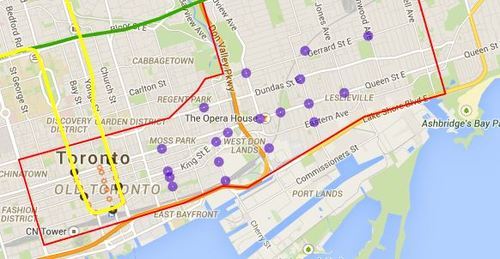
    Given that an assessment is currently underway, the city is looking for feedback from the public. One of the ways you can do that is by clicking here. The site will allow you to comment on the potential station locations (shown below using purple circles). I did it this morning and I would encourage you to do the same if you’re from Toronto.

    For clarity, this current study is only for the eastern portion of the relief line (study area is outlined in red below).

    image

    Once you’ve given this some thought, I’d love to have a discussion in the comments about where you think the relief subway line should go (or if you even think it’s a good idea in the first place).

    My initial thought is that it should connect into King station, run along King Street East, merge with Queen Street East near the Don Valley, go through Riverside and Leslieville, and then start making its way north to Danforth Avenue.

    My reasons are as follows:

    • King Street East is the most vibrant pedestrian street on the east side of downtown. There isn’t enough commercial activity further south.
    • King Street would allow it to eventually cut right through the Financial District when it heads westward.
    • The connection to Union station (for GO Transit, VIA Rail, and the Union-Pearson Express Train) would be manageable from King Street. Plus, SmartTrack may feed directly into Union.
    • King Street is roughly the midpoint between Queen Street and Lakeshore Boulevard. And if you place it too far south, it would take away from the proposed Queen’s Quay LRT line.
    • Having it merge into Queen Street near the Don Valley would allow it to service both Regent Park to the north, as well as the West Don Lands neighborhood to the south. It would also allow for a connection to a Cherry Street LRT line servicing the future Portlands neighborhood.
    • Queen & Broadview is emerging as a major node with a significant amount of density in the pipeline. And further north, Dundas & Carlaw is similarly seeing a lot of intensification.

    But I may have missed a few things. These are just my thoughts. What are yours?

  • East Room co-working space

    image

    Amy Bath needs to leave comments here on ATC more often because she has great feedback and insights.

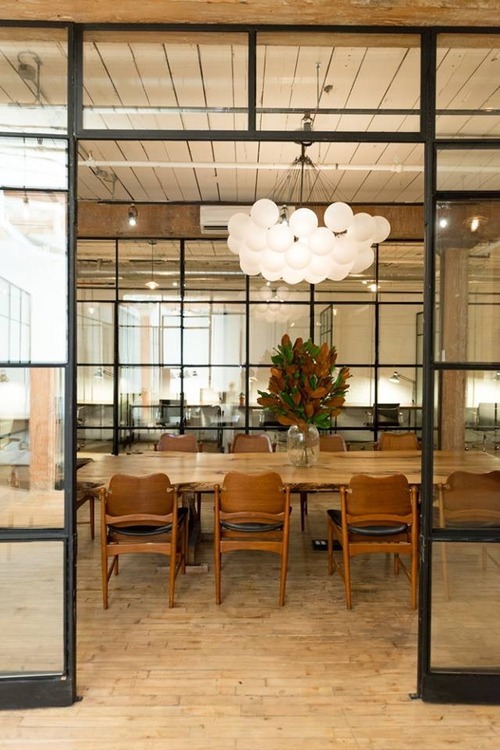
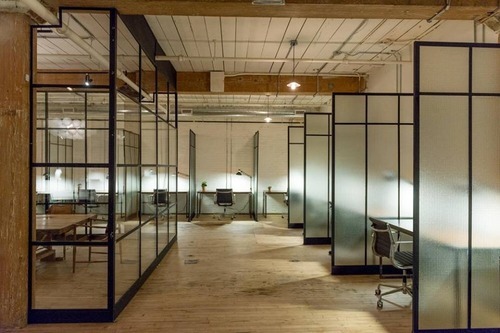
    This morning she tipped me off to a brand new co-working space on the east side of Toronto called East Room. If you haven’t yet heard of it, I would encourage you to check out their website. They’re in a gorgeous heritage building along the Don Valley and they seem to have executed really well. I love their design aesthetic.

    //platform.instagram.com/en_US/embeds.js

    They currently offer two different memberships: a resident membership ($500/month) and a club membership ($250/month).

    image

    This is exciting to me because I have a soft spot for both good design and the east side of Toronto. But probably more importantly, it speaks to the changing nature of work and the workplace, as well as to the shifts in how space is being consumed.

    Co-working spaces are, of course, blowing up all over the world from Philadelphia to Berlin. The internet has empowered new ways to freelance and make money, and these kinds of spaces are really a result of that. Because even though it’s entirely possible for many of us to work remotely at home, we still crave the social interaction that comes from being within an office environment. And that’s a big part of what these spaces are. They’re a social fabric.

    Amy’s hope is that condos will eventually start including amenity spaces that are similar to co-working spaces, and I think that’s a really interesting idea. The challenge, however, is that most developers today (and property managers) aren’t equipped to operate these kinds of environments.

    But maybe it’s only a matter of time before some do become equipped, because I’m sure we’re going to see more, not less, of these kinds of urban spaces.

    Images: @eastroom_

  • Get to know Riverside | Dirt.

    Whatever you do, don’t call it Leslieville. It’s RiversideSpanning 10 blocks along Queen Street East from the Don Valley Parkway to Degrassi Street, this part of town often gets rolled up into the hyped Leslieville neighbourhood. But they’re not one in the same. Formerly known as Queen Broadview Village, Riverside is a small neighbourhood within the larger South Riverdale precinct. But what it may lack in size, it certainly makes up for in terms of culture and history.

    Get to know Riverside | Dirt.