Daily insights for city builders, delivered every morning at 6 AM ET. I’m Brandon Donnelly — a Toronto-based real estate developer and founder of Globizen. I’ve been writing here since 2013.
My partner Kieran sent me this chart this morning:
It is a summary of the average weekday miles traveled by adults in private vehicles, including taxis and ride-hailing vehicles, for the 50 largest metro areas in the US (data is from the fall of 2023). At the top of the list with the most miles traveled is Raleigh, and at the bottom of the list with the fewest miles traveled is, not surprisingly, New York.
The other cities on the bottom of this list probably won’t surprise you either. But it’s a good reminder of how built form determines our mobility choices. If you look up which US cities have the highest population densities and the most compact built forms, I think you’ll generally find that it mirrors what you’re seeing here.
On Monday it was reported — by the Wall Street Journal, Tech Crunch, and others — that Uber will be laying off another 3,000 employees and closing 45 of its offices around the world. Here is a quote from TechCrunch:
“I knew that I had to make a hard decision, not because we are a public company, or to protect or stock price, or to please our Board or investors,” Uber CEO Dara Khosrowshahi wrote to employees today in a memo, viewed by TechCrunch. “I had to make this decision because our very future as an essential service for the cities of the world — our being there for millions of people and businesses who rely on us — demands it. We must establish ourselves as a self-sustaining enterprise that no longer relies on new capital or investors to keep growing, expanding, and innovating.”
According to this SEC filing, the company expects to pay approximately $110 million to $140 million in severance and other termination benefits, and somewhere between $65 million to $80 million in costs related to closing its offices.
All of this is, of course, being driven by a steep decline in ride bookings, which is about 70% of the company’s revenue. Ride bookings were down 80% in April from a year earlier. For Q1 2020, they were down about 5% compared to 2019.
Uber Eats has seen a spike in demand with people staying at home. Bookings were up 52% in Q1 2020 from a year earlier. The problem is that, unlike its rides business, their food delivery business is far from profitable. That’s the point of the possible merger with Grubhub.
The company has said that they are seeing some signs of a recovery in markets that have begun to reopen. But it’s too early to predict what that will really look like. The hole is pretty deep.
Either way, the company is making some really tough decisions right now. But it seems to be doing what it needs to do in order to get to the other side of this and become a self-sustaining and profitable business. Full disclosure: I own some $UBER.
There’s a lot of data/speculation out there about the impact of ride-hailing apps. Many dense urban centers are claiming that they have increased traffic (slowed average speeds) and pulled people away from public transit. The University of Toronto published this study last year. And the WSJ recently published this chart for Chicago:
To be honest, I’m not sure how much of the above is a result of ride-hailing apps, overall urban growth, e-commerce deliveries, public transit disinvestment, or other factors. But what is clear is that ride-hailing is pretty convenient and most (if not all) cities are seeing massive growth in this space.
But all of this feels to me like a bit of a red herring. People will obviously choose what is most convenient and relatively affordable. And congestion was a problem well before people started using these apps (demand > road supply). The only solution I have seen work is to price congestion/roads.
Earlier this year, the University of Toronto Transportation Research Institute (UTTRI) published this report on the impacts of ride hailing services in the City of Toronto.
What is clear from the report is that ride-hailing services — which they refer to as Private Transportation Companies (PTC) — are driven by two dominant use cases: 1) going out at night and 2) commuting to and from work.
Friday and Saturday nights are by far the busiest periods for PTC travel, with the peak usually happening around midnight on Sunday morning. About 13,100 trips per hour, mostly concentrated in the core.
Overall, it is estimated that Toronto does about 176,000 daily PTC trips (as of March 2019). That places it behind New York and Chicago in terms of the size of the market. But Toronto also didn’t complete its first PTC until 2014. Here’s a comparison chart:
Another diagram that I found interesting was the proportion of shared ride trips by neighborhood. It shows that much of the inner suburbs are hailing shared rides — sometimes as high as 45% of all trips. This is interesting because it is people effectively gaming the system.
Because the population densities are lower in the suburbs than in the core, you’re a lot less likely to get paired with other riders when you select that option. So what tends to happen is that you end up getting a private ride for the price of shared ride. I know I’ve played the odds before.
If you’d like to download a full copy of the report, click here.
Each year, Bloomberg NEF (New Energy Finance) publishes a long-term forecast of how electric vehicles and shared mobility will/might impact our cities. Predicting the future is never easy. And forecasts are never right. But they’re valuable to do.
By 2040, BNEF believes that 57% of global passenger vehicle sales and 30% of the global passenger vehicle fleet will have some form of an electric drivetrain. Either full battery electric (BEV) or plug-in-hybrid electric (PHEV). Looking at this another way, we have about 17 years (2037) until ICE and electric vehicles are expected to intersect and hit 50/50 in terms of global sales.
A big part of what is driving the adoption of electric vehicles is that the price of lithium-ion batteries keeps coming down. Assuming this trend continues, the price of EVs and ICE vehicles (in most segments) should reach parity sometime in the mid-2020s. Meaning, yes, it’s more expensive to produce an EV today.
All of this will also impact mobility services (ride-hailing and ride-sharing). Today, less than 5% of annual kilometers traveled by passenger vehicles around the world is thought to be done through some form of a ride-hailing app. That’s still a pretty significant number, actually. Though only about 1.8% of this fleet is electric.
By 2040, shared mobility services are expected to rise to 19% (see above) and — because their costs are coming down — 80% of this fleet is expected to be electric. Autonomous vehicles are not expected to meaningfully impact global mobility until the 2030s. But the growth in shared mobility services is still expected to reduce the demand for car ownership, and likely parking.
Other high-level findings from BNEF’s 2019 Electric Vehicle Outlook can be found here. If you want to access the full report, you’ll need to be a BNEF client.
As a kid growing up in the suburbs, I got my driver’s license the day I turned 16. Being able to drive was a big deal. But we know that this desire to drive has been changing in profound ways. Here’s some recent stats on the percentage of licensed drivers in the US by age (taken from the WSJ):
In 1983, about 46% of 16-year-olds had a driver’s license. By 2014, this number had dropped to 24.5%, which is the lowest it has been in recent years, and was probably impacted by the broader economy. As of 2017, this number was up to about 26%.
If you’re a car company, I would imagine that these are pretty important numbers. They represent the top of the sales funnel. Most people probably like to have a driver’s license in hand before they go out and buy a car.
Supposedly, some people in Detroit are betting that young people will still eventually buy a car. And when they do, it’ll be a nice big one like an SUV or a truck. But, the data suggests that it is not just young people who are eschewing driving.
Here’s some data from the University of Michigan Transportation Research Institute (via NPR), looking at the proportion of licensed drivers in the US by all age categories:
While the biggest drop has certainly happened among younger generations, licensing is still down for older cohorts. Based on these numbers, we don’t hit parity until somewhere around 50 to 54 years old.
And the only cohorts where licensing has increased significantly are when people reach over 55. Over 70 is up by a huge margin — more than the drop among 16 year olds — which is probably a symptom of people living longer.
Some of this decrease among young people can probably be attributed to delayed family formation and people living in denser urban environments, where it is more convenient to get around without a car. But I don’t think that’s all of it.
Which suggests to me that the race to autonomy is a pretty important one to win.
It costs $299 every 30 days and you get 30 rides included (up to $15 each). So it represents a possible 1/3 discount on rides. If you go over the 30 rides per month or over $15 on any one ride, you simply pay the difference. Though as a subscriber, you get 5% off additional rides.
Subscriptions are good for business. They can be like an annuity. And I suspect that with the above model, there will be unutilized rides every month that the company is just able to bank. You can’t carryover rides with this plan.
But moreover, Lyft’s “All-Access Plan” is designed to help you ditch your car. Trade your car payment for a ride subscription plan. So if the numbers didn’t quite work for you before, maybe they do now. Depending on the situation, I can certainly see this plan being cost effective.
But as ride hailing/sharing continues to nibble away at public transportation and personal vehicle ownership, what will this mean for cities?
Earlier this year Uber sold its Southeast Asia business to Grab. At the time, it was estimated that Grab had 95% of the ride-hailing market in Southeast Asia. That’s why Uber decided to sell. Instead of continuing to bleed, they figured it would be better to instead merge businesses in exchange for a “sizeable stake in Grab.” This is similar to the deal that it struck in China with Didi.
It’s clear evidence of cultural advantage. Though maybe you could argue it’s first mover advantage. Either way, many, including Wired, have argued that while Uber has dominated in the West, it has often struggled in the developing world. Different markets. When Grab launched you could pay with cash because so many users didn’t have a credit card.
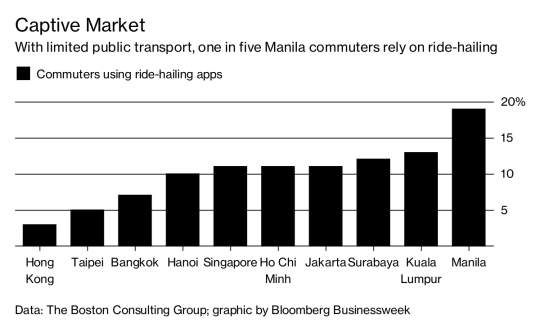
Here is another interesting insight from Bloomberg (see above): Nearly 1 out of every 5 commuters in Manila relies on a ride-hailing service because the public transit situation is allegedly so dire. Grab controls 90% of the market with 35,000 vehicles receiving somewhere around 600,000 requests a day.
When Uber launched it was positioned as “Everyone’s private driver.” It was expensive. It was luxurious. And it was done because they knew they weren’t going to be able to compete on speed and/or price in the early days. But now ride-hailing services are tackling the very opposite end of the spectrum.
New York City is considering a congestion charge for drivers entering Manhattan below 60th street. It is part of Governor Cuomo’s Fix NYC plan. But we all know how difficult these things are to implement.
Last month, Felix Salmon wrote a piece in Wired where he argued that our cities are dying of traffic congestion and that the cause is ride-hailing services like Uber and Lyft. The solution: A tax on ride-hailing services.
The article elicited a few reactions, including this one by Charles Komanoff over at Streetblogs and this one by Joe Cortright over at City Observatory. Joe’s message: “The problem isn’t the ride-hailed vehicles, it’s the under-priced street.”
Precisely.
Felix later followed-up with a post on his blog where he clarified that the reason he loves this idea – of taxing ride-hailing companies, not riders – is that it’s far more politically palatable than a blanket tax on all cars. I don’t disagree.
Which is why I think my idea is something which is eminently politically possible, in contrast to congestion pricing, which has been implemented exactly nowhere in the USA.
Americans love their cars, and they love the freedom that cars represent, and they hate the idea that they should be taxed for driving their cars. Tolls on roads and bridges are bad enough, but a fee just to drive in to a city?
That said, I’m with Charles and Joe.
Last year, it was reported that roughly 25% of all Uber trips in New York City were UberPool trips. I’m not sure what the number is today, but these are people who are car pooling to get around. That’s generally considered to be a positive thing.
Are these really the trips we want to be discouraging (and singling out) with a charge simply because we don’t have the moxie to do what is right and makes rational sense?
And what they found was that, for the first time ever, Uber and Lyft exceeded traditional taxis and rental cars when it came to business expenses. Uber was at 48% and Lyft was at 4%. So together, these two platforms have more than half of this particular market.
If you compare this to Certify’s data from the same quarter last year, “ride-hailing services” previously accounted for 34% of receipts, whereas taxis and rental cars were at 22% and 44%, respectively. So Uber is up in a big way.
This may not be surprising for a lot of you, but I thought it would be valuable to check-in on what the numbers say.
I’m hit with two thoughts. Firstly, it’s not a question of mobile apps superseding traditional taxis; it’s a question of one company taking over. And secondly, people seem to be favoring Uber over driving themselves around. I know I’ve been heading in that direction.