
Daily insights for city builders, delivered every morning at 6 AM ET. I’m Brandon Donnelly — a Toronto-based real estate developer and founder of Globizen. I’ve been writing here since 2013.

Tag: richard florida

  • Big cities have rebounded the fastest since 2008

    Josh Lehner of the Oregon Office of Economic Analysis published a study earlier this summer where he looked at employment growth according to city size across the US.

    What he found since the Great Recession of 2008-2010 is that larger metros – with populations greater than 1 million people – have rebounded the fastest. They are shown in the light blue line below:
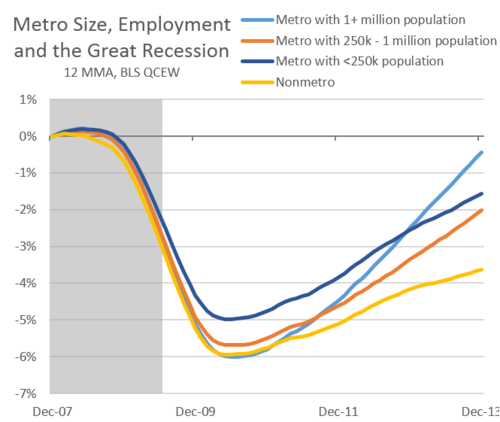
    According to Josh:

    This is at least partially due to the fact that all those good economic things — agglomeration effects, knowledge spillovers, clustering, etc — happen in certain locations, which are usually bigger cities.

    However, if you go back to the 1980s, you find that this trend isn’t consistent. Large metros outperformed in the late 90s. But they were more or less on par with smaller metros during the housing boom of the early 2000s and actually under performed in the early 90s recession.
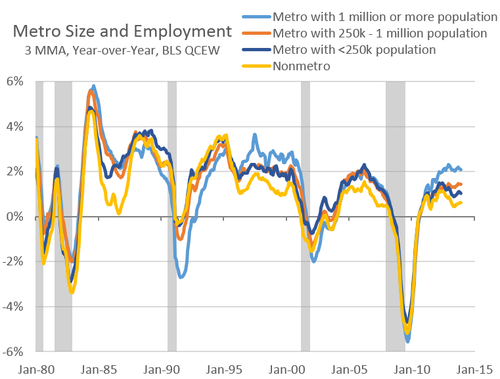
    One possible explanation for this – which Josh proposes – is that the recent housing boom acted as a sort of equalizer for smaller metros. It created stronger population growth outside of the bigger cities.

    I buy that.

    But then does that mean that going forward big cities will continue to outperform? Is this going to be more or less the new norm? Intuitively, I would think yes.

    You can find Josh’s blog post, here. Richard Florida also wrote one for CityLab, here.

  • Does the world need a Global Parliament for Mayors?

    Earlier this month a team consisting of Benjamin Barber (who is author of If Mayors Ruled the World: Dysfunctional Nations, Rising Cities), Richard Florida (who is Director of the Martin Prosperity Institute here at the University of Toronto), and Don Tapscott (who is a leading authority on innovation) released a research report advocating for a global network of cities that they’re calling a “Global Parliament for Mayors.”

    Here’s a snippet from the press release:

    “Nation-states work together through multi-lateral agreements and global institutions in an effort to solve global problems. But states have limitations, and their cooperative efforts in our new era of interdependence and globalization are increasingly insufficient and even ineffective and outmoded,” say the three prominent researchers. A Global Parliament of Mayors represents a new type of governance network – one with enormous potential.

    “Our proposed parliament would operate as a global urban network with a vibrant online community that collaborates on key issues 365 days a year,” they say. “Multi-stakeholder governance has come of age and is now fully independent from control by any government, or governmental organizations like the UN.”

    And if you dive into their report, you’ll find the following 5 reasons for why they believe a Global Parliament for Mayors (GPM) makes sense:

    1. Global migration to cities. Most people live in cities, so it makes sense to concentrate problem-solving capabilities there.
    2. Urban predisposition for problem-solving. Cities are entrepreneurial, close to the people and richly connected to a wide variety of stakeholders. They have a history of cooperation and pragmatic problem-solving. 
    3. A need for experimentation with new governance models. Traditional models of state-based global governance have struggled to advance effective solutions to many global problems, so there is an urgent need to experiment with new models. The GPM is the most promising. 
    4. Digital networks. Online collaboration technology makes it possible to operate a largely virtual parliament that would not only be more cost-effective, but more transparent, inclusive and productive.
    5. Digital citizens. There is a large, educated and motivated population of digital citizens that could be tapped to improve urban governance.

    In principle, I agree with the direction. And I feel that way because of the two major shifts outlined above: More people are living in cities (a trend that all urbanists talk about ad nauseam) and digital networks are having a disruptive effect on the way we run companies and live our lives.

    I’ve talked before about how the internet is causing a decentralization of value creation (see Airbnb, YouTube, and so on) and so I think it only makes sense that our governance structures will inevitably go through a similar transformation.

    The governance models that we are living with today were put in place during a time when the world was a different place. At one point, nation-states were the de facto way to effectively organize ourselves on a global stage – probably because there wasn’t any other reasonable alternative.

    But today, we are connected and interdependent in entirely new ways. And so the opportunity in front of us is to create a governance structure that leverages the progress and innovation that’s happening in cities, everywhere.

    If cities are our most important economic unit, then mayors are arguably some of our most important leaders. So it behooves us to figure out how to give them the frameworks and forums to best do their job.

  • New ideas need old buildings

    In reading a recent Financial Times article called, Are creative people the key to city regeneration?, I was reminded of a famous line from the late urbanist Jane Jacobs: “New ideas need old buildings.” What she meant by that is the following:

    Cities need old buildings so badly it is probably impossible for vigorous streets and districts to grow without them…. for really new ideas of any kind—no matter how ultimately profitable or otherwise successful some of them might prove to be—there is no leeway for such chancy trial, error and experimentation in the high-overhead economy of new construction. Old ideas can sometimes use new buildings. New ideas must use old buildings.

    And what she was effectively getting at is that we live in a world obsessed with historical data and precedence. To use the words of business thinker Roger Martin: “The enemy of innovation is the phrase ‘prove it.’” Because, if it’s never been done before, how can you prove it? You can certainly imagine it. But you can’t prove it.

    If you’re in the business of building buildings, convincing your lender to give you the money to build something that’s never been done before, is an almost impossible sell. That’s not the way it works. Which is why Jane Jacobs famously said that “new ideas need old buildings.”

    We’ve seen this story play out in countless cities around the world. The creatives move into an scuzzy neighborhood, make it cool and then investment follows. The neighborhood has been proven. But for this cycle to continue, we need a continuous stock of derelict buildings and undesirable neighborhoods, or at least areas that offer the same kind of affordability and flexibility to creative entrepreneurs.

    Often these circumstances have been the result of failure. The proven ideas that got the buildings built in the first place became no longer relevant. And so the buildings were left to expire. But in many global cities, these kinds of areas are an endangered specifies. However, it’s in our best interest to make sure that we don’t lose our creativity alongside them.

  • Core counties > outlying counties

    Recent US Census Bureau data has once again confirmed that there’s a growing preference for living in urban cores. More specifically:

    It finds that population growth has been shifting to the core counties of the USA’s 381 metro areas, especially since the economic recovery began gaining steam in 2010. Basically, the USA’s urban core is getting denser, while far-flung suburbs watch their growth dwindle.

    To put numbers to these statements, core counties in the US grew approximately 2.7% and outlying counties grew approximately 1.9% from 2010-2013. Most of the growth came from net migration, as opposed to higher birth rates.

    The two big factors at play–which will be obvious to readers of this blog–appear to be both a desire to live in amenity rich and walkable communities and a continuing trend towards marrying and having kids later in life, which can often be the trigger for moving to the suburbs.

    But the big question is whether or not this trend is here to stay or if it’s an ephemeral fad caused by a bunch of over-educated and under-employed Millennials refusing to grow up. I would argue that it’s not a fad.

    If there’s a clear consumer preference for urban neighborhoods, then I don’t think people are just going to pick up and leave overnight. As long as there’s adequate housing within the means of growing families, I think they’re going to stay in or go to the areas in which they truly want to live.

    There are also many other macroeconomic trends reinforcing this shift. Just yesterday, Richard Florida wrote an article in Atlantic Cities talking about how venture capital investment is shifting away from the suburbs, towards city centers and walkable communities. These companies (receiving investment) are the next generation of employers and they’re starting in core areas.

    I’ll take that as a leading indicator.

  • Recommendation to remove the elevated Gardiner Expressway

    I’ve written a lot lately about the Gardiner Expressway East. First to argue that I think it should be torn down and, second, to provide a counter argument as to why some people think North America’s urban freeways are here to stay. I wanted to avoid confirmation bias.

    Well a recommendation has been made to City Council and it is, indeed, to remove the eastern portion of the Gardiner Expressway. They are now asking Council to approve it. The item will first go to the Public Works and Infrastructure Committee on March 4, 2014 and, subject to the results of that meeting, will then go to City Council on April 1, 2014. 

    The recommendation to Council identified the following 4 key features of the preferred “remove” option:

    1. Widening of Lake Shore Boulevard east of Jarvis Street by two lanes into an eight-lane landscaped at-grade boulevard;
    2. The lowest overall public investment at $240 million net present value (NPV) because of significantly lower lifecycle costs despite a higher upfront capital cost than Maintain;
    3. Public land disposition proceeds of approximately $80 to 90 million NPV from the release of about 4 hectares of land (which could support 260,000 square metres of development)
    4. Highest compatibility with Official Plan and Central Waterfront Secondary Plan principles and objectives as well as approved plans, such as the Don Mouth Naturalization and Flood Protection EA, Lower Don Lands Framework Plan, Keating Channel Precinct Plan and the Port Lands Acceleration Initiative.

    If you’d like to read more about what’s going to Public Works and City Council, click here.

    One thing I didn’t mention in my previous posts is the land disposition piece (item #3 above). By removing the Gardiner East, roughly 10 acres of public land will be freed up which, according to their estimates, could allow for 2.8 million square feet of new development. That’s roughly the size of our 72-storey First Canadian Place.

    I’ve been crystal clear about my position on the Gardiner East and so I’m delighted to see it seemingly move forward in that direction. I know a lot of people are concerned that the removal option could result in some commute times being 5 to 10 minutes longer by 2031, but I think we’ll have even bigger problems by 2031 if we continue with the status quo.

    Urban theorist Richard Florida has argued many times before that when cities get to around 5-6 million people they come to a point where they have to make tough decisions about the way they’re going to continue to grow and prosper. Toronto is at that moment. Our car dependent ways are already crippling productivity levels.

    What kind of city do we want to be by 2031? I don’t think that we can afford to just “maintain.”

  • Gentrification, animated

    A friend of mine sent me a link this afternoon to an art project called “Vacated”. The artist (Justin Blinder) reverse engineered Google Street View images to create a series of animated GIFs intended to demonstrate New York’s “changing urban landscape during the Bloomberg administration.”

    In his description of the project, Blinder ends by saying that “it’s up to the viewer to decide whether this change represents widespread gentrification.” Given the recent discussion we’ve had (here on Architect This City) about gentrification, I thought this post might be a good addendum.

    One of the big takeaways from our discussion, I think, was idea that there’s good gentrification and bad gentrification. Gentrification, after all, is really just another word for investment. And so generally I would consider this to be a good thing for communities.

    But there are instances when investment comes in and ruins what made the community worth investing in, in the first place. Perhaps the investment brought about the destruction of heritage buildings or the loss of the fine grain urban character that initially made it a great place to be.

    In these cases, I would say that this is bad gentrification. Sure there has been investment, but now the community has lost what made it cool. And as Jane Jacobs rightly pointed out: “When a place gets boring, even the rich people leave.”

  • Richard Florida on why creativity is the new economy

    Richard Florida recently gave a talk at the Rotman School as part of Toronto’s “Big City, Big Ideas” lecture series. It was called: Why Creativity Is the New Economy. You can watch it here via Rotman. It’s about an hour long.

    If you’re familiar with the work of Richard Florida, you’ll find much of what he talks about familiar. But there is one point that I think is absolutely worth reiterating again, and again: The new economic unit of our time is the city. It used to be nations but, in today’s world, cities trump nations, provinces and states in terms economic importance.

    Florida has long stressed this point in his work and I think he’s absolutely right. The problem, however, is that our governance structures are ill-suited to deal with this shift. There are too many layers of government and our cities do not have nearly enough autonomy. 

    Toronto is also facing a profound leadership deficit at the municipal level, to say the least (See Rob Ford). This cannot continue. Strong municipal leaders are critical to our sustained global economic competitiveness. It’s every global city for themselves and I, for one, want to win.

    To give you an example of the dramatic rise of cities, take a look at this recent TechCrunch article on billion dollar startups. If you take a look at learning number 9, you’ll see an incredible interesting fact: San Francisco—not “the Valley”—is now home to the most billion dollar startups. Startups are eschewing the suburbs for the city.

    I’ve written a lot on this trend, but I still don’t think that our governments have truly woken up to the fact that, in the new economy, our cities are our most important asset.

  • Labour Day thoughts…

    Today is Labour Day (or Labor Day for my American friends).

    Many of us simply think of it as the official end of summer, but it’s also the day we’re supposed to celebrate the labour union movement and the achievements of workers. Given this, and the fact that yesterday’s post was about Detroit, it seems like an appropriate time to talk about jobs.

    In many ways, the woes of Detroit are simply an extreme example of what’s happening in many advanced economies. The loss of manufacturing based jobs is creating a void that is not being filled – or is being filled differently – by new industries.

    The first piece to this is what I mentioned yesterday: education.

    Manufacturing jobs allowed unskilled workers to make good middle class salaries. But other than a few remaining instances – such as in Fort McMurray, where high school graduates can make six figures working in the Canadian oil sands and the average price of a home is pushing $800,000 – I think it’s pretty clear that the opportunities for unskilled workers is on the decline.

    Therefore (and this is old news), we clearly need to figure out ways to retrain existing workers and ensure that the next generation is equipped with the skills and knowledge to compete in this new world. The problem though – and this is the second piece – is that I’m not sure the new economy will require the same raw number of people.

    What I mean by this is that scaling up production of an automative plant is quite different than scaling up an internet platform like Twitter or Tumblr. You just don’t need as many people, which is why the returns to being smart have grown massively for those few. And this is part of the reason we’re seeing rising income inequality across the board.

    Now, I don’t know what the answer is, but I think we’ve already shown that the transition to a new economy isn’t going to be a smooth one. To that end, I’ll leave you with one last thought which came from a former professor of mine at Rotman, Walid Hejazi.

    His argument is that it’s actually unethical for governments to subsidize unproductive sectors of the economy, such as a manufacturing, in order to sustain jobs. The reason being that you then have high school students telling themselves that they don’t need to go to University because they can simply go work at the local plant and make decent money. But what they don’t realize is that there’s a very real expiry date to those opportunities and, when it comes, it’ll be much harder for them to be retrained.

    What are your thoughts?

    Here’s what venture capitalist Fred Wilson had to say today.

  • Cost of a car

    Every time I bring my car in for service, I’m reminded of how expensive it is to maintain one. Between car payments, insurance, gas, parking in the city and service, owning a car eats into a lot of disposable income.

    So for cities where the residents don’t need a car to get around, there’s potentially a lot of additional income that can get placed in other sectors of the economy.

    Richard Florida, and others, have argued that we’ve historically been overspending on housing and transportation, and that it restricts capital from flowing into other, more productive, areas of the economy.

    I’d be curious to see a study that compares transportation spending versus other local economic measures. How would a driving city compare to a public transit or biking city?

  • My own study of the distribution of college graduates in the cities and suburbs of America’s metropolitan areas, conducted with my Martin Prosperity Institute colleagues Charlotta Mellander and Kevin Stolarick, finds the concentration of college grads in the urban core to be especially advanced in America’s largest metro areas. Metro areas with more than 3 million people have nearly twice the density of college grads in their center cities than those with populations of 1 million to 3 million. As metro areas grow larger and more congested, more highly educated and affluent people seek more-central locations. When the alternative is hours of commuting on crowded highways and gridlocked streets, more people are willing to trade their lawns, soaring cathedral ceilings, and multiple bathrooms for a more efficient, less car-dependent way of life.

    Richard Florida