Daily insights for city builders, delivered every morning at 6 AM ET. I’m Brandon Donnelly — a Toronto-based real estate developer and founder of Globizen. I’ve been writing here since 2013.

Tag: rich people

  • Los Angeles approves new “mansion tax”

    If you’re looking to pass a new ordinance and/or create a new tax, it’s important to have the right name. Take, for example, Los Angeles’ new “mansion tax.” The majority of people do not have a so-called “mansion.” And so signaling to people that you’re going to tax this thing and then redistribute the funds to help others with better housing is, not surprisingly, attractive to many. Here’s how the new tax works:

    Known as Measure ULA — for “United to House LA” — the ordinance marketed as a “mansion tax” will impose a 4% tax on property sales above $5 million, rising to 5.5% on sales above $10 million. So a $5-million sale would include a $200,000 tax, and a $10-million sale would include a $550,000 tax, which is typically paid by the seller.

    Of course, if you’re a rich person with a mansion, your first thought is going to be, “how do I avoid having to pay this?” Here are two unproven and possibly illegal options that I am not condoning in any way:

    For example, if a homeowner is selling a mansion for $15 million, they’d be slapped with a $825,000 tax bill. But if they split up the property into three parts owned by three different entities and sold all three pieces for $4.999 million each, they would hypothetically elude the tax since it only kicks in at $5 million.

    Another strategy might be to hatch deals off the books to keep a sale under $5 million. For example, if a seller wanted $7 million for their house, they could reach a deal with a buyer to sell it for $4.999 million, thus avoiding the tax, but then sell the furniture in the home for $2 million.

    I don’t have a mansion, so I’m fortunate enough not to have to worry about such things. But I do think about the impact on things like new rental supply. My understanding of the ordinance is that if you’re a developer of rental housing, and you buy a lot for $4.99 million, build a mid-market apartment, and then turn around and sell it to a pension fund for $10.01 million, you would be subject to this new tax.

    Hmm. I wouldn’t call this a mansion.

  • The sources of wealth

    Back in the old days, and by the old days I mean the 1980s, there were a handful of ways in which you were likely to get rich. You either inherited it, or you made it in oil or real estate. The Forbes list of the 100 richest Americans was first published in 1982 and, at that time, 60 of the people on this list had inherited their wealth. Of the 40 new fortunes on the list, about 60% were primarily related to oil or real estate. If you couldn’t inherit your money, these two industries were a good place to start.

    But as Paul Graham explains in this recent essay about “how people get rich now,” this is no longer the case. On the 2020 list, there were 73 new fortunes, but only 4 stemmed from real estate and only 2 stemmed from oil. As you might imagine, today’s biggest driver is what we call tech and, more specifically, it is people founding tech companies (there are also a couple of examples of early employees doing very well). Of the 73 new fortunes last year, approximately 30 came from tech, including 8 of the top 10 fortunes on the list.

    Given how many people are starting new companies today (it has become easier and cheaper) and given how many of these companies are quickly growing to big valuations (things are scaling faster), it is perhaps tempting to think about this period of time as being entirely unprecedented. Never before have we seen so many young people getting rich by starting their own company. And never before have we seen such inequality.

    However, Graham argues in his essay that this period of time is the default. What we saw in the second half of the 20th century was actually an anomaly. Indeed, if you go back to the end of the 19th century, the richest people in the US were mostly people who were starting their own companies and taking advantage of new technologies, such as that of mass production.

    His claim is that for the most part it wasn’t really viable to start your own company in, say, the 1960s. Instead, most people simply went to work for a big company that had some sort of oligopolistic positioning in the market. And it turns out that was pretty good for maintaining a strong middle class. Less people were getting fabulously rich. I’d like to see some more data points around entrepreneurship and wealth during this era. But regardless, I think it’s pretty clear that the dominant sources of wealth have changed.

  • US counties with the highest per-capita income

    Below are the US counties with the highest per-capita income (as of 2018), according to this recent Bloomberg article:

    Teton, WY is home to the Jackson Hole valley (which has some of the best skiing in the world). And Pitkin, CO is home to Aspen. Turns out, rich people like ski towns.

    Interestingly enough, 2018 saw per capita income grow in the greatest number of US counties since 1981. According to the Bureau of Economic Analysis, it was 97% of all counties:

    For the full Bloomberg article, click here.

    Charts: Bloomberg

  • The global pyramid of wealth

    Every year the London-based property consultancy Knight Frank publishes something called The Wealth Report. And it’s one of those reports that I could go through for hours. 

    It includes a ton of really fascinating stats that speak volumes about where in the world wealth is being created and how it’s moving around. And of course there are a lot of connections between wealth, real estate, and city building.

    Below are 3 diagrams that really stood out for me in the 2015 version. 

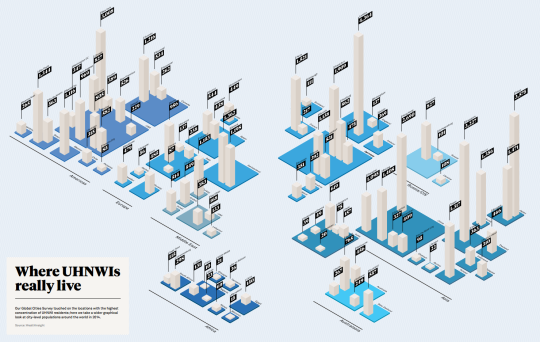
    The first diagram shows which cities have the most Ultra High Net Worth Individuals (UHNWIs). An UHNWI is defined as an individual with assets exceeding US$30 million, but excluding personal assets and property (such as one’s principal residence). Click here to see the full size image (I know the numbers are small).

    image

    Not surprisingly, London (4,364), Tokyo (3,575), Singapore (3,227), New York (3,008), and Hong Kong (2,690) are at the top of the list. But I was a little surprised – albeit happily surprised – to see Toronto (1,216) come in at #2 in North America, beating out Mexico City (1,116), Los Angeles (969), and Chicago (827). 

    The second diagram shows you how many square meters of luxury property (apartment) you can buy for US$1 million in a bunch of different cities around the world. 

    In Monaco (top end), that’ll buy you 17 square meters (183 square feet) and in Cape Town (bottom end), that’ll buy you 208 square meters (2,196 square feet).

    image

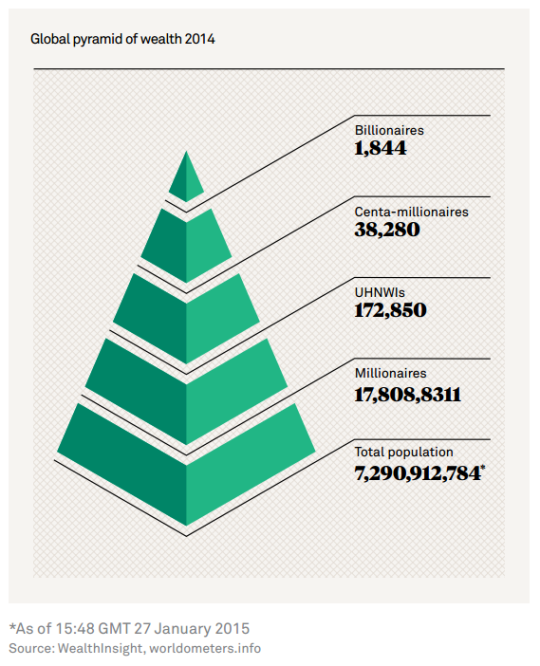
    The third and last diagram is what they call the global pyramid of wealth. It’s a pyramid of everyone in the world and then the number of millionaires, UHNWIs (see above), centa-millionaires, and billionaires. And if you do the math, the top of this pyramid comes nowhere close to 1% of the global population.

    image

    It’s fascinating (and exciting) to see where and how global wealth is concentrating. But it should also make you think about rising income inequality. I know it does for me.

  • Are there enough nerds in Miami?

    image

    I was browsing through my online reading list this morning (as I do every morning), and I stumbled upon this Dezeen article talking about a big new 6.5 million square foot development being proposed in Miami’s Park West neighborhood. 

    The goal of the project is to transform Miami into “Florida’s Silicon Valley.”

    This sort of thing is happening all around the world. From Buffalo to Lisbon, cities everywhere are betting on tech, startups, and entrepreneurship to grow their economy in the 21st century. And I personally think that’s really exciting.

    But as I was reading the article, I couldn’t help but think of an old essay that Paul Graham wrote back in 2006 called, How to be Silicon Valley. (Paul Graham is a famous Silicon Valley entrepreneur/investor).

    In his essay Graham argues that to be or to replicate the model of Silicon Valley in your city, you basically need two types of people: rich people and nerds. The idea, of course, being that the nerds work on the cool new ideas and the rich people then fund them.

    Using this logic, he specifically calls out Miami as a city where few startups happen and as a city not likely to become another Silicon Valley. Though there’s lots of money and rich people in Miami, there simply aren’t enough nerds. In Graham’s words: “It’s not the kind of place nerds like.”

    But that was back in 2006. 

    The iPhone didn’t even exist yet. Things have since changed. Now there are successful tech companies like Snapchat (valuation north of $15 billion) that are based out of cities like Los Angeles. And I think you could argue that Los Angeles and Miami do share some similarities.

    So while it may have seemed far fetched in 2006 for Miami to become a startup hub, is that really the case today?

    Image: Dezeen