Daily insights for city builders, delivered every morning at 6 AM ET. I’m Brandon Donnelly — a Toronto-based real estate developer and founder of Globizen. I’ve been writing here since 2013.
Benedict Evans asks some great questions in this recent post about ecommerce penetration. Instead of just looking at the product itself and/or the way in which we buy it (online versus offline, for example), he focuses on the logistics model that accompanies the transaction.
What can be parceled and shipped via Amazon? What can be delivered using a bicycle? What requires some sort of special delivery or collection method?
The point he is making is that different things need to happen for a new fridge to make it to your home, compared to say a Chipotle burrito. And these differences matter when it comes to how we should be thinking about ecommerce and the real estate in our cities.
Personally, I find it helpful to reframe the questions in this way.
Here’s an excerpt from the post:
But if I buy online and then drive to the store to collect it, is that different to phoning and reserving it? We didn’t have a statistics category for ‘telephone ordering’. If I use an app to order pizza instead of phoning the restaurant, has that become ‘ecommerce’ or is it still pizza delivery? 30 years ago, if I drove to Walmart instead of walking to a neighbourhood store, or drove to Best Buy instead of going to a department store, we didn’t call that ‘car-based commerce’. So is this a tech question, or a retailing question, or an urbanism question?
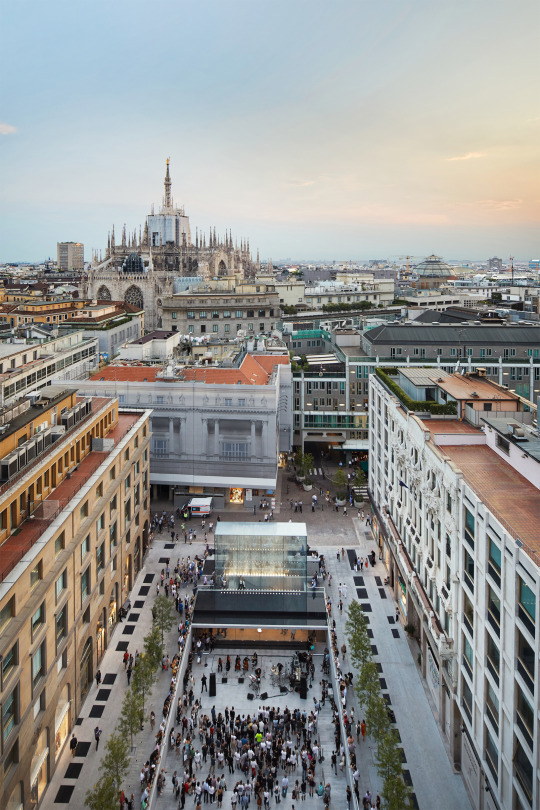
This past July, the Apple Piazza Liberty opened in Milan. Above is a photo from the opening via Apple. There’s a band playing in the middle of the piazza.
The store is central to Apple’s vision of transforming its retail locations into “town squares.” And in this case, the store is quite literally an Italian piazza.
There’s a lot that is interesting about this store and this strategic move, as well as what this could signal about the future retail. (Curbed discusses that here.)
The urbanists who read this blog will likely lament the privatization of public space. Because at the end of the day, it is a gray area. Can I hang out an Apple Town Square all day and just read a book?
But at the same time, this is not necessarily a new idea. From the very beginning, the modern shopping mall was intended to be a new kind of town square. Or at least that’s how Victor Gruen saw it.
However, what is perhaps new is this appropriation of public spaces for the purposes of what is arguably a new kind of retailing experience – one that almost feels paradoxical.
In the case of Apple Piazza Liberty, as well as in some of its other town squares, the actual retailing space is mostly hidden. Here it is underground. (How much to rent the basement?)
And yet, Apple’s presence feels monumental and almost sublime. Glass box, waterfall, and subtle Apple logo sitting in the middle of a beautiful Milanese piazza.
Earlier this week, Apple let us know that it is now calling its stores “town squares.” Not surprisingly, this elicited more than a few reactions. The Verge called it a “pretentious farce.” Others called it arrogant. Who is Apple to think that its stores could ever come close to a real town square?
It also raised important questions around the actual “publicness” of the spaces within our cities. Traditionally, town squares have indeed been public. But our cities are now also filled with many privately owned public spaces (POPS). Most of the time you don’t know the difference. Though sometimes you do.
The reality is that there is a longstanding tradition of private retail-oriented spaces trying to simulate the experience of a town square, and certainly of a gathering space. The creator of the modern mall, Victor Gruen, always thought of his “garden courts” as a kind of substitute for traditional urban spaces. This was him trying to nobly urbanize the suburbs.
What is perhaps unique about Apple’s town square nomenclature is that – beyond simply wanting to be a Starbucks-esque “third place” – they seem to be telling us that they want to usurp the public nucleus away from the proverbial “garden court” and place it in their individual stores.
And the reactions we have seen are because that feels far fetched.
However this plays out, this is a very clear acknowledgement by Apple that in today’s world being a store simply isn’t enough. That’s no longer interesting. Consumers have far easier options at their disposable. You need to give us more of a reason to visit you in your store or, dare I say, your town square.
Venture capitalist Benedict Evans recently published a post on his blog called, Ten Year Futures. If you haven’t already noticed, I really enjoy this sort of curiosity and line of thinking. Here is an excerpt where he talks about retail being at a tipping point:
“First, ecommerce, having grown more or less in a straight line for the past twenty years, is starting to reach the point that broad classes of retailer have real trouble. It’s useful to compare physical retail with newspapers, which face many of the same problems: a fixed cost base with falling revenues, the near-disappearance of a physical distribution advantage, and above all, unbundling and disaggregation. Everything bad that the internet did to media is probably going to happen to retailers. The tipping point might now be approaching, particularly in the US, where the situation is worsened by the fact that there is far more retail square footage per capita than in any other developed market. And when the store closes and you turn to shopping online (or are simply forced to, if enough physical retail goes away), you don’t buy all the same things, any more than you read all the same things when you took your media consumption online. When we went from a corner store to a department store, and then from a department store to big box retail, we didn’t all buy exactly the same things but in different places – we bought different things. If you go from buying soap powder in Wal-Mart based on brand and eye-level placement to telling Alexa ‘I need more soap’, some of your buying will look different.”
I’ve said this many times before, but the way the above excerpt ends is yet another remind that one has to look deeper beyond the obvious change(s). Yes, ecommerce is growing and impacting physical retail. But what other changes might ensue because of this shift?
Earlier this week on the day before April Fools’, Amazon launched two new services. The first was called Amazon Dash (see above video) and the second was called Amazon Home Services. The entire internet seemed to think that Dash was actually an April Fool’s joke, but it turns out it’s not. In fact, it’s actually an incredibly smart product.
The way it works is simple. Each branded Dash Button is about the size of a pack of gum. You mount it in, on, and near things that you replace on a regular basis, such as laundry detergent, coffee refills, and so on. Then all you have to do is push the button and your order gets sent to Amazon. Shortly after the product arrives at your door. I say “shortly” because you can be certain that Amazon’s goal is to make that time frame as short as physically possible.
I don’t know about you, but I could definitely see myself using this product. There are a number of essentials – such as laundry detergent and toilet paper – that I just hate shopping for. I have to create reminder appointments in my calendar just so I don’t forget. In fact, I did that today and I still forgot to pick everything up on my way home (my phone died).
But what’s even more interesting about Dash, I think, is that it increases the threat to brick-and-mortar retailing and, more specifically, big box stores. Because if same day and same hour delivery is a big threat to big box stores, just imagine one button and same hour delivery. And, is it only a matter of time before something like this comes to Apple Watch? It seems like the right medium for it.
Isn’t it interesting how something that most people believe is a silly joke could actually turn out to be a huge innovation? I try to always remain open minded. Sometimes it’s hard. But it’s good practice.
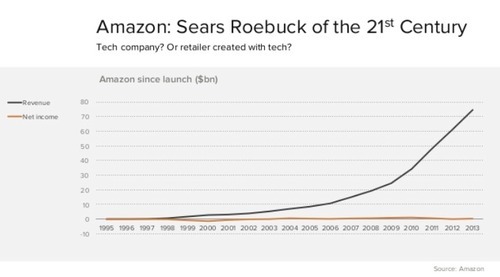
One company that came up during our discussion was not surprisingly Amazon.com. But the initial comment was that they don’t make any money. Fortunately for me I had just gone through a presentation by venture capitalist Benedict Evans the night before called: Mobile is eating the world. And so I pulled out my phone and presented this slide:
The fact that Amazon operates with basically no net income is on purpose. Look at their revenue growth! So I wouldn’t dismiss them as being a fad. They may only account for 1% of all US retail sales today, but I’d put money on that percentage growing.
The other reason I bring up Amazon is because, in some ways, I think of them as the online equivalent of a big box store. Just like a Walmart or Costco, where you can buy everything from tires to groceries to prescription drugs, I buy a lot of different things, besides just books, off of Amazon.com. You might do the same as well. And this is where I see the immediate threat to offline retailing and retail real estate: big box stores.
In the second half of the 20th century, big box stores were incredibly disruptive to the retail landscape (and to cities). They used cheap land on the outskirts of cities, cheap buildings, and economies of scale to offer rock bottom prices to consumers. The value proposition was about cheap, not about differentiation. But as cheap as they may be, the internet can still do it cheaper.
And retailers know this, which is why I think they all now sell groceries. Groceries have a very low online penetration. Basically everybody still buys groceries in-person. So if you offer that, you have a reason to draw people inside your store, where they will hopefully buy all the other stuff that they need. But as the online value proposition continues to get stronger, I think we’ll see many other, more significant, changes.
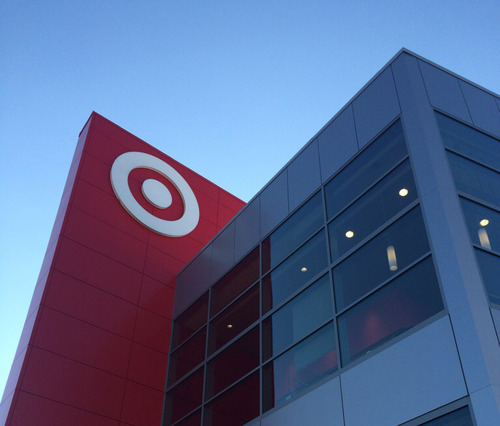
Tonight I finally got the opportunity to visit the Stockyards retail center at the corner of St. Clair West and Weston Road in Toronto. It’s a 550,000 square foot complex that was only recently completed. The major anchor tenant is Target and it just so happens to be the first new construction Target in Canada.
What’s interesting about the Stockyards development is that it’s a reinvention of the suburban big box store format that we all know so well. You know, the big store surrounded by a sea of parking. And from my past experience working on projects similar to this one, I can tell you that the Stockyards project is generally loved by planners at the city.
So what’s the big deal?
Let’s first look at how it would work for a traditional big box store development. Assume you’re a developer and you’re trying to secure a 150,000 square foot big box store tenant for your site.
Historically, in order for that tenant to even consider signing with you, you’d need to be able to offer her a single level format. In other words, her 150,000 square feet needs to be all on one level. Multiple levels are more expensive to build and they add another layer of complexity when it comes to shopping carts, back of house loading, and so on.
On top of this, she’s going to have onerous parking requirements. It wouldn’t be unheard of for her to ask–or demand–for 3.5 parking stalls per 1,000 square feet of rentable area. If you do the math in this example (150,000 / 1,000 x 3.5), you get 525 parking spots. This number usually exceeds any of the parking requirements that your local municipality might have. And historically, it has always been surface parking. So forget about building a parking garage and don’t even waste a second thinking about underground parking. That’s way too expensive.
Finally, the tenant will want her building oriented in such a way that the entrance is directly in front of the largest possible number of parking stalls. Usually this means that the front of the building is facing inward, away from the street, and the rear of the building is facing outward towards the rest of the city. If you could provide all of this and the demographics in your catchment radius were favorable for her business, you’d be in a pretty good position to sign a deal.
The problem with this format is that most cities don’t want it anymore. It goes against everything that most progressive cities are trying to promote in terms of walkable and transit-oriented communities. Large surface parking lots don’t make for great cities and neither do introverted buildings. At the same time, land values are getting to a point where developers need to use their land more intensively. Big surface parking lots just aren’t the highest and best use.
So how then do you make big box retailing work?
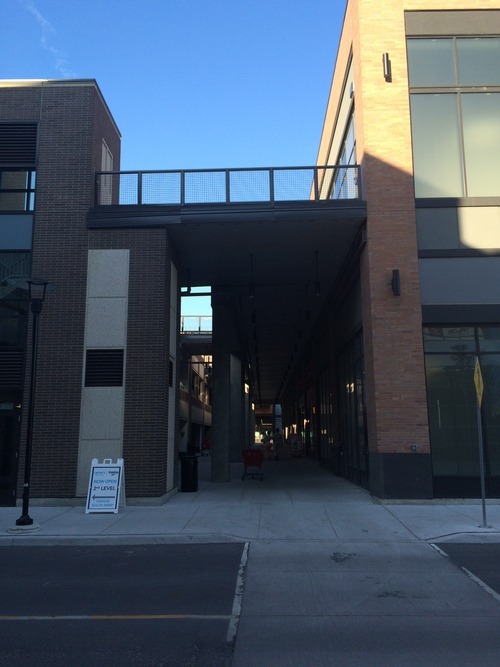
That’s where the Stockyards comes in. What they’ve done is put smaller retailers along the perimeter of the site with direct access from the sidewalk; they’ve buried the parking in the middle of the site (and built structured parking); and they’ve moved the anchor and larger tenants (Target, Winners, etc.) to the second floor. I don’t think that all big box stores would go for this, but Target is known to be one of the more progressive in this regard.
So functionally, if you’re taking transit and walking along the street, you have shops engaging you and you’re not looking at the loading area of some big box store. And if you happen to be driving–as many people do to big box stores–you can either drive in and park on the ground floor (and then take an escalator up) or you can drive up the second floor parking area and walk right into the store as you normally would. What they’ve basically done is adapted big box stores to a more urban context.
Now, I can see why many at the city like this development and I certainly think it’s a step in the right direction in terms of getting both developers and tenants to think more urban. But I wouldn’t say that we’ve nailed the formula here. When I was there the space felt empty and I had trouble orienting myself after I parked. But it’s certainly a major improvement compared to the big box stores across the street.
If you’ve had a chance to visit the Stockyards, I would love to hear from you in the comment section below.
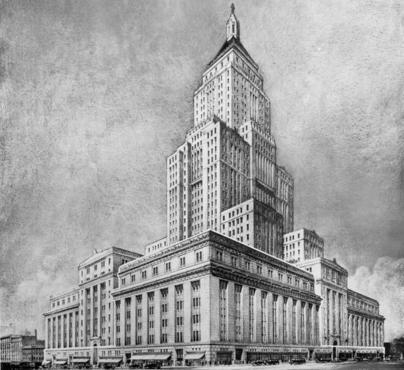
I was out last night near Yonge and College for a friend’s going away party and the topic of the College Park building came up (originally an Eaton’s department store). We talked about how in the 1920s it was planned as a 38-storey Art Deco tower (see above photo), but that the Great Depression forced Eaton’s to scale back their plans. They ended up building a 7-storey building, albeit an impressive one.
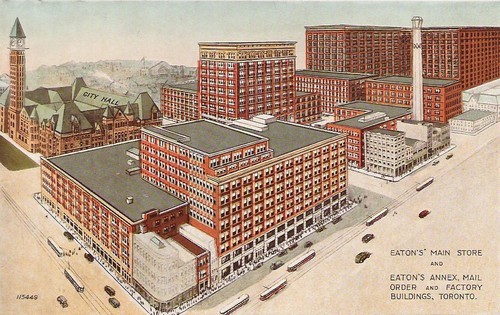
Then today, thinking about that discussion, I became curious about the story of Eaton’s. Where exactly did it start and how did they get to a point where they were planning the largest retail and office complex in the world?
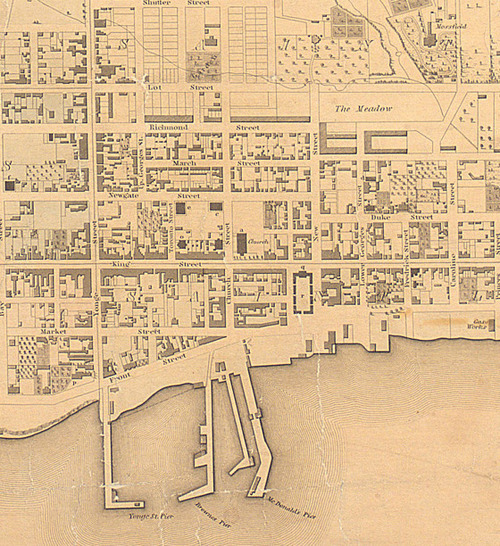
Well, as many of you probably know or can guess, the first Eaton’s store was opened where the Toronto Eaton Centre mall currently sits today. The exact address was 178 Yonge Street, which is just north of Queen Street. But what was interesting about this location is that, at the time, it was considered to be far removed from Toronto’s center of fashion and retail. That was King Street East. Below is a map from 1842.
In 1869 when Timothy Eaton opened his first store, the heart of Toronto was what is today known as Old Town (although most people would probably just refer to it either as King East or as the St. Lawrence Market). People shopped along King Street between Yonge and Jarvis, and Queen Street probably would have felt out of the way.
But Eaton’s succeeded at Yonge & Queen, along with rival store Simpson’s, and retailing shifted northward. With Eaton’s College Street, the company was once again looking north. In fact, they wanted to move their entire operation from Queen Street up to College Street, and they even tried to get Simpson’s department store to do the same (somebody clearly understood agglomeration economies).
But since the full build out of Eaton’s College Street never actually happened, both stores were kept in operation and a customer shuttle bus was run between the two of them (until the Yonge subway line opened up in the 1950s). With the opening of the Toronto Eaton Centre mall in the 1970s, Eaton’s closed both Queen and College Street locations, and consolidated operations near Dundas Street.
In 1999, after 130 years of operation, the company went bankrupt.
What I find interesting about this story is that it speaks to how dominant the department store business model was at the time and how it was shaping the city around it. If Eaton’s had achieved its vision for the corner of Yonge & College, Toronto might look a lot different today. Perhaps we’d all be shopping for fashion along College Street.