Daily insights for city builders. Published since 2013 by Toronto-based real estate developer Brandon Donnelly.

Tag: restaurant

  • CloudKitchens has spent more than $130 million on property over the last two years

    According to a recent Wall Street Journal review of property and corporate records, Travis Kalanick’s ghost kitchen startup, called CloudKitchens, has spent over $130 million over the past two years buying more than 40 properties in about two dozen cities.

    Travis is co-founder and the former CEO of Uber and this latest startup provides commercial kitchens to restauranteurs who are looking for a low-cost way to launch delivery-only food concepts.

    In some ways, it can be compared to coworking spaces for delivery-only restaurants. Instead of renting a full restaurant space, you lease 200-300 square feet of real estate at a lower cost address. CloudKitchens then handles all of the distribution and fulfillment, effectively lowering the barriers to entry for food startups.

    Some of the properties that they have been buying include a vacant restaurant space in Miami Beach for $9.2 million (May 2020) and an industrial property in Queens, New York for $6.6 million (March 2020). They’ve also bought in cities like Portland and Las Vegas.

    As you might imagine, now is a pretty good time to be buying some of these properties. And if you think about it, there are some real cost advantages to what they are doing, not to mention some co-working-style arbitrage on the real estate.

    The company is apparently going to great lengths to conceal what and where they are buying. But what is perhaps more interesting is their asset-heavy approach. They’re buying lots of real estate, which is inline with what companies like Opendoor are doing, but is distinct from Uber’s asset-light approach.

    It is also different from what many other ghost kitchen startups are doing. It seems that most are leasing their spaces. There has to be a reason for this difference.

  • Tasty data

    A recent study and research paper by the MIT Senseable City Lab — called, Tasty Data — has discovered that restaurant data alone can be used to accurately predict location-based factors such as daytime population, nighttime population, number of businesses, and overall consumer spending within a specific geography.

    They started by pulling restaurant data from Dianping (Chinese equivalent of Yelp) for 9 Chinese cities: Baoding, Beijing, Chengdu, Hengyang, Kunming, Shenyang, Shenzen, Yueyang, and Zhengzhou. They then paired their Dianping data with other available data (such as aggregated mobile phone data) and used machine learning to search for any correlations.

    Below is a diagram of “nighttime population” in Beijing. They are using a 3 km2 grid.

    If you’re a regular reader of this blog, you’ll know that I like these kinds of studies. By 2020, it is estimated that 1.7MB of data will be created every second by every person on earth. The numbers are staggering. And yet, “official” data sources, such as census data, remain slow and fairly limited. Studies like this one continue to show us what’s next.

    Image: MIT Senseable City Lab

  • On good design

    Last summer, Zach Mortice published this article in Metropolis talking about two new buildings in Chicago. Here is his architectural description of the first:

    Ross Barney’s design is unabashedly cosmopolitan, yet welcoming. Conceived as a series of interlocking Miesian pavilions, it comprises a glass cube containing the dining room and a smaller opaque volume, which holds the kitchen. The glass envelope shows off the restaurant’s burly cross-laminated timber beams, the first time this ultra-strong, low-carbon structural system has been used in Chicago. The exterior pergola is clad with solar panels and provides shade across an entire city block while also generating most of the restaurant’s energy. With a landscaped plaza and outdoor seating, there’s a strong focus on attracting pedestrians to this green-starved section of the city, with a landscaped plaza and outdoor seating.

    Zach is describing the then new flagship McDonald’s in the River North area of Chicago. That’s maybe not what you were thinking as you were reading the description, but it is, of course, part of a broader transformation for the brand:

    “We don’t need to be loud anymore,” says David Vilkama, McDonald’s global creative director. “We’re trying to move away from the old, cheap, plasticky, in-your-face fast food culture.”

    It is a clear example of the value of good design and also how it has seemingly become table stakes for many firms and industries. 

    But as Zach points out in this article, is this also evidence that brands need to, not only invest in good design, but also move upmarket in order to maintain growth?

    In other words: Does good design inevitably equal more expensive?

  • Introducing Stephen Avenue Place

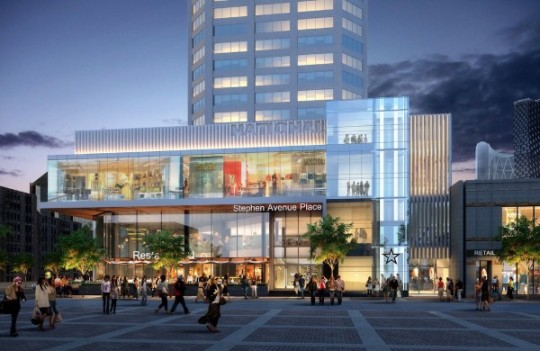
    Today, the Slate Canadian Real Estate Opportunity Fund I announced a new name for its 40 storey tower at 700 2nd Street in Calgary: Stephen Avenue Place

    It also announced that it has partnered with Oliver & Bonacini Hospitality and Concorde Entertainment Group to create three new dining destinations at the property: a top floor restaurant, a food hall, and a high-energy restaurant/bar/patio at street level.

    Here are a couple of excerpts from today’s press release:

    Stephen Avenue Place offers 620,000 square feet of rentable space at the nexus of the historic Stephen Avenue Walk and 2nd St. This classic of the Calgary skyline will undergo a significant renovation – from its public-access ground floor to exclusive tenant amenities and top-floor restaurant – that will reposition it as a modern hub for energy, innovation, business, dining and shopping.

    The acquisition and renovation of Stephen Avenue Place is part of Slate’s growing investment in Calgary. In the past 18 months, Slate has increased its footprint in Calgary to 2.3 million square feet with the purchase of 21 office properties, including 12 downtown.

    “We are thrilled to acquire and develop such a high-quality property in downtown Calgary that offers businesses, diners and shoppers the very best in location, amenities and access,” said Slate founding partner Blair Welch. “Stephen Avenue Place will undergo an extensive renovation to fully reflect the way we work and live now, while respecting and celebrating its history and future as a Calgary landmark.”

    For the full press release, click here. And to learn more about Stephen Avenue Place, including leasing opportunities, click here.

    Disclosure: As many of you already know, I work for Slate Asset Management L.P. I am responsible for the company’s ground-up development efforts.

  • Why you should sometimes ignore your customers

    In business we are told to listen to our customers. Be customer-centric. In city building we are told to listen to the community. Be community-focused. And there’s no question that these mantras exist for a reason. They are paramount.

    But when should you not listen?

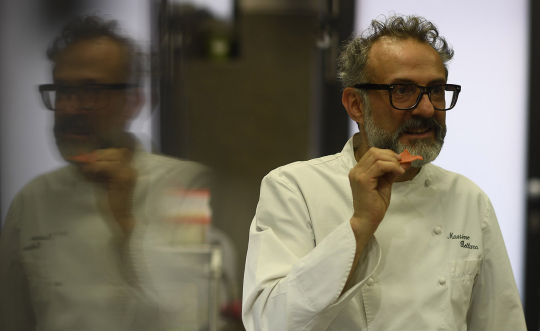
    I watched a Chef’s Table documentary last night on Massimo Bottura (pictured above), who is the owner and operator of Osteria Francescana in Modena, Italy. Osteria Francescana is a 3 star Michelin restaurant and widely ranked as one of the best restaurants in the world.

    But it wasn’t easy for Massimo at the beginning. His goal was to bring the Italian kitchen into the 21st century and so his plates are often creative takes on classic Italian dishes. His restaurant blends the old and new; food and contemporary art.

    This approach upset a lot of people at the outset. Massimo was seen almost as a traitor who was turning his back on traditional Italian cooking within provincial Modena. Don’t mess with centuries of tradition they would say. Grandma knew best, son.

    Because of this, his restaurant sat empty in the early years, to that point that he was ready to close its doors. The only reason he kept it open was because his wife encouraged him to give it one more year. She said: This is the kind of food you want to make. If you don’t try, you’ll regret it.

    So he gave it another year and luckily he got a few breaks, including a glowing review by a well known food critic from out of town. Once this hit, the Modenese started to quickly rethink their distaste for Massimo’s idiosyncratic dishes. Before long, his restaurant was full.

    So what changed? It wasn’t the dishes. It was perception. The out of town critics and positive reviews gave people permission to like the dishes. This is critical because nobody needs permission to like tradition. It’s tradition, after all. There’s little risk in that.

    But there’s risk in liking something new that hasn’t been done before. Change creates uncertainty. And if Massimo’s wife hadn’t encouraged him to stick with it just a bit longer and ignore the naysayers, the world may not have one of its top restaurants.

    Sometimes we don’t know what we like and want until we are shown.

    Image: Osteria Francescana 

  • The value of absurdity for innovation (and a story about tacos)

    Vegan tacos by Karolina Wiercigroch on 500px.com

    https://500px.com/embed.js

    “Great ideas alter the power balance in relationships. That’s why great ideas are initially resisted.” –Hugh Macleod

    I have been following the work and writing of designer Tobias van Scheider for quite some time now. If you don’t subscribe to his newsletter and you end up liking this post, you should consider signing up.

    Recently I stumbled upon something he published back in October called “Ignore Everybody”, where he argues that when you’re exploring something new – that could potentially fail – one of the best things you can do is ignore everybody. 

    And that’s because:

    “We have to understand that ideas are by nature very fragile. They’re like little naked babies, unable to protect themselves. If we really believe in a new idea, we have to protect her with great effort. This is difficult, because oftentimes the greatest ideas get killed by the people around us. Executing on a great idea is by nature a lonely path. If everyone would agree with you, the idea is probably not that great anyway.”

    I am incredibly interested in how new things get started and how new ideas thrive. Fostering innovation has become a critical component of city building in today’s world. But sometimes I feel as if we’re thinking too top-down, as opposed to bottom-up. 

    As Tobias rightly points out in his article, lots of great ideas started as stupid little projects. Who would have thought that a teen sexting app with disappearing messages (Snapchat) would become a company worth many billions of dollars?

    It’s for this same reason that Sam Altman of Y Combinator recently wrote that sometimes its better to call your new company a project, rather than a business. When you call it a business you impose all kinds of biases onto it in terms of viable business models, and so on. But when you keep it a “project”, it becomes more acceptable to be experimental.

    As an example of all this, I was fascinated to learn this past weekend about a Toronto-based ad agency called OneMethod. Because as part of their agency they have a division called the MethLab, where the goal is to simply experiment with “absurd ideas.”

    One of those absurd ideas was a social media campaign slash pop-up taco restaurant – remember, they are an ad agency not restauranteurs. It was so grassroots that they ended up having to sell original art work that happened to come with a “free” taco in order to get around all the legal requirements for serving food. Brilliant.

    The idea was so well received that it has grown into a fully fledged restaurant called La Carnita, which today operates across 3 permanent locations and happens to be one of the most popular taco restaurants in Toronto.

    But let me ask you this, if they had instead gone out to investors – as an ad agency wanting to get into the taco business – would they have been able to raise the money for their first physical restaurant? I can imagine this being a lot more difficult.

    On a larger scale, this is exactly what Google is doing with Alphabet. The company was reorganized and rebranded so that they could continue to work on absurd ideas outside of the Google cash cow. If the idea/project takes off, then it becomes a fully fledged company. If it doesn’t, then it gets shut down and something else is tried.

    This is what people and companies are doing today to stay relevant in the innovation race. 

    But in some ways it feels like a battle to allow the absurd to survive. That’s why the best approach might be to just ignore everybody. There’s value in the absurd but maybe you’re the only one who sees it right now.

  • First crowdfunded real estate project opens in D.C.

    Want further evidence that technology and the internet are going to dramatically transform many “non-tech” industries such as real estate? 

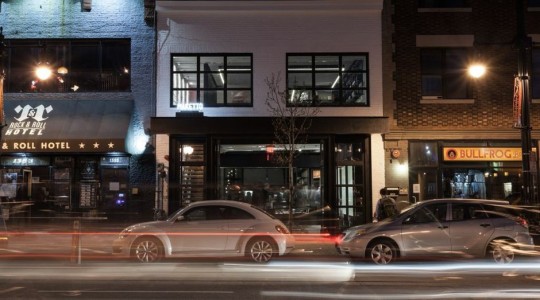
    Take a look at 1351 H Street NE in Washington D.C (pictured above). It houses a hybrid retail store and restaurant and is probably the first truly crowdfunded real estate project.

    The project was completed using a platform called Fundrise, which I’ve written about before here on Architect This City. Their vision is to completely democratize real estate investment by removing middlepeople and outdated regulations that restrict who and how people can invest in real estate.

    To accomplish this, the founders of Fundrise went out in 2011 and bought the building located at 1351 H Street NE for $825,000. The goal was for it to act as their proof of concept. 

    They then spent a significant amount of time and money figuring out how to make it legal for small and local investors to participate in the project (as opposed to just accredited investors). It was ultimately done through a “local public offering” filed with the SEC.

    So how does it work?

    In the case of 1351 H Street NE, they first went out to the local community and asked them what they wanted to see. That’s how they ended up with a unique retail store / restaurant. It’s what the community wanted.

    Once this was established, they went out and issued 3,250 shares and crowdfunded $325,000 from 175 local investors. This was for an ownership share in both the building and the future business. The average investment amount was $2,000, but people were able to invest as little as $100.

    This is an incredible accomplishment. It takes real estate investment and development to a local level and really empowers small entrepreneurs to start businesses that may have been previously unfundable by traditional sources.

    I don’t know what you think, but I think this is the beginning of a powerful transformation. Many of the structures that are currently in place were formed at a time when it wouldn’t have been practical to crowdsource ideas and crowdfund money. But now that is very possible. It was just done.

    Image: Maketto