
Daily insights for city builders, delivered every morning at 6 AM ET. I’m Brandon Donnelly — a Toronto-based real estate developer and founder of Globizen. I’ve been writing here since 2013.

Tag: resonance consultancy

  • Desirable vs. affordable

    Resonance Consultancy, which is a placemaking firm that we have spoken about before on the blog, is working on a new America’s Best Cities report. And as part of this, they’ve been surveying Americans about which cities they would most like to live in and visit. The result is a list of the most “desirable” US cities that looks like this:

    1. New York
    2. Miami
    3. Los Angeles
    4. Las Vegas
    5. San Diego
    6. Chicago
    7. Seattle
    8. San Francisco
    9. Houston
    10. Denver

    The long and the short of it seems to be that people generally want to live in the places where they like to travel. But what’s interesting is that if you look at the US cities that have actually grown the most in absolute numbers over the last few years (specifically April 2020 to July 2023), the list transforms into this:

    1. Dallas (+462,639)
    2. Houston (+360,649)
    3. Phoenix (+219,008)
    4. Atlanta (+200,414)
    5. Austin (+189,896)
    6. Tampa (+167,672)
    7. San Antonio (+145,884)
    8. Charlotte (+144,767)
    9. Orlando (+144,542)
    10. Jacksonville (+107,396)

    The only city that shows up on both is Houston.

    What this suggests is that cities very much have brands. And when you ask people where they’d ideally like to live, they think of the sexiest ones. Places like New York, Miami, Los Angeles, and so on. But it when it comes to actually moving somewhere and paying for a home, there are clearly other realities to consider — the most important of which is probably affordability.

  • The rise of global citizens

    Leisure travel, according to Resonance, is growing:

    In fact, spending on leisure travel and recreation has outpaced the overall growth in consumer spending over the last decade, and inflation-adjusted spending on leisure activities as a share of overall consumer spending grew from 9.5% in 2013 to nearly 13% by 2022. This means that the travel and tourism industry is getting a growing share of a growing pie, which bodes well for the long-term future of those hotels and destinations that cater primarily to leisure travelers.

    And so are blended trips (trips that combine business and leisure). Though the way people are going about it has evolved:

    What used to involve adding a day or two on the weekend to a weekday business trip has shifted to the mixing of business and pleasure throughout the week. With a greater percentage of the workforce in the U.S, Canada and the U.K. only going into the office 2-3 days per week, workers from these countries are free to blend their travel for up to a week. And with as much as a quarter of professionals in the U.S. now working remotely, a whole new class of nomadic travelers has emerged who are able to travel anywhere, anytime—as long as their accommodations have adequate high-speed internet and appropriate workspaces.

    At the same time, cities are really clamping down on short-term rentals, which is a common way people do blended trips. Resonance believes this will create new opportunities:

    But while increased regulation and enforcement of the sector will wipe out the businesses of many “professional” hosts and investors, it’s also creating new opportunities for cities and developers to create new neighborhood-oriented hotels that satiate travelers’ desire for local experiences while also being additive to the quality of life of local residents.

    It might be the case that these two things are inversely correlated. More people are traveling for fun and for work, and so now cities are trying to manage that demand; more travel leads to more regulation. Whatever the case, I do agree that this is an important consumption trend.

    My working theory is this: if money wasn’t an object, a lot of people would love to have homes all around the world and live in multiple places. I certainly would. And the list of places is already in my phone. But since this isn’t practical for most, we have Airbnbs, neighborhood-oriented hotels, Soho House global memberships, and the ability to buy fractions of second homes.

    These solutions all respond, at least partially, to our desires for new experiences and for a deeper attachment to places. But now that tech is expanding the reach of cities, these desires are becoming further untethered. And so my view is that there’s going to be a lot of opportunity in the world of “making people feel like they’re global citizens.”

  • The global cities attracting talent, visitors, and investment

    Earlier this month, Resonance Consultancy published its 2024 World’s Best Cities ranking. Or, in their words: its definitive power ranking of the 100 global cities that it believes are shaping tomorrow.

    These are always fun to flip through, which is I guess why people do them and why people look at them; but I do think it’s important to look at the underlying methodologies. Otherwise, what does “world’s best” even really mean?

    In this case, they’re looking at global cities through the lens of three key categories: livability, lovability, and prosperity. More specifically though, the report looks at factors that are demonstrated to have moderate to strong correlations with attracting talent, visitors, and/or businesses.

    This makes it distinct from rankings that are more focused on things like livability. Because according to Resonance, factors such as commute times, crime, and housing affordability don’t tend to correlate strongly (at least in the short-term) with a city’s ability to attract talent, tourism, and investment.

    While this may seem a bit counterintuitive, it does also make sense. People don’t move to London because they’re looking for affordable housing and a reasonable commute. They move to London because they want to be in the center of the world.

    And yes, London tops their power ranking:

    The top of this ranking isn’t all that surprising. It’s the usual suspects. But I continue to be impressed by how quickly Dubai has transformed itself into a top global city. Also impressive is how Dublin punches above its weight of just over 500,000 people.

    I am medium surprised to see Hong Kong nowhere on this first page (there are another 65 cities not shown here). It usually features as a top global city. But presumably this is the result of Beijing meddling. People are looking elsewhere — like Singapore.

    For the full list of cities and to download a copy of the report, click here.

  • The world’s best cities

    Whenever you see a best-of-anything ranking, you should probably ask yourself what the hell “best” even means. In this case, Resonance Consultancy is ranking the world’s cities based on six alliterative categories: place, people, programming, product, prosperity, and promotion.

    Some of these metrics are qualitative, but many are, in fact, quantitative. Number of COVID-19 infections in 2020; number of direct destinations served by the city’s airports; number of foreign-born residents; number of top-rated restaurants (TripAdvisor); most Instagram check-ins, and so on.

    The result is this list of the world’s best cities:

    1. London
    2. New York
    3. Paris
    4. Moscow
    5. Tokyo
    6. Dubai
    7. Singapore
    8. Barcelona
    9. Los Angeles
    10. Madrid
    11. Rome
    12. Chicago
    13. Toronto
    14. San Francisco
    15. Abu Dhabi

    I arbitrarily chose the top 15 cities in order to make sure that Toronto was included in this ranking. If you’d like to download a full copy of the 2021 World’s Best Cities report, you can do that over here. I recommend you check out their performance criteria.

    Toronto, for example, performs very well when it comes to “people.” That’s fairly consistent across most of these rankings. But it didn’t fare so well when it comes to “place.” That category includes things like the average number of sunny days and the number of high quality sights & landmarks.

  • The views are different here

    Tourism Toronto launched a new campaign this week and with it came a great video that has been making the rounds online. It feels authentic. It actually feels like Toronto. Watch it here if you can’t see it embedded below. 

    [youtube https://www.youtube.com/watch?v=eS_tYWIoZzk?rel=0&w=560&h=315]

    But why exactly is it a successful example of place branding?

    Resonance (place branding consultancy) wrote a post about it and also spoke with Tourism Toronto’s EVP and Chief Marketing Officer. Here’s an interesting excerpt about the two things they wanted to achieve in the campaign/video:

    “The campaign—and certainly this video—is trying to achieve two things,” Andrew Weir, Tourism Toronto’s executive vice president and chief marketing officer, tells Resonance. “First, international visitors tend to think of destinations by country, so we had to connect Toronto to the Canadian story.” He says the sprawling, wild country is still generally known for mountains, forests and wilderness, and Toronto wasn’t connecting to that narrative. Enter the “Canada’s Downtown” identity as a way to both incorporate the destination in a national context and differentiate from it. “Toronto is home of the country’s stock exchange, the center of media, the big sports teams are here, we have the long-run theater productions,” Weir rhymes off. “It is the urban center of Canada.”

    The second objective for the campaign (and one held high throughout the commercial) was to be unabashedly proud of the city’s unique alchemy, diversity and inclusivity.

    “We’ve seen the foundation for local pride laid by people and brands like Drake and the Raptors and we wanted to build on that, to separate ourselves from other cities. We tapped into that energy that’s embedded in Toronto’s identity and sense of place.”

    Pride—and a devotion to inclusivity and openness—jumps off the screen. Given the current political direction towards closed borders and suspicion, the goosebumps pop often while viewing.

    At the end of the day though, I think it comes down to the fact that it feels like it captures the zeitgeist of Toronto. As I said at the beginning of this post, it feels authentic. And good place branding doesn’t invent identity. It takes things that are already latent and then exploits them.

    It’s either that or I just like seeing the Chinese food place I go to at 3am featured in a video.

  • World’s best city brands

    Resonance Consultancy – they do brands and strategies for places and products – has just released a new report called: World’s Best City Brands – A Global Ranking of Place Equity.

    With all of these sorts of rankings, it really depends on the research methodology being used and the rigor in which it is being applied. In this case, they evaluated each city based on “six pillars of equity”:

    1. Place: Perceived quality of a city’s natural and built environment
    2. Product: A city’s key institutions, attraction and infrastructure
    3. Programming: The arts, culture and entertainment in a city
    4. People: Immigration and diversity of a city
    5. Prosperity: Employment, GDP per capita entertainment in a city and corporate head offices
    6. Promotion: Quantity of articles, references of a city and recommendations online

    What’s perhaps unique about this study is that it combines measurable statistics with “visitor perception metrics” – data that they mined from social media. Here’s an excerpt from the methodology page:

    “Our team became interested in the way visitors and citizens themselves influence the identity and perception of cities. Increasingly, they do it through their evaluation of experiences on social media and via the comments, images and reviews they share with family, friends and people around the world. These opinions and attitudes, much more than traditional marketing, influence the way people perceive places today.”

    This is a fascinating shift for city brands and is something that we have discussed before on this blog. All of us are now involved in telling the story of the places in which we live and visit.

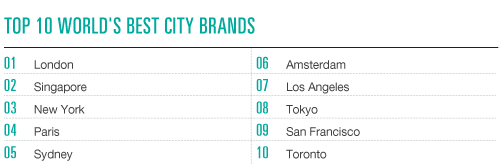
    The entire report is well done and worth a read. It’s also a free download (you’ll need to enter your contact info). But below are the top 10 world’s best city brands. Not really any surprises for me. What about for you?

    image