
Daily insights for city builders, delivered every morning at 6 AM ET. I’m Brandon Donnelly — a Toronto-based real estate developer and founder of Globizen. I’ve been writing here since 2013.

Tag: research study

  • Personalities and places

    Here is an interesting study about personalities and places (Journal article here and study here). It is interesting because so many of us are working from home and away from our regular environments. But it is also interesting because a lot of us, here on this blog, are in the business of creating spaces. And these environments have an impact on all of us.

    The researchers for this study started by assessing the personalities of some 2,000 university students. The objective was to determine their baseline temperaments according to the “Big Five” personality traits: openness, conscientiousness, extroversion, agreeableness, and neuroticism. Once that was established, the students were sent out into the world with a location-based app on their phone.

    Four times a day, the participants were asked to enter their current location, as well as answer a few questions about their current state of mind. The big takeway from this study is twfold and is as follows: “People actively select their environments, and the environments they select can alter their psychological characteristics [both] in the moment and over time.”

    The first bit is perhaps not all that surprising. We all have different personality traits and we choose environments that suit what we like. Extroverts, for example, tend to spend less time at home and more time at restaurants, bars, clubs, and at friends’ places. (Presumably this means that quarantine was a lot harder for extroverts.)

    The second part of this finding suggests that once we have actively chosen where we want to be, that environment then impacts how we feel at that exact moment, as well as over a certain period of time. You’ll have to read the study for the nuances around this. But it is fascinating to me because it helps me explain why I feel different now that I’m mostly working from home.

    Beyond poor video call connections and the lack of in-person collaboration, there also seems to be the psychological impact of not being in a particular environment. Not having to commute is a nice feature, particularly for some, but it also means not being around colleagues and not being able to meet for that impromptu craft beer. Turns out those things matter for our mental state.
  • We are all biased against creativity

    image

    I would like to do a follow-up to yesterday’s post about innovators and creators, because I recently stumbled up the following quote:

    “We think of creative people in a heroic manner, and we celebrate them, but the thing we celebrate is the after-effect,” says Barry Staw, a researcher at the University of California–Berkeley business school who specializes in creativity.

    It is taken from a Slate article called: Inside the Box – People don’t actually like creativity. And it’s supported by a bunch of research, including a 2010 study conducted by professors at Cornell University, the University of Pennsylvania, and the University of North Carolina.

    The key finding was that people generally hold a bias against creativity, and it’s activated when we become motivated to reduce uncertainty. This might be because we fear rejection or because we’ve come to learn that reducing uncertainty and promoting the status quo is often better for career advancement. 

    There’s less perceived risk.

    But here’s the thing: celebrating creativity after the fact is meaningless. There’s no genius in that. Everyone now knows this truth. The heroics come into play when you’re both willing to be misunderstood and willing to be dead wrong.

    Of course, talk is cheap. 

    Here are 5 suggestions for promoting greater creativity at your company taken from Tom Tunguz’s blog, who himself is borrowing from Barry Staw (author quoted above):

    1. Hire people who’s skills aren’t precise matches for the needs of the company.
    2. Encourage employees not to listen blindly to corporate policy and conventional wisdom; not all to speak with the same voice.
    3. Those in power should go as far as possible to encourage active opposition to ideas. (Similar to Drucker’s obligation to dissent).
    4. Optimize for adaptiveness. Have extra labor capacity and explore side projects. (How many creative companies started or were reinvigorated by side projects? Twitter and Slack are two that immediately come to mind).
    5. Lead rather than follow. Take risks.

  • This U.S. housing boom is different

    Just a few days ago, The Federal Reserve Bank of San Francisco published an interesting research study where they argue that this U.S. housing boom is different than that of the early 2000s.

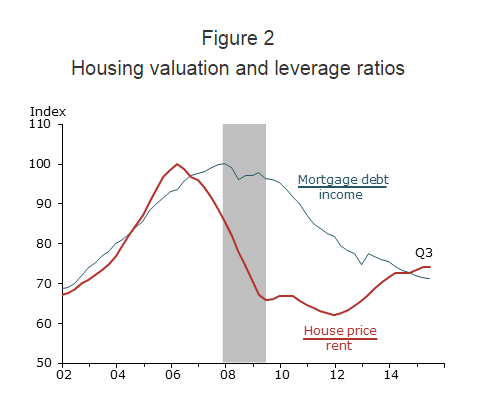
    During the last boom, U.S. home prices peaked in 2006 and then dropped about 30% in the wake of The Great Recession. Since then prices have rebounded – almost to their pre-recession levels. This has some people asking whether this story is headed towards the same ending.

    But the FRBSF is saying no:

    “We find that the increase in U.S. house prices since 2011 differs in significant ways from the mid-2000s housing boom. The prior episode can be described as a credit-fueled bubble in which housing valuation—as measured by the house price-to-rent ratio—and household leverage—as measured by the mortgage debt-to-income ratio—rose together in a self-reinforcing feedback loop. In contrast, the more recent episode exhibits a less-pronounced increase in housing valuation together with an outright decline in household leverage—a pattern that is not suggestive of a credit-fueled bubble.”

    And here’s the chart:

    Source: Flow of funds, Bureau of Economic Analysis (BEA), CoreLogic, and BLS. Data are seasonally adjusted and indexed to 100 at pre-recession peak.