Daily insights for city builders, delivered every morning at 6 AM ET. I’m Brandon Donnelly — a Toronto-based real estate developer and founder of Globizen. I’ve been writing here since 2013.

Tag: rer

  • Uberpooling your way to cheap rides

    This morning on my way into the office I ran into a friend who lives in my building (downtown). She works in midtown and so I asked her how she gets into the office. She told me that she either takes the subway or an Uber, but that increasingly she has been taking Uber, particularly on the way home.

    We then started talking costs and she told me that what she does is carpool with a friend from work using UberPOOL. They live nearby and so what they do is leave from the same place at night (the office) and then select a midpoint location between their homes for the drop-off. After splitting their portion of the fare, the ride costs her about $3.25.

    As she was telling me this, I couldn’t help but think to myself: Wow, this is massively disruptive to transit. That is the same cost as taking the subway. So why take transit? With the subway, there may be a speed argument in certain instances, but that certainly wouldn’t be the case with some of Toronto’s streetcar lines (such as the King line). It’s faster to walk.

    However, there are obviously geographic limits to how far you can go in an UberPOOL before your costs greatly exceed taking transit. But as Uber and other similar services continue to bring down the price of a ride (eventually the labor cost component will disappear), how big does that area get?

    All of this – including my own mobility patterns – has got me thinking yet again about the role of transit in the city of tomorrow. 

    One segment that continues to be underserved is the regional scale. Here in the Greater Toronto Area, we are working on that by transforming our commuter rail service into a two-way all-day Regional Express Rail service. Today that strikes me as being hugely valuable. And unless driverless vehicles somehow solve our traffic problem, it will likely remain that way.

    I would love to get your thoughts in the comments below.

  • The London Crossrail

    On Thursday afternoon the mayor of Toronto, John Tory, was in London meeting with their mayor, Boris Johnston, and talking about Toronto-London business relations, the economy, and transit.

    Here is the tweet:

    //platform.twitter.com/widgets.js

    On the topic of transit, the big item to see and discuss was The Crossrail. For those of you who might not be familiar with it, here are a few bullet points from their website:

    Crossrail is Europe’s largest construction project – work started in May 2009 and there are currently over 10,000 people working across over 40 construction sites.

    The Crossrail route will run over 100km from Reading and Heathrow in the west, through new tunnels under central London to Shenfield and Abbey Wood in the east.

    Crossrail will transform rail transport in London and the south east, increasing central London rail capacity by 10%, supporting regeneration and cutting journey times across the city.

    Crossrail will bring an extra 1.5 million people to within 45 minutes of central London and will link London’s key employment, leisure and business districts – Heathrow, West End, the City, Docklands – enabling further economic development.

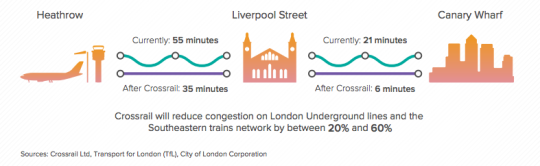
    And below is a neat diagram that I found in this City of London report. I think it does a good job summarizing some of the spatial impacts of The Crossrail.

    image

    In the past I’ve been negative about John Tory’s SmartTrack proposal, which is clearly inspired by The London Crossrail. I had my reasons for that. But I want to be clear that I am not in any way negative on Regional Express Rail as a mobility solution.

    Toronto would benefit greatly from RER and Metrolinx is working diligently to deliver it to the region. I can’t wait for that to happen so I can drive even less than I already do.

  • Toronto mayoral candidate announces regional express line

    image

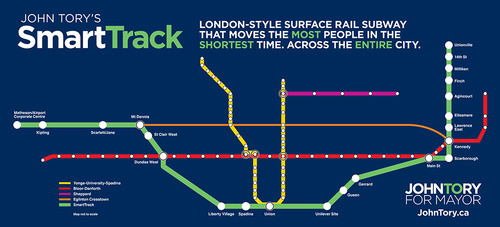
    Yesterday Toronto mayoral candidate, John Tory, proposed a transit line called SmartTrack. It’s part of his One Toronto transit plan. If you’re interested in watching the full 30 minute announcement, click here.

    As somebody who came out of the gate as a strong proponent of the “Yonge Relief Subway Line” (and as somebody I immediately supported for that reason), this proposal first hit me yesterday as a disappointment. Not because I don’t think we need a regional express rail network in the region (we do), but because I feel that he is backing away from that initial commitment and depriving the core of the transit infrastructure it needs.

    As soon as I found out about the plan, I immediately emailed one of my friends at Metrolinx. I told him I thought it was an “epic fail”. He pushed back and asked me to consider the merits of Tory’s plan. After having slept on it (and calmed down), I’m now prepared to talk about both the benefits of SmartTrack and why I was disappointed. 

    SmartTrack is basically a regional rail plan, intended to move people from the outer and inner suburbs to and from downtown using an integrated fare system. That is, riders will not have to pay a separate fare to transfer from subway to SmartTrack. 90% of the track needed for the plan is already existing, which means it will be cheaper and quicker to build compared to the full relief subway line. It will also bring employment centers such as Airport Corporate Centre in Mississauga into the transit network. For these reasons, the SmartTrack plan would certainly be beneficial for the region. 

    But, there’s a densities mismatch.

    If you look at the number of stops proposed in Scarborough and Markham, and compare it to the number of new stations proposed for downtown (1 – Spadina station) and the downtown shoulder neighborhoods (2 – Liberty Village and the Unilever site), the plan starts to look lopsided. SmartTrack would help residents of downtown get out to the suburbs, but it would do little to help them move in and around the core.

    If you look at the way Toronto is intensifying on a map, it looks like an upside down letter T. Density now hugs the waterfront and then follows our subway lines up north. I believe that the SmartTrack plan would help to relieve the pressures on those subway lines, but I don’t think it adequately addresses the bar of the T that now runs parallel to the lake.

    So while I do think that the Toronto region would be well served by regional express rail, I don’t think we can forget about the central part of the city. This shift in focus may have something to do with where Tory believes his voter base now sits, but let’s not forget that there’s a strong correlation between population density and transit ridership levels. 

    Now, let’s hear from you. What do you think of Tory’s One Toronto plan and SmartTrack proposal?