Daily insights for city builders, delivered every morning at 6 AM ET. I’m Brandon Donnelly — a Toronto-based real estate developer and founder of Globizen. I’ve been writing here since 2013.

Tag: renting

  • Rent control and road pricing — economics is the study of choice

    Yesterday’s post tried to pit politics against the realities of how we know cities and economics work. So today, I thought I would share a set of memos from Howard Marks (of Oaktree Capital) titled Economic Reality, Political Reality (which he refers to as an oxymoron), and Shall We Repeal the Laws of Economics?

    In this last one, he specifically talks about things like price gouging (starting with the grocery industry) and apartment rent controls. Each is worth a full read when you have the time, but here I’ll leave you all with a few city building-related thoughts.

    Marks describes economics as the study of choice. And within these choices, there are many complicated moving pieces and second-order consequences. Take, for example, rent control in New York City. What rent control does is stop the free market from being able to freely set rents. The result:

    A person in favor of this arrangement would argue that it maintains affordability and diversity. What it means in purely economic terms is that some people who couldn’t afford to live in New York City if rents were set by free-market forces are able to live there if they’re lucky enough to secure an apartment with regulated rent. But other people who would like to live in New York City and can afford higher rents can’t do so because there are no apartments for them. And lastly, landlords that have apartments that are somehow unregulated can command higher rents than would be the case if additions to the supply of apartments weren’t being discouraged. It’s a matter of personal philosophy whether this is good or bad. But clearly, the laws of economics and the actions of free markets aren’t at work in New York City. Someone in government is making the decisions.

    Much like inclusionary zoning in the case of new housing, the tradeoffs with regulated rents are that you get (1) less overall housing supply and (2) more expensive prices for the people that can pay market rents.

    You could argue, as Marks suggests, that these are acceptable outcomes; but regardless of your opinion, there are real consequences to this policy decision. There’s no such thing as a “free lunch” in economics, and consequently there’s no such thing as no-cost affordable housing. The question is: Who pays?

    Going back to the topic of traffic congestion from yesterday’s post, Toronto’s general reluctance to implement any form of road or congestion pricing is also an economic choice. We have priced our roads so cheaply that demand is always going to outstrip supply. And this is expected. What we are experiencing today is a natural market outcome.

    Targeting bike lanes as part of the problem is meant to counter this by increasing road supply. Less bike lanes means more space for cars, right? But the second-order consequence of this choice is that you push people off their bikes (which take up less road space) and into cars (which take up more road space). So demand is also likely to increase.

    The stark reality of solving traffic congestion is that it will require greater change. It will mean fewer people driving, more people taking transit and biking, and the people who do continue to drive will have to pay more for it.

    Of course, this is not what any politician wants to talk about. As Marks says: “In the world of politics, there can be limitless benefits and something for everyone. But in economics, there are only tradeoffs.” The tradeoff we have decided to make is cheap roads in exchange for crippling traffic congestion.

  • Rent-controlled apartment

    It is estimated that about 1% of the total housing stock in New York City is rent controlled (2019 figure), which is something different than rent stabilized.

    Generally the way the former works is that you have to have been living continuously in the home since July 1, 1971, and the building itself needs to have been constructed before 1947. If this is the case, then in theory, you should have seen relatively minor rent increases over the years.

    This was the case for the late real estate agent, Alice Mason, who died at the beginning of this year at the age of 100:

    She never left the rent-stabilized [controlled?] apartment where she held her storied dinners, in a century-old building on East 72nd Street. (In Manhattan real estate parlance, it was a classic eight, a gracious prewar layout that included three bedrooms and two maid’s rooms.) In 2011, the developer Harry Macklowe bought the building for a reported $70 million and began to turn the units into condos, buying out the tenants to do so. But Ms. Mason refused to give up her apartment. When she moved there in 1962, the rent was $400 a month. At her death, it was $2,476. The apartment below her, in the same line, was recently on the market for just under $10 million.

    Green, Penelope. “Alice Mason, Real Estate Fixer and Hostess to the Elite, Dies at 100.” The New York Times, 13 Jan. 2024, www.nytimes.com/2024/01/11/style/alice-mason-dead.html.

    For better or for worse, this is an obviously awesome deal, and reason enough to never move and have family members move in with you before you die so that you can try and pass down this asset for generations to come.

  • Our bias toward homeownership

    We have a cultural bias toward homeownership in this country. Other countries have it too. We believe that homeownership is what you should aspire to.

    In 2011, Statistics Canada pegged the homeownership rate at 69%. 9.2 million households out of a total of 13.3 million. Other more recent data suggests that it’s probably a bit lower, though still higher than that of the US since the financial crisis.

    Regardless, more owners than renters.

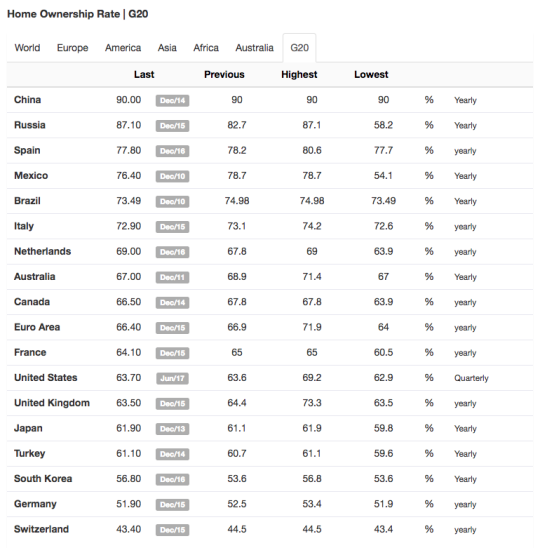
    I am not here to throw stones. I get it. I own my home. However, I do think it’s important to put this into perspective. Below is a chart from Trading Economics of homeownership rates in the G20:

    image

    At the bottom of the list – with the lowest homeownership rates – are Germany and Switzerland. Germany appears almost evenly split between owners and renters. And Switzerland is more renters than owners. 

    Both of these countries are wealthy. Both have a higher GDP per capita than that of Canada according to the World Bank and the International Monetary Fund. 

    Anecdotally, I can also say that some of the wealthiest people I know have made the decision to rent. They have simply decided to invest their capital elsewhere.

    I’m not trying to insinuate any sort of correlation with these statements, but I am trying to draw attention to a cultural bias.

  • VIA 57WEST in New York starts renting apartments

    image

    Bjarke Ingels’ West 57th Street project in New York (developed by The Durst Organization) has just started renting apartments (March 1). 

    Since I’m in the rental business, I thought it would be worthwhile to take a look at the rents – though I tend to obsess over all buildings and not just rental ones.

    Firstly, the project has a total of 709 apartments and 178 different unit types because of the architectural variations in the building. Of these units, 142 of them (20%) have been designated as affordable and were offered up via a lottery to people who fall within certain incomes ranges. 

    Here are the affordable rents via 6sqft.com:

    image

    I don’t know the exact numbers, but Curbed New York speculated – based on what was seen at other buildings on the west side – that the total number of applicants for these 142 units may have reached over 100,000!

    For the market-rate units, the average monthly rents are as follows (via Curbed NY):

    • Studio: $2,770
    • One-bedroom: $3,880
    • Two-bedroom: $6,500
    • Three-bedroom: $11,000
    • Four-bedroom: $16,500

    I wasn’t able to find average unit sizes (to calculate per square foot rents), but I estimate the overall average unit size to be around 1,000 square feet. 

    940,000 sf (total gross floor area)45,000 sf of retail x 0.80 efficiency (lower than average because of the shape of the building) / 709 units = approximately 1,000 sf of rentable area per unit. That’s just my rough guess based on what I could find online.

    Based on the Curbed comment section though, there are certainly some smaller units:

    image

    If anyone has any additional figures, please share them in the comments below. I think there are a few subscribers to this blog who are involved in the project.

    Image from via57west.com

  • The evolving gig economy

    This morning venture capitalist Fred Wilson wrote a post on his blog talking about the gig economy and Hillary Clinton’s economic speech last night. 

    Here’s a snippet from Clinton’s talk:

    Meanwhile, many Americans are making extra money renting out a small room, designing websites, selling products they design themselves at home, or even driving their own car. This on-demand, or so-called gig economy is creating exciting economies and unleashing innovation.

    But it is also raising hard questions about work-place protections and what a good job will look like in the future.

    So, all of these trends are real and none, none is going away. But they do not determine our destiny. The choices we make as a nation matter. And the choices we make in the years ahead will set the stage for what American life in the middle class and our economy will be like in this century.

    The headlines this morning are making it seem like Hillary Clinton is taking direct aim at companies like Uber. But the transcript suggests that she’s being far more balanced than that: these new companies are creating exciting opportunities, and they are not going away, but there are still things to figure out.

    That’s basically how I feel.

    Take, for example, Airbnb. I think Airbnb is a great idea and company. A lot of my friends use it both as consumers and as suppliers of space.

    But for many (most?) condos in Toronto, owners are strictly prohibited from renting out their units on leases that are less than six months. It’s a direct ban on short-term leasing and it’s written into the Condo Corporation’s Declaration.

    And there’s good reason for that. Who wants to buy a condo only to find out that next door is being operated as a nightly hotel? Most people would even prefer that their neighbor is an owner rather than a renter.

    That doesn’t mean I believe Airbnb should not exist. I think we’ll likely end up getting more transparent about how buildings (and portion of buildings) are operating, as opposed to it being a shadow economy. And that could help.

    If you have any ideas for how companies like Airbnb might be better integrated into urban life, I would love to hear from you in the comment section below.

  • Should you own or rent your home?

    image

    I was at a good friend’s wedding last night (congratulations again to Adrien + Rachel!), and one of the topics that came up at our table was whether it is better to own or rent your home. Now, in North America, conventional wisdom would suggest – almost mandate – that you have to own your place. If you’re still a renter, well then you’re “throwing away your money” my friend.

    But are you really? 

    A big part of the value of owning your home is that it’s forced savings. Every month when you make those principal and interest payments, you’re paying down your mortgage and socking away money for the future. And this can be a great thing for a lot of people, particularly if you’re not disciplined enough to save otherwise.

    But when you own a home, you’re also spending time and money on maintaining that home, and you’re also tying up capital that could be used elsewhere. So consider this: what if, instead of putting your savings towards a downpayment, you simply continued to rent and created an investment portfolio that you then contributed to on a regular basis just as you would a home?

    Depending on your assumptions, renting could turn out to put you further ahead financially. Here’s an example of that scenario from the Globe and Mail.

    Similarly, I remember being told in business school that companies that own their own real estate tend to under perform those that do not. And the rationale is that owning lots of real estate ties up capital that could otherwise be reinvested in the core business. In other words, if your core business is making widgets, then invest your money in making better widgets, not in real estate.

    But this is not to say that everybody should rent. Obviously I’m a big believer in real estate. And for a lot of people, owning may make sense. This post was really just to say that the owning vs. renting decision may not be as black and white as you might think.

    Image: Flickr

  • A century of homeownership and renting in England and Wales

    This morning while I was reading about gentrification in Berlin, I clicked through to an interesting overview of homeownership and renting in England and Wales over the last century. Here’s a video. If you can’t see it below, click here.

    [youtube https://www.youtube.com/watch?v=LDnGryGJ1ZA]

    The video starts in 1918, where the vast majority of households (77%) rented. As of 2011, this number has reversed. 64% of households in England and Wales now own their home.

    If you compare this housing trend to what happened in the United States and Canada, you’ll see a similarity. Although, the US was ahead in terms of promoting homeownership. They reached 50% ownership somewhere in the mid 1940s, whereas England and Wales didn’t reach this number until around 1971.

    image

    All of this is an interesting reminder that our obsession with homeownership is a relatively new one. But it’s also not a universal one. The homeownership rate in Berlin is 15.6%, and it’s only 49.5% in London. People in big cities tend to rent more.