Daily insights for city builders, delivered every morning at 6 AM ET. I’m Brandon Donnelly — a Toronto-based real estate developer and founder of Globizen. I’ve been writing here since 2013.

Tag: rental

  • W57 — A new hybrid building typology

    image

    We’ve been talking about a lot of heavy topics here on Architect This City lately. Everything from the contentious Gardiner Expressway East to minimum population densities to density creep. 

    So today I thought we could talk about something a bit more fun: architecture.

    When I was in New York last weekend, one of the buildings that was on my must-see list was the now under construction West 57th Street by Danish architect Bjarke Ingels. See photo above. (It also happens to be at the exact location where the West Side Highway transitions from elevated to surface boulevard.)

    This is supposedly the first North American project for Bjarke Ingels (he also has a project in Vancouver now). And if you’re a regular reader of this blog, you’ll know that I’m a fan of his work. His diagrams and storytelling ability were a big inspiration for me when I was in architecture school.

    The concept behind the project was to create a new hybrid building typology, one that is a cross between the typical European perimeter block building and the North American skyscraper. And the result is pretty wild.

    Here’s a video in case you aren’t familiar with the project. Click here if you can’t see it below.

    [youtube https://www.youtube.com/watch?v=_0JbTbOm_iQ?rel=0&w=560&h=315]

    I think it’s a really exciting project. What are your thoughts?

  • A few thoughts on Toronto’s rental resurgence

    Photograph Condos in Fog by Richard Gottardo on 500px

    Condos in Fog by Richard Gottardo on 500px

    Earlier today I attended a lunch and learn talking about the renewed interest in rental apartment development here in Toronto. Since this is a topic I’ve written about a few times here on Architect This City, I thought I would summarize some of my key takeaways from the panel discussion:

    • Market fundamentals are strong for purpose-built rental apartments. Vacancy is very low and demand will likely outstrip supply for many decades to come given the barriers to building (land availability, planning/approvals, and so on).
    • As of September 2014, CMHC reported 2,212 purpose-built rental units under construction in the Toronto region. And yet the annual demand for new rental housing is likely somewhere between 10,000 to 30,000 units (clearly some of this demand is being absorbed by condo rentals – the secondary rental market).
    • Millennials and retirees are seen as core markets for new rental apartments. Millennials want to live in urban centers and they like the flexibility that renting provides. Retirees want to know that they won’t be asked to move out because the owner wants to sell their condo unit.
    • It’s almost impossible to compete against condo developers when it comes to buying land (despite the next point). They (condo developers) will pay more. Therefore intensifying our “tower in a park” building stock is going to be a critical component of meeting rental demand in the region.
    • Part of what’s driving this interest in purpose-built rental (on the part of developers) is a softening condo market. So don’t be surprised when some developers flip back to condos when it makes financial sense to do so.

    It was interesting to hear this last point. It’s something that has been on my mind, but for whatever reason wasn’t really being talked about by the industry. That’s not to say that I think the condo market is in trouble though. It has just become more balanced. And ultimately that’s probably a good thing.

    Either way, I think that more rental and more housing options are a positive for the city and for consumers.

  • A new chapter

    Photograph St. Lawrence by Ralph Sobanski on 500px

    St. Lawrence by Ralph Sobanski on 500px

    I have an announcement to make on Architect This City today.

    Next week I’m joining the development team at CAPREIT (TSE: CAR.UN) here in Toronto. CAPREIT is one of Canada’s largest residential landlords. They are a growth-oriented real estate investment trust with over 41,839 residential units in major urban centers across both Canada and Ireland.

    They also happen to be headquartered in the St. Lawrence Market area, which means I now live and work in the same neighborhood. As we discussed here, location matters a lot.

    So here’s to a new chapter. I’m looking forward to diving into the multi-family business. Change is good.

  • Condo or rental apartment — does it matter?

    Photograph Community by Evgeny Tchebotarev on 500px

    Community by Evgeny Tchebotarev on 500px

    Toronto is the condo capital of North America. For a number of years now, there have been more condos under construction in this city compared to any other in North America, including New York.

    But recently the real estate community has become incredibly interested in building multi-family apartments (also known as purpose-built rental buildings). Which is why about 7 months ago I wrote a post called, Rise of rental.

    It has been decades since Toronto built rental apartment buildings at any sort of scale. That means that our existing stock is generally pretty old and that condominiums – rented out by individual investors – have been almost exclusively fulfilling the need for rental apartments in this city.

    But given that purpose-built rental apartments are on the rise, I’ve been thinking a lot lately about them and about the consumer perspective. 

    And so here’s my question to you:

    If you were looking for a place to rent, would it make a difference whether it was a condominium (rented out by an individual investor) or whether it was a professionally managed apartment building? You can assume that the suite itself is identical.

    There are obviously many differences between both forms of tenure, but I’m curious to what extent that factors into the decision making process for consumers. It hasn’t really been an option in recent years, but that seems destined to change.

    I hope we can have a discussion in the comment section below.

  • Reading between the lines of a midtown triplex

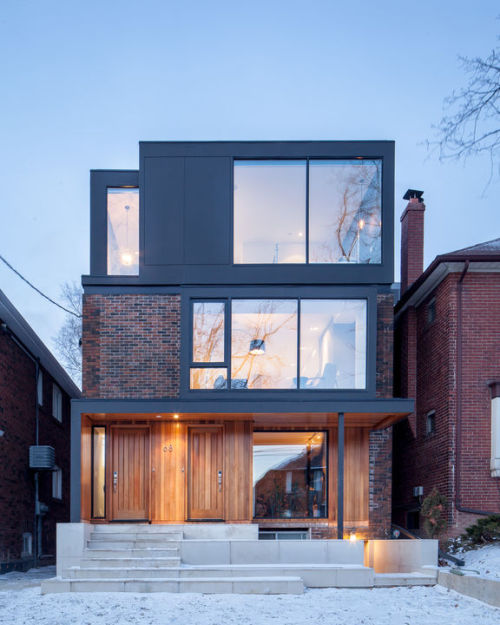
    A few days I retweeted the above home from Dwell Magazine. Then yesterday I was driving through midtown Toronto and I stumbled upon it. And that got me thinking more about this kind of project.

    The house is a triplex with, presumably, one unit in the basement, one unit on the main floor, and one unit across the 2nd and 3rd floor. The existing detached house was only 2 storeys and so a third floor was added to create what is likely the “owner’s suite.”

    It’s not uncommon for many of the houses in central areas of Toronto to be converted into duplexes and triplexes or to flip back into single family homes after being subdivided for rentals. It goes to show how adaptable the single family house can be.

    But it’s not everyday that you see such a high end triplex being built as, what seems to be, a permanent residence and kind of dream home for the owners. Historically, when people built their dream home it has meant a single family home.

    This might not seem like an important distinction, but I think it demonstrates a growing acceptance of intensification within low-rise single family neighborhoods.

    Part of this I’m sure has to do with rising housing costs. But I think it also has to do with valuing location over raw space and with an acceptance of urban density.

    I don’t know about you, but I would have no concerns with permanently laying down roots in a house like this. It’s beautiful.

    Image: Dwell

  • A century of homeownership and renting in England and Wales

    This morning while I was reading about gentrification in Berlin, I clicked through to an interesting overview of homeownership and renting in England and Wales over the last century. Here’s a video. If you can’t see it below, click here.

    [youtube https://www.youtube.com/watch?v=LDnGryGJ1ZA]

    The video starts in 1918, where the vast majority of households (77%) rented. As of 2011, this number has reversed. 64% of households in England and Wales now own their home.

    If you compare this housing trend to what happened in the United States and Canada, you’ll see a similarity. Although, the US was ahead in terms of promoting homeownership. They reached 50% ownership somewhere in the mid 1940s, whereas England and Wales didn’t reach this number until around 1971.

    image

    All of this is an interesting reminder that our obsession with homeownership is a relatively new one. But it’s also not a universal one. The homeownership rate in Berlin is 15.6%, and it’s only 49.5% in London. People in big cities tend to rent more.