Daily insights for city builders, delivered every morning at 6 AM ET. I’m Brandon Donnelly — a Toronto-based real estate developer and founder of Globizen. I’ve been writing here since 2013.

Tag: rem koolhaas

  • 3 thoughts from Rem Koolhaas

    Earlier this year, architect Rem Koolhaas of OMA spoke with Mohsen Mostafavi (dean of the Harvard Graduate School of Design) to close out the 2016 AIA convention

    I still remember my first architectural theory class where the professor told us all that Koolhaas was the most important living architect of our time. And today, if you think about all of the stars that have grown out from his firm – such as Bjarke Ingels and Joshua Prince-Ramus – it is certainly a defensible argument.

    Koolhaas is generally very critical of globalization and the market economy when it comes to creating good architecture. His view is that “pure profit motives” are leading to cities that are basically not designed.

    This is a fairly common belief within architectural circles, which is why many celebrated names would rather work on a museum over a residential condo project. The latter is too motivated by profit. It’s not architecturally interesting.

    I, on the other hand, have always believed in working within the confines of the market to try and promote great architecture and city building. I’m not saying that the market is perfect, but profitability is a constraint that every industry deals with. Architecture is no exception.

    That said, there are other things that I agree with Koolhaas on. Below are 3 verbatim highlights taken from a Fast Company article summarizing his talk with Mostafavi: 

    Communication needs an overhaul.

    “Architecture has a serious problem today in that people who are not alike don’t communicate. I’m actually more interested in communicating with people I disagree with than people I agree with.”

    "To have a certain virtuosity of interpretation of every phenomenon is crucial. We’re working in a world where so many different cultures are operating at the same time, each with their own value system. If you want to be relevant, you need to be open to an enormous multiplicity of values, interpretations, and readings. The old-fashioned Western ‘this is’ ‘that is’ is no longer tenable. We need to be intellectual and rigorous, but at the same time relativist.”

    Architecture’s greatest value in the future might not even be architecture.

    “Architecture and the language of architecture—platform, blueprint, structure—became almost the preferred language for indicating a lot of phenomenon that we’re facing from Silicon Valley. They took over our metaphors, and it made me think that regardless of our speed, which is too slow for Silicon Valley, we can perhaps think of the modern world maybe not always in the form of buildings but in the form of knowledge or organization and structure and society that we can offer and provide.”

    Preservation is a path forward.

    "We’ve tried to discover domains and areas in architecture which are not a simple vulgar multiplication of uninspired global projects. Recently, we have looked at preservation. The beautiful thing about preservation is you begin with something that already exists and therefore is already local. By definition, a preservation project is an homage to earlier cultures and mentalities to which you can add a new dimension, a new function, a new beauty or appeal. Almost every impulse signals that globalization needs rethinking or adjustment.”
  • The back-end of our cities

    I love cities. We all love cities right now. 

    Everyone, for good reason, seems to be fixated on both people returning to cities (like those narcissistic Millennials) and people urbanizing for the very first time. This latter scenario is happening rapidly across the developing world and in many cases – but not all cases – it is helping to lift people out of extreme poverty.

    But by most measures, urban areas represent only about 2-3% of the world’s land area, despite housing over 50% of our population. So here’s an interesting thought for this morning: What is happening and what will happen with the remaining 97-98%?

    In this recent talk by architect Rem Koolhaas, he attempts to dissect the future of living, loving, and working through the lens of architecture. However, he starts by saying that architecture is, in fact, too slow to properly capture the zeitgeist of any time period. It is, “an unbelievably slow art.” That said, Koolhaas has a remarkable ability to identify what is happening (see Delirious New York) and then call it out in a way that you probably haven’t thought about. 

    In the above talk, he hones in on the impact of Silicon Valley – certainly the spirit of our time – on the rural landscape outside of our cities. Interestingly enough, he also talks about how the tech industry has begun to borrow terminology from architecture in order to describe itself.

    Screenshot from the video:

    image

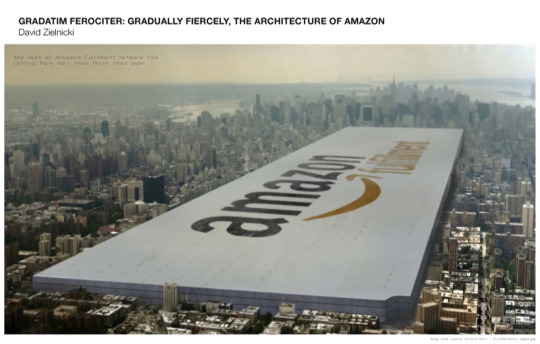
    Despite their ethereal appearance, technology giants still have large physical footprints for servers, production, logistics, and so on. But there’s no reason – or way – to accommodate them inside of our cities and so they cluster outside, in the 97-98% areas. These are places like the Tahoe-Reno Industrial Center, which is the home of Tesla’s new Gigafactory.

    Because of sheer scale and because there’s no need for them to possess much in the way of humanistic qualities, these are spaces which are void of architecture, urbanism, and, in some cases, a light spectrum beyond what is absolutely necessary for the specific function of the building (discussed in the video).

    Of course, the periphery has long serviced the core. But Koolhaas’ thinking has, as it often does, made me consider this phenomenon in a slightly different way. He paints a picture of a spiky world where we are all crammed into sensor and app-driven cities (the front-end), all of which are then powered by big mechanistic boxes that many of us may be naive to (the back-end). In some ways it feels like the Matrix. What we see and experience could just be the tip of the iceberg.

    Architecture may be unbearably slow, but as a society we have always built what matters to us most at the time. At one point it was places of worship. But today, at least for part of our landscape, it is boxes not intended for us to really experience. Maybe that’s not really architecture. Maybe it is simply the back-end for our cities.

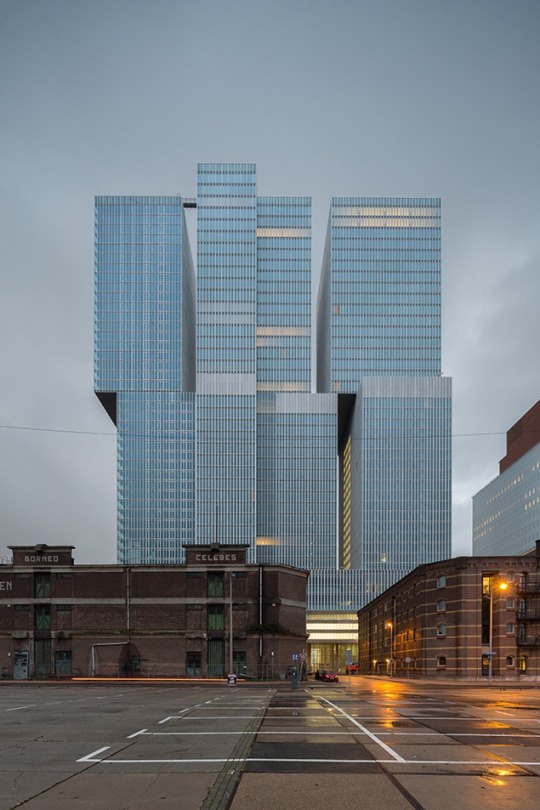
  • De Rotterdam…

    image

    “Manhattanism is the one urbanistic ideology that has fed, from its conception, on the splendors and miseries of the metropolitan condition – hyper-density – without once losing faith in it as the basis for a desirable modern culture. Manhattan’s architecture is a paradigm for the exploitation of congestion.” 

    Rem Koolhaas, Delirious New York, 1978

    Image: De Rotterdam by photographer Ossip Van Duivenbode via The Architectural Review

  • The world in 2050

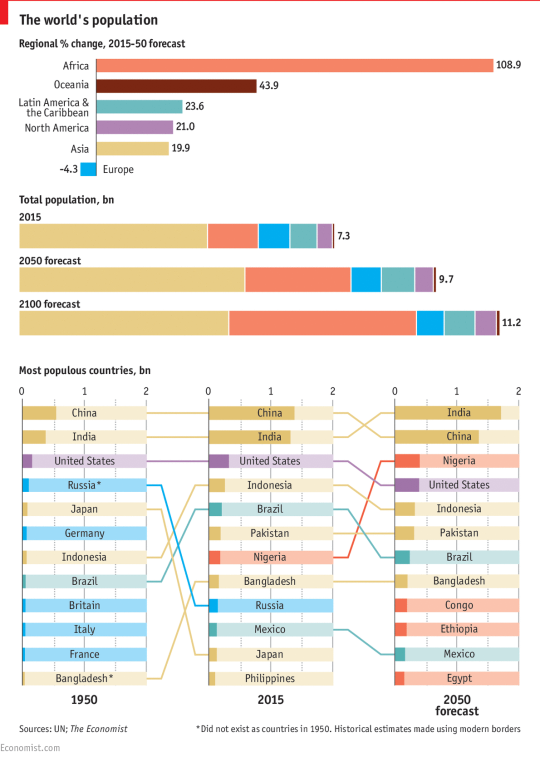
    The United Nations recently released its 2015 version of World Population Prospects. It looks as if they put out and revise this report every 5 years.

    The Economist then took some of their data and assembled it into the following charts:

    image

    It’s obviously extremely difficult to predict what will happen in the world by 2100, but to the extent that forecasting is possible, the world’s population is expected to reach somewhere around 11.2 billion people. Today it’s 7.3 billion.

    The bulk of this growth is expected to happen first in Africa, and then in Asia. By 2100, Africa’s share of the global population is expected to grow to 39% and Asia’s share is expected to decline to 44%.

    If you’ve been following population trends, most of this shouldn’t come as a surprise to you. The meaningful population growth happening in the world today is happening in the developing world. 

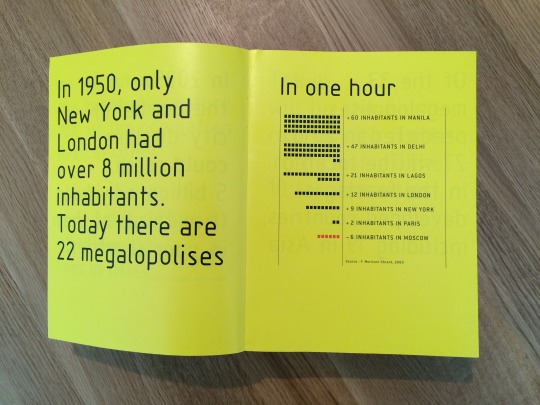
    That’s why architects, such as Rem Koolhaas, have been studying cities like Lagos (Nigeria) since the late 1990s and early 2000s. Below is a photo from a book/research project that I love called Mutations (2000). I pulled it from my bookshelf this morning.

    image

    It’s interesting to think about what all of this will mean for the global economy and for global governance. 

    The United States is about to be alone when it comes to advanced economies with a globally competitive population. Europe is shrinking, which leads me to believe that a strong EU is likely important. And we now have lots of megalopolises with big populations, but with very low income levels.

    Nigeria is the largest economy in Africa, but per capita income is somewhere around $3,000.

  • Architectural spoonerism

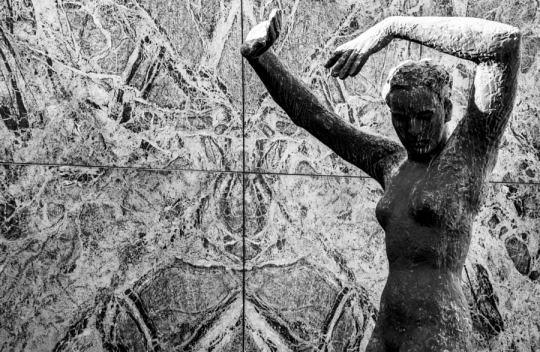
    Pavelló Alemany by Sergi Pera on 500px.com

    https://500px.com/embed.js

    Back in architecture school we used to joke around that to be a great architect you had to have a badass sounding name. This was largely driven by the fact that so many famous architects were/are European and so they had/have more unique sounding names – at least to us.

    Think Rem Koolhaas, Bjarke Ingels, Ludwig Mies van der Rohe, Le Corbusier (actually Charles-Édouard Jeanneret-Gris), Alvar Aalto, and so on.

    There are of course lots of great non-European architects and lots of names that don’t sound as badass as the ones listed above. But that didn’t stop of us from perpetuating the belief that you needed a badass name.

    So what could you do if your name wasn’t badass enough to be a famous architect? Well we applied the principles of architectural spoonerism. That meant we switched around the first letter of your first name with the first letter of your last name to create a new architectural identity.

    Sometimes this worked beautifully, but sometimes it didn’t work at all. In my case, I became Drandon Bonnelly, which is arguably a bit more badass. But the best example is that of my friend Alex Feldman. He became Flex Aeldman. Now that’s badass. He sounds like an architect bodybuilder.

    What’s your badass architect name? Let us know in the comment section below. Perhaps we can dethrone Flex as the best one out there.

  • Day 1 in Quebec City

    I just checked into the Chateau Laurier Quebec after a busy day touring the city. I don’t have a ton of time to write this post before dinner (though I have a few post ideas brewing). I did however want to share some of the day’s events and some of my photos.

    After I landed I went straight to Île d’Orléans. I had never been there before so I’m glad I got the opportunity. It’s about twice the size of Manhattan and it has a population that hovers somewhere between 7,000 and 10,000 people depending on the season.

    The first stop was a “sugar shack”, which is apparently a big deal in Quebec and in the springtime. The place was packed. Here I had a traditional Quebec lunch (which was great) and I learned that all of the Canadian stereotypes are actually true. We really do put maple syrup on everything.

    After lunch I then asked if we could stop at a few of the local wineries. I love wine and I love wine culture.

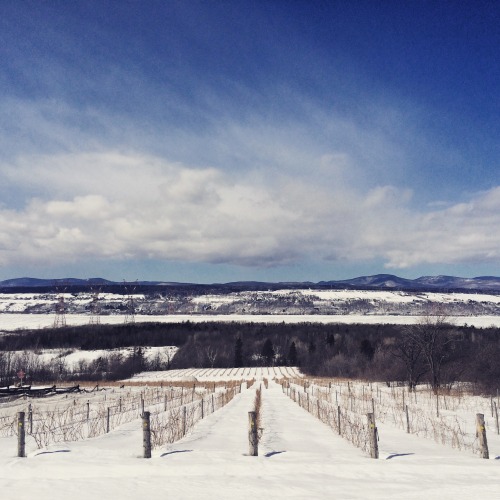
    imageimageimage

    I picked up one bottle of “wine” from Cassis Monna & Filles. It’s actually made from black currants though, which I was told was illegal to grow in North America for a long time. It’s far more popular in Europe.

    The winery is run by a father and his two daughters. And I thought they did a great job with their brand story and their overall identity.

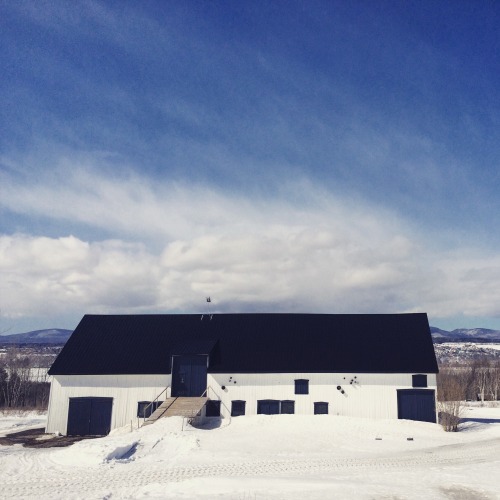
    After leaving the island, I then went to the Montmorency Falls. I had no idea Quebec had falls, but they do. And the vertical drop is bigger than that of Niagara Falls.

    image

    Finally, I finished the afternoon with a quick tour of downtown and the OMA designed expansion to the fine arts museums. It has one aggressive cantilever.

    Here’s a video of the project. Click here if you can’t see it below. 

    [vimeo 111133943 w=500 h=281]

    If you’re interested, you can also follow my social posts on the Porter Escapes website by clicking here.

  • The future of the architecture profession

    image

    Yesterday I had a really interesting conversation with somebody about the future of the architecture profession. We spoke about how Joshua Prince-Ramus of REX believes that architects have marginalized themselves as a result of shying away from liability. We spoke about how architecture schools need to teach more about about business and making money. And we spoke about why I decided to never practice architecture and instead become a developer.

    At the end of it all, he came to more or less the same conclusion that I did in this post. He felt that as more and more trained architects choose to become developers, that maybe the future will be firms that vertically integrate both architecture and real estate development. For those of you not in the building industry, this is fairly uncommon practice today. Typically, developers retain the services of an architect to design their buildings and do not handle this in-house.

    But there are firms that do. DDG out of New York and San Francisco is one example. Although there’s a subtlety worth mentioning. According to their website, they say that they often act as the “design architect” for their projects. This means that there would still need to be an “architect of record”, whose name would appear on the building permit and who would ultimately end up shouldering the liability for the design.

    You see, a bifurcation has happened even within the architecture profession itself. You have “design architects” who may or may not be licensed, but do a lot of the fun design work upfront for a project. And you have production oriented firms that actually produce the technical drawings needed for construction. The fees are generally higher in the latter case (unless maybe you’re a starchitect), but the work is less creative.

    The emergence of these two streams of architecture is precisely what Joshua Prince-Ramus is talking about when he says that architects have marginalized themselves by shying away from liability. He believes that architects are reducing themselves to designers and stylists, from master builders. So his argument is that architects need to reinsert themselves into more of the building process.

    What I’ve been suggesting is that architects should become owners. They should insert themselves into the development process. And the reason I feel this way is because I worry about the tendency for production and construction to just be farmed out to the lowest bidder. Design and development, on the other hand, are high value creation items.

    Truthfully though, I don’t really know which option is better for the profession in terms of relevance. I know which one I’m most interested in, but that could just be a personal preference. What do you think?

    Image: The Red List

  • The essence of the stock market is speculation

    Dutch architecture firm OMA (Office for Metropolitan Architecture) has a subtle way of being incredibly subversive in their architecture.

    The recently completed 1.9 million square foot Shenzhen Stock Exchange (SZSE) building is presently making the rounds online and I personally find it incredibly striking. It has the same timelessness about it that makes me love Mies’ Toronto Dominion Centre.

    But it wasn’t until I read the description on OMA’s website that I decided to blog about it. Here’s the first paragraph:

    “For millennia, the solid building stands on a solid base; it is an image that has survived modernity. Typically, the base anchors a structure and connects it emphatically to the ground. The essence of the stock market is speculation: it is based on capital, not gravity.

    All of these factors suggest an architectural invention: our project is a building with a floating base. As if it is lifted by the same speculative euphoria that drives the market, the former base has crept up the tower to become a raised podium.”

    It’s a powerful, yet potentially controversial, symbol, as one could argue that efficient markets should, at least in theory, operate not on ramped speculation but upon fundamental values. However, if markets are an expectations game, perhaps you could simply argue that the building symbolizes a perceived bright future.

    Either way, very interesting.