Daily insights for city builders, delivered every morning at 6 AM ET. I’m Brandon Donnelly — a Toronto-based real estate developer and founder of Globizen. I’ve been writing here since 2013.
The CEO of Foursquare — Jeff Glueck — published an interesting op-ed in the New York Times today, calling on Congress to regulate the location data industry. Currently, there are no formal rules in place.
In case you’re not aware, Foursquare is one of the largest independent companies operating in this space. I have written about them many times before on the blog.
Here’s an excerpt from Jeff’s op-ed explaining why this matters:
But location data can also be abused. Bounty hunters were able to buy the current location of a cellphone for $300, Vice reported, because telecom companies sold the real-time location of phones to shady companies. And apps that track location data may turn around and sell that data, revealing someone’s every movement — whether it is to a retail store, an abortion clinic or a gay bar. Bloomberg Businessweek recently reported on a company with thousands of cameras selling car locations to debt collectors and others; there is no “opt-in” involved, and it’s illegal in all states to cover your license plate.
I am writing about this today because I think it’s relevant to city building. Location data is inherently spatial. It is how we exist in cities. So it shouldn’t come as a surprise to any of you that this is valuable information — hence why it is being abused.
Here we have a company advocating for more, not less, regulation. They, of course, want it to be sensible. But I still think it says things about the current location data environment. To learn about the specifics of what Jeff is proposing, click here.
Following the lead of San Francisco, a new non-profit, member-supported organization for New York tech companies has just launched. It’s called Tech:NYC. Here are their goals, taken from this blog post:
Tech:NYC’s primary goals are to support the growth of the technology sector in New York City, to increase civic engagement by leaders of the New York tech community, and advocate for policies that will attract tech talent, jobs, and opportunity to NYC.
Tech:NYC will advocate for policies that: 1) underscore a regulatory environment that supports the growth of technology companies and technology talent in NYC; 2) promote inclusivity; and 3) ensure access for all New Yorkers to connectivity, technology tools, and training.
What makes something like this important is that many public policy issues are now rooted in the tech sector. Think about all the debate regarding ride-sharing, home-sharing, drone regulation, contract employees, and so on.
But what is also clear is that many cities are struggling to deal with these issues. As I’ve argued before, just saying no to innovation that doesn’t fit neatly into our currently regulatory boxes is often shortsighted.
So how do we put in place policies that deliver the right results and that are balanced? How do we grow the tech base while at the same time managing the disruptive fallout? That’s what this group hopes to do.
And it strikes me that every big city could likely benefit from an organization like this.
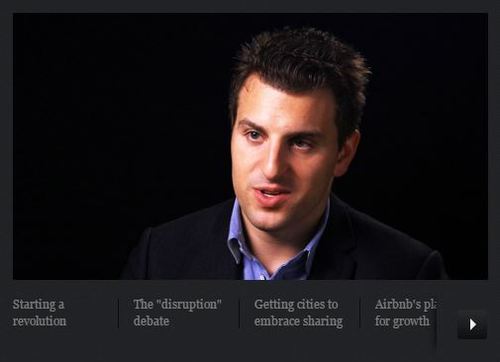
McKinsey recently put out a great interview with one of the founders of Airbnb, Brian Chesky, talking about the relationship between his company and cities. I thought it was fascinating. Click here to watch the video.
If you don’t feel like doing that, I’ve also pasted the interview transcript below and bolded some of the really interesting takeaways. Let us all know what you think in the comment section below.
It’s a currency of trust, and that used to live only with a business. Only businesses could be trusted, or people in your local community. Now, that trust has been democratized—any person can act like a brand.
Airbnb is a way that you can, when you’re traveling, book a home anywhere around the world. And by anywhere, I mean 34,000 cities in 190 countries. That’s every country but North Korea, Iran, Syria, and Cuba.
The reason we started was I was living with my roommate, Joe, in San Francisco, and I couldn’t afford to make rent. That weekend, the International Design Conference was coming to San Francisco. All the hotels were sold out. Joe had three air beds. We pulled the air beds out of the closet, we inflated them, and we called it the “Air Bed and Breakfast.”
The reason it’s grown so fast is, unlike traditional businesses, we don’t have to pour concrete. The infrastructure and the investment was already made by cities a generation ago. And so all of a sudden, all you needed was the Internet.
The ‘disruption’ debate
I never really loved the word “disruption,” because it suggests that maybe it’s the kid in a class who was disruptive, who probably didn’t add a lot to class. I think that we have a lot to add to society.
Over time, cities have gotten so big that the sense of community has gotten lost. And I think once you know everyone, that community can reemerge. And as far as our relationship with cities, we can’t succeed without a city. Or we can’t really thrive without a city. We don’t want to thrive in spite of a city. And I think if we work together, it’s going to be amazing. I think the people win. And I think if we don’t work together or if we fight, the loser isn’t really us or the city—it’s the people in that city.
Getting cities to embrace sharing
Fundamentally, the idea of the sharing economy is going to be great for cities. It means that people all over a city, in 60 seconds, can become microentrepreneurs. And they can be empowered. And they can make an income. Now, this is amazing, but it’s also complicated because there are laws that were written many decades ago—sometimes a century ago—that said, “There are laws for people and there are laws for business.” What happens when a person becomes a business? Suddenly these laws feel a little bit outdated. They’re really 20th-century laws, and we’re in a 21st-century economy.
It’s probably going to be a fair amount of work to revise some of the laws and rethink the way cities and platforms work together, but I think that work is worth it. Because what cities don’t have to do is invest billions of dollars in infrastructure to create jobs. Whereas historically, to create opportunities, cities would need massive projects and investments, these jobs only require the Internet. Now what they need to do is navigate the legal framework, which is typically outdated. We want to work with the cities. We’re not telling them that their laws are terrible. The world continues to change. Laws must continue to adapt for that world.
We want to help cities understand what our world looks like so they can modernize the laws to make sense. We’re not against regulation. We want to be regulated because to regulate us would be to recognize us.
Airbnb’s plans for growth
We want travelers to be able to book homes anywhere. Anywhere includes Asia. Asia’s a nascent market for us. Number two, we’re also looking at other use cases. Airbnb started as a way for travelers to find a budget way to vacation in a city. But now we’re starting to see people who aren’t on a budget. They want a much more high-end experience. And the third is that at the end of the day, if you’re traveling to Tokyo, you’re not traveling to Tokyo to stay in a home or a hotel. You’re traveling to Tokyo—if you’re on vacation—because you want to have an experience. And we’d love to do more to make that experience special and memorable.
The future of sharing: Your free time
I don’t think people would view the jobs created in the sharing economy as jobs. I don’t even know if they get counted as jobs when the White House has a new jobs report. They are jobs. As far as I can tell, people are working, they’re making income, and they depend on that income. Half of our hosts depend on it to pay the rent or mortgage. Maybe it’s a new kind of job. Maybe it’s like a 21st-century job. Tom Friedman talks about how in the future people may not have jobs. They’ll have income streams.
I believe that the sharing economy broadly can probably provide tens of millions of jobs or income streams for people all over the world. This is going to have a pretty big effect on the economy, mostly a good one.
The sharing economy started by democratizing and creating access to probably two of the biggest assets people have: their homes and then their cars. But I think the whole idea of ownership is changing. When my parents were young, owning things was a privilege, and there was a sense of romance to owning a house, owning a car.
Today’s generation sees that ownership also as a burden. People still want to show off, but in the future I think what they’re going to want to show off is their Instagram feed, their photos, the places they’ve gone, the experiences they’ve had. That has become the new bling. It’s not the car you have; it’s the places you go and the experiences you have. I think in the future, people will own whatever they want responsibility for. And I think what they’re going to want responsibility for the most is their reputation, their friendships, their relationships, and the experiences they’ve had.
So I think the biggest revolution will be in the biggest asset of all. The biggest asset is not a house. It’s not a car. It’s people’s time. People’s time may start with just gigs: waiting in line for you, delivering something for you. Over time, I think it’s going to move upmarket. And eventually, menial tasks become real trades, and real trades become art forms.
Somebody may say, “I cook a great brunch. I wonder if people would enjoy having brunch at my house?” And you could be able to book a brunch at someone’s house, instead of at a restaurant. That person isn’t trying to create a restaurant, they’re just allowing someone to have brunch. They build a reputation. One day, that person can be a Michelin-rated chef in their house.