Daily insights for city builders, delivered every morning at 6 AM ET. I’m Brandon Donnelly — a Toronto-based real estate developer and founder of Globizen. I’ve been writing here since 2013.

Tag: real estate

  • Survey: Homes for families

    I was looking through real estate listings this morning (which I do quite often out of sheer interest), and I started noticing a number of 3 bedroom condos (here in Toronto) that were priced under $1 million.

    Now, this is a lot of money now matter how you slice it. But given that the average price of a detached home in the city is now well over $1 million, I can’t help but wonder if condos will become more accepted as the family home.

    I’ve written about this topic a lot, because it’s something I’m interested in and I like living in a condo. But I’m seeing far more of my network looking for a low-rise house upon marriage/kids than for a bigger apartment/condo.

    So today I thought I would run a very quick survey. There are only 3-4 questions depending on how you answer and it basically revolves around housing type and whether or not you have or plan to have a family. I also ask what city you live in because I think this will have an impact on preferences.

    If you have 30 seconds, I would love to get your input and I’m sure the ATC community would be interested as well. The responses are anonymous, but I’ve made them public. Click here if you can’t see the survey below.

    [googleapps domain=”docs” dir=”a/brandondonnelly.com/forms/d/1wyMguhSlNv6pe6DS3duyJUqpzjImHI_KiYer1CKTVxo/viewform” query=”embedded=true” width=”640″ height=”600″ /]

  • W57 — A new hybrid building typology

    image

    We’ve been talking about a lot of heavy topics here on Architect This City lately. Everything from the contentious Gardiner Expressway East to minimum population densities to density creep. 

    So today I thought we could talk about something a bit more fun: architecture.

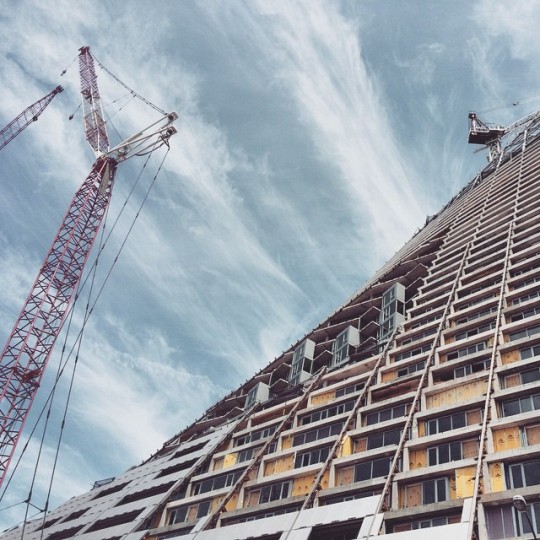
    When I was in New York last weekend, one of the buildings that was on my must-see list was the now under construction West 57th Street by Danish architect Bjarke Ingels. See photo above. (It also happens to be at the exact location where the West Side Highway transitions from elevated to surface boulevard.)

    This is supposedly the first North American project for Bjarke Ingels (he also has a project in Vancouver now). And if you’re a regular reader of this blog, you’ll know that I’m a fan of his work. His diagrams and storytelling ability were a big inspiration for me when I was in architecture school.

    The concept behind the project was to create a new hybrid building typology, one that is a cross between the typical European perimeter block building and the North American skyscraper. And the result is pretty wild.

    Here’s a video in case you aren’t familiar with the project. Click here if you can’t see it below.

    [youtube https://www.youtube.com/watch?v=_0JbTbOm_iQ?rel=0&w=560&h=315]

    I think it’s a really exciting project. What are your thoughts?

  • Top 10 freeways without a future

    https://500px.com/embed.js

    Last year The Congress for the New Urbanism (CNU), which is based out of Chicago, published a report called, The 2014 Freeways Without Futures. It listed the top 10 freeways across North America that are in need of removal, replacement, and revitalization. You can download the full PDF report by clicking here.

    Here’s an introductory snippet from the report:

    The 2014 Freeways Without Futures Report lists the top opportunities in North America for replacing aging urban highways with boulevards or avenues that connect to the networks of streets. They are presented in no particular order of rank. As in previous reports, the criteria for the 2014 list is based on a number of factors: the age and design of structures, redevelopment potential, potential cost savings, ability to improve both overall mobility and local access, existence of pending infrastructure decisions, and community support.

    And here’s the list of freeways without a future:

    1.  I-10/Claiborne Overpass, New Orleans
    2.  I-81, Syracuse, New York
    3.  Gardiner Expressway, Toronto
    4.  Route 5/Skyway, Buffalo
    5.  Inner Loop, Rochester New York
    6.  I-70, St. Louis
    7.  I-280, San Francisco
    8.  I-375, Detroit
    9.  Terminal Island Freeway, Long Beach
    10.  Aetna Viaduct, Hartford

    Not surprisingly, the Gardiner Expressway is on the list. CNU is in agreement with the “remove” option currently being contemplated by Toronto City Council and will be doing their part to support the Gardiner East petition that Stephen and I created. Thank you for that 🙂

  • The cost of saying “no”

    https://500px.com/embed.js

    When you rezone a property to build something new, pretty much every city will ask you to provide reports and studies that assess the potential impacts of that something new. 

    They’ll ask you to look at the impact on traffic, the impact on storm water, the impact on shadows in the area, and the list goes. This, of course, is fair and reasonable. It makes sense to measure the impact of the proposed changes to see if it will work in the given context. 

    But those are not the only impacts to consider. I think that many of us underestimate the flip side, which is the impact of doing nothing, or in this case, building nothing. Here’s a recent quote from an excellent interview with urban economist Edward Glaeser:

    Personally, I believe there are always huge costs to saying “no” to people who want to create space for new families that want to live in the city; who want to make the city more affordable. There are always costs – I believe that very, very strongly – but, sure, there are also benefits to saying “no” at certain times.

    Glaeser is, of course, not saying that we should allow unfettered development. He is saying that there are costs (or impacts) to building and costs to not building. The challenge is that we assume, often incorrectly, that saying “no” simply means the status quo will prevail. And we do not consider the impacts.

    So what does that mean? Here’s an example.

    The Neptis Foundation, which is a nonpartisan and charitable urban research group, just published an interesting report called, Growing Pains: Understanding the new reality of population and dwelling patterns in the Toronto and Vancouver regions

    What the report did was compare growth and settlement patterns in both the Greater Toronto (and Hamilton) Area and Metro Vancouver between 2001 and 2011. And what they found was two different stories.

    Of the one million people that moved to the Toronto region between this period, roughly 80% of them settled in new greenfield housing subdivisions at the urban edge. And only 18% of people moved to areas that were well serviced by public transit.

    By contrast, only 31% of Metro Vancouver’s population growth went to greenfield areas and 69% went to urban intensification areas. Nearly half of these new residents ended up settling next to high frequency transit.

    From an environmental standpoint, Vancouver’s settlement pattern is obviously preferable. But it takes hard work to achieve that. The barriers to infill development are more formidable than the barriers to greenfield development. This is despite the fact that there are well documented social, economic, and environmental costs associated with urban sprawl.

    My point with this example is that growth and demand will find somewhere to settle. Some locations make more sense than others, but sometimes there’s no choice when we have decided to say “no.” So what we ought to be doing is measuring both the impact of building, as well as the impact of not building.

  • #DensityCreep

    The Toronto Star published an article today called: Midtowners battle the rise of the midrise. It’s about a group called The Density Creep Neighborhood Alliance, which was formed in order to fight a 4 storey stacked townhouse project that is currently going through the rezoning process.

    Here’s a snippet from the article:

    “I’m really concerned about my property value going down,” says Lisa Goodwin, 49, a stay-at-home mother of two who has lived in a four-bedroom dwelling on Keewatin Ave. for 19 years. “Right now all the houses are $1.1 to, say, $2.2 (million) but they’re looking at putting in places that are only $500,000.”

    Not surprisingly, social media took hold of this and #DensityCreep quickly started trending on Twitter. BuzzFeed ran a piece called, Toronto Real Estate Is So Preposterous People Are Protesting Condos That “Only” Cost $500K. And somebody even bought densitycreep.com (their site is .ca) and redirected it to NIMBY on Wikipedia.

    There’s so much I could say about this. But you all already know what I’m thinking. So I’ll end with this quote from the article:

    “The simple fact of the matter is that the creation of a more sustainable, equitable, and affordable city requires the development of midrise and other more dense housing options along major roads, subways, and streetcar lines in already built up areas,” says Christopher De Sousa, director of the School of Urban Planning and Regional Planning at Ryerson University.

    We have work to do.

  • Learning from boutique hotels

    At the beginning of this year, my friend Amy Bath wrote an interesting post on her blog comparing condos and boutique hotels. It’s called: Could condos be more like boutique hotels? It’s a great read and it touches on something that I think we will see more of going forward.

    The idea is that boutique hotels – many of which invest heavily in things like programming and “cultural engineering” – could serve as a model for condos and developers who want to further differentiate themselves by doing more with their common areas and amenities. I think it’s a great idea. 

    But let’s backup for a second.

    In many cases, I feel that developers tend to privilege the brands of their specific projects over their own corporate brands. This likely has something to do with the entrepreneurial nature of how development projects often come together, but I personally don’t think it’s the best approach.

    It’s the equivalent of a car company downplaying its own brand and instead creating a new one for each and every car model that it comes out with. That’s a lot of work and it’s harder to build brand equity that way. So I think the trend is probably away from this approach.

    But as that happens, developers will inevitably start to wonder how they can differentiate them themselves: How do I make my bricks and mortar less of a commodity? The same way that Apple made computers not about processor speeds and memory, but about something so much more. You create a brand story and an experience.

    And one of the best ways I think you could do that is through exactly what Amy is talking about: programming and cultural engineering.

  • Real estate and house music in Johannesburg

    I’ve written about the Ponte Tower in Johannesburg before. At 54 storeys, it is the tallest building in Africa. It’s located in Hillbrow, which is an inner city neighborhood known for its crime and poverty. 

    In the 1970s when the tower was built, Hillbrow was an Apartheid-designated white-only neighborhood and the tower was filled with affluent residents. But that didn’t last long and eventually the wealth fled for the suburbs.

    Here’s a brief 6 minute video talking the Ponte Tower. Let’s call it the real estate perspective. Click here if you can’t see it below.

    [youtube https://www.youtube.com/watch?v=3EIKmmSifqw?rel=0&w=560&h=315]

    Now, here’s a Real Scenes documentary talking about the thriving electronic music scene in Johannesburg. I think it’s fascinating to look at a city from a particular subculture and, compared to the first video, I get a very different feel for the city. Click here if you can’t see it below.

    [youtube https://www.youtube.com/watch?v=Ykt2f6o7-e8?rel=0&w=560&h=315]

  • Locations of the 100 tallest skyscrapers in the world

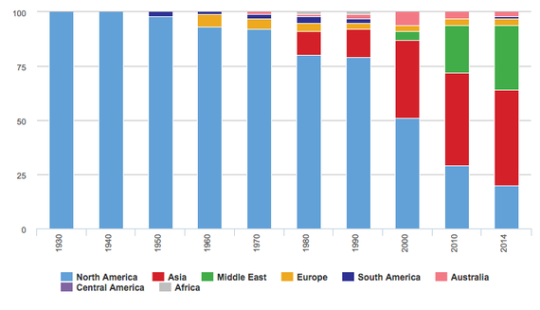
    This morning I stumbled upon the following chart (via The Atlantic) summarizing the locations of the 100 tallest skyscrapers in the world.

    As you can see North America dominated tall buildings for most of the 20th century. But then in the 1980s, Asia starting building. Then in the 2000s, the Middle East started building. And today, Asia and the Middle East are where the world’s “supertalls” sit.

    What’s fascinating about this shift is that in many cases, there’s absolutely no physical or economic need to developing so tall. Yes, rising land values can drive up the height of a building, but not to the extent that we’ve been seeing.

    Instead, building “the tallest building in the world” is more symbolic than anything else. It’s about ego. It’s about asserting your position on the global stage. And so while this is a chart about tall buildings, it’s actually a pretty telling chart about global ambitions.

  • I would make a terrible politician

    Ever since I was a little kid, I have thought that I would one day get into politics. 

    A lot of it has to do with me wanting to affect positive change, which is also one of the reasons I love real estate development (and one of the reasons I write this blog). Developers might have a bad rap in some circles, but I view it as a mechanism for positive change in the built environment.

    However, I have also felt that politics is something that’s better to do when you have grey hair and you don’t actually need the money to live. That way people take you more seriously and you can, hopefully, just do what you feel is right as opposed to playing the political game.

    But more and more I find myself thinking: Brandon, you would make a terrible politician.

    I don’t want to play games. I don’t want to have to think about which stance will win me the most votes. And I don’t want to have to dance around questions so I can avoid upsetting certain constituents. I’d rather be clear and decisive about what I think is the right thing to do.

    But that doesn’t always work so well in politics. So I think I’ll just stick to building things and writing this daily blog.

  • The perfect high street

    How do you create and maintain a thriving high street in this era of increasing online shopping? This was one of the questions that Monocle asked at its recent Quality of Life Conference in Lisbon and here’s a video with its recommendations. Click here if you can’t see the video below.

    [youtube https://www.youtube.com/watch?v=Ox2WJwDbuIo?rel=0&w=560&h=315]