Daily insights for city builders, delivered every morning at 6 AM ET. I’m Brandon Donnelly — a Toronto-based real estate developer and founder of Globizen. I’ve been writing here since 2013.

Tag: real estate

  • Sidewalk Labs, Amazon HQ2, and the Milanese Leonardo

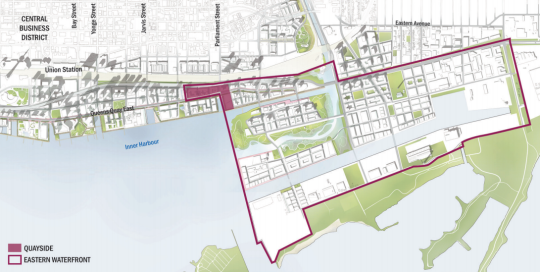
    Earlier this week the WSJ announced that Sidewalk Labs (Alphabet Inc.’s urban innovation organization) is close to a deal with Waterfront Toronto to develop a new 12-acre section of the eastern waterfront. Sidewalk Labs would be their innovation and funding partner. It’s not final yet and it’s still subject to board approval, but the sentiment is that it should go.

    There aren’t a lot of details about the project – other than the fact that it will be fairly big, up to 3 million square feet – but the overall intent is digital city building. It’s about imagining what a city could be if you built it today “from the internet up.” More info about Sidewalk Labs, here.

    I thought of this project as I read Seth Godin’s daily blog post this morning in bed. Here are two snippets from that post:

    When a new technology arrives, it’s often the nerds and the neophiliacs who embrace it. People who see themselves as busy and important often dismiss the new medium or tool as a bit of a gimmick and then “go back to work.”

    There’s never a guarantee that the next technology is going to be the one that moves to the center of the conversation. But it’s certain that a new technology will. It always has.

    Openness matters.

    I’m anxious to learn more details about the project, but this is obviously very exciting. It also creates momentum and strengthens the case for Amazon HQ2 in Toronto. The above 12-acre Quayside area is only the tip of the iceberg. There’s the rest of the eastern waterfront and also East Harbour.
    image

    Some people have been critical of this city’s push for Amazon HQ2. Anthony Lacavera, chairman of Globalive Capital, called this “the biggest Trojan Horse of all time.” His view is that Amazon would simply use HQ2 Toronto as a mechanism for cheaper labor (USD > CAD) and to siphon the best and brightest down to the US.

    Now, I agree that it would be more impactful to create the next Amazon then to simply lure in its second headquarters. Big entrepreneurial successes are what fuel the darwinian evolution of startup hubs. The founders, early employees and investors make boatloads of money and then they start reinvesting that back into the ecosystem by, among other things, backing the next generation of entrepreneurs.

    But does this necessarily mean that an Amazon HQ2 would be detrimental to Toronto by acting as a conduit to the US? Will it discourage entrepreneurship? Should we eschew all US firms out of fear that this may in fact happen? I don’t think so.

    There’s tremendous value in concentrating smart people in one place – ideas build on ideas. And I don’t think technology has been able to disrupt that, at least not yet. One example of this is a theory that Paul Graham calls the Milanese Leonardo:

    You can see how powerful cities are from something I wrote about earlier: the case of the Milanese Leonardo. Practically every fifteenth century Italian painter you’ve heard of was from Florence, even though Milan was just as big. People in Florence weren’t genetically different, so you have to assume there was someone born in Milan with as much natural ability as Leonardo. What happened to him?

    And his reasoning is as follows:

    Nothing is more powerful than a community of talented people working on related problems. Genes count for little by comparison: being a genetic Leonardo was not enough to compensate for having been born near Milan instead of Florence. Today we move around more, but great work still comes disproportionately from a few hotspots: the Bauhaus, the Manhattan Project, the New Yorker, Lockheed’s Skunk Works, Xerox Parc.

    Xerox Parc (Palo Alto Research Company) is a great example of the kind of positive externalities that can happen as a result of smart people being in close proximity to each other while they wrestle with similar problems. It has been well documented that it was Steve Jobs’ visit to Xerox Parc that inspired many of Apple’s early innovations.

    So my view: let’s increase Toronto’s urban metabolism and make it the Florence of 1450.

    Ed Clark – who is leading the charge for HQ2 in Toronto – has been clear that large taxpayer subsidies are not on the table for Amazon. That would not be fair to the existing companies in this city. If that is what it is going to take, then we are not going to win. We will win based on our city, our human capital, and our openness to the rest of the world. That feels right.

    Welcome Sidewalk Labs. Welcome Amazon. This city is open for business and to new ideas. 

    Image: Waterfront Toronto
  • How Trump’s tax plan would impact the mortgage interest deduction

    image

    In the US you can reduce your taxable income by deducting the mortgage interest you pay toward your principal residence. You can’t do this in Canada, at least not on the property where you live.

    However, there are limitations. It is capped at loans up to $500,000 or up to $1M if you’re married and you file jointly. On the other end of the spectrum, you also need a loan big enough such that an itemized deduction will save you more money than the standard deduction.

    Not surprisingly, the MID is popular among homeowners. And from a public policy standpoint, one of its selling features is that it’s supposed to stimulate homeownership. But many have argued that it doesn’t actually do this – it unequally benefits people with larger mortgages. (Canada has a higher homeownership rate than the US.)

    Right now it looks like you need to buying a home worth at least $305,000 in order for the mortgage interest deduction to make economic sense for you. Again, if your loan isn’t big enough, you’re simply going to opt for the standard deduction. 

    In 2015, about 22% of all US taxpayers opted to take advantage of the MID. According to Zillow, only about 29% of all homes in the US are valuable enough for the MID to actually make sense. Though in some cities, like San Francisco, it’s pretty much all of the homes. Of course.

    Zillow also recently looked at what the recent tax reforms put forward by the Trump Administration would mean for the MID and the real estate market

    One of proposed changes is a doubling of the standard deduction. What this means, based on Zillow’s math, is that you would need to be buying a home worth at least $801,000 today for the MID to make sense. This also means that the deduction would now only benefit about 5% of all homes in the US.

    This would seem to only exacerbate the criticism that the MID does not in fact stimulate homeownership in the segment of the market that needs it the most. But perhaps this is the only politically palatable way of removing it – gradually.

    Photo by Erol Ahmed on Unsplash

  • Building relationships

    2003/2004 was roughly the time period when I started to become interested in development as a career. My good friend Rick Sole and I used to talk about it all the time in architecture school. How do we break into this space? There are no formal paths, like law for instance, and so we felt like we had to create our own opportunities.

    What I ended up doing was creating a list of every developer that I felt was doing cool and interesting work. I didn’t know enough about the industry at the time to assess other things and so that was really my only criteria. Do they care about design in their projects? I then started cold emailing and cold calling.

    Not everyone got back to me, but many did and some agreed to meet with me. This was at a time when I had zero experience and I was frankly not very valuable as a hire. So I am incredibly grateful to all of the people who said yes and took the time to speak and meet with me.

    As you go through your career, this curve eventually flips. You go from having no experience and begging people to meet with you to having experience (and other things you can offer people) and people now wanting to meet with you. Generally people want to meet when they think they can gain from you.

    But the best way to build a relationship is to start when you don’t need anything. I will never forget the people that met with me when I had nothing to offer them. And you can bet that I will always have all the time in the world for them.

    I’m not going to claim that I respond to every one of my cold emails. I definitely do not. But I respond to as many as I can and I try and pay it forward with some time. You could say it’s playing the long game, but it’s probably also the right thing to do.

    How do you approach relationship building?

  • Depression babies

    Recently I’ve been seeing a number of posts/articles talking about the dot-com bubble. It seems to be driven by talk of a pending crypto bubble. 

    Whatever the case may be, the recounts are interesting. In this one by venture capitalist Fred Wilson, he talks about how 90% of his net worth went to zero following the crash. And the only reason it wasn’t all of his net worth was because he was fortunate enough to sell some tech stocks in advance of the crash to buy “two significant pieces of real estate.” The two properties were 10% of his net worth before the crash and 100% of his net worth after the crash.

    Fred goes on to talk about how he had to learn about diversification the hard way. And this reminded me of a theory that many of you are probably familiar with called “depression babies”. This is the belief that large macroeconomic shocks – such as the Great Depression and the dot-com boom – create a lasting impact on people’s propensity to take financial risks.

    And indeed, there’s evidence to suggest that this is in fact the case. In this 2010 paper by Ulrike Malmendier and Stefan Nagel, they came to the following conclusion: “Our results show that risky asset returns experienced over the course of an individual’s life have a significant effect on the willingness to take financial risks.”

    I often think about this with respect to my own career. I started working in real estate before the 2008 financial crisis. I also happened to be living in the U.S. at the time – where it was far worse than in Canada. We got off easy. I remember seasoned real estate professionals telling me that it was going to take at least 20 years before the U.S. would build another commercial office building. It was that bad. And that was the sentiment at the time.

    Of course, that wasn’t the case. It didn’t take two decades to resume building. But I like to think that 2008 will remain permanently etched in my mind. It’s my reminder that crashes can and will happen. Don’t forget that. Stay disciplined. At the same time, it’s my reminder that these periodic crashes create opportunities. Because fear invariably makes us overshoot the mark.

  • Airbnb-ing your way to homeownership

    I just discovered an interesting new Seattle-based startup called Loftium

    The way it works is that they provide down payment assistance (up to $50,000) to prospective homeowners as long as they commit to renting out one of the home’s bedrooms on Airbnb for 12 to 36 months. Loftium is positioning it as a way to help first time buyers get onto the property ladder.

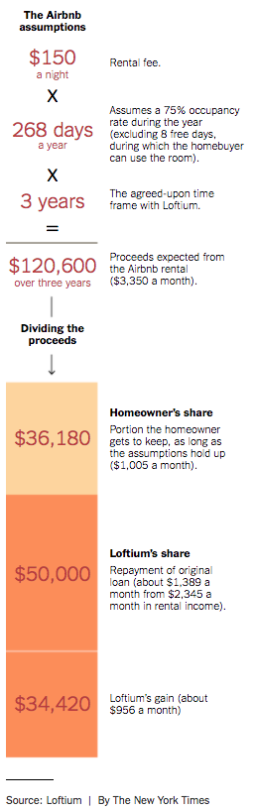
    Here’s an example of how the math might work (taken from the New York Times):

    The details certainly matter a great deal here but, high level, the homeowner gets $50k upfront, ~$1k per month in shared Airbnb revenue, and the opportunity to buy a home. You just have to be committed to being a host.

    And from Loftium’s perspective, they put out $50k at the outset and get back just over $28k a year for 3 years. Assuming these assumptions are correct, that’s a pretty good IRR. 

    However, if the home doesn’t generate enough Airbnb income during the agreed upon term, Loftium is on the hook because the homeowner doesn’t owe anything after the “services contract” expires.

    Think this will fly? Would you use it?

  • My old Philly apartment

    I’m in Philly right now for a good friend’s wedding. 

    I always feel nostalgic when I come back to this city. Some of my most memorable years were spent here. I grew a lot in those 3 years. I also think that Philly is a highly underrated city – such an intimate urban scale.

    I’m staying at the newly renovated Warwick Hotel in Rittenhouse Square. The lobby is beautiful, as are the corridors, but the rooms already feel a bit a dated to me. However the Barcelona Chair in my room is a welcome addition. That thing will never go out of style.

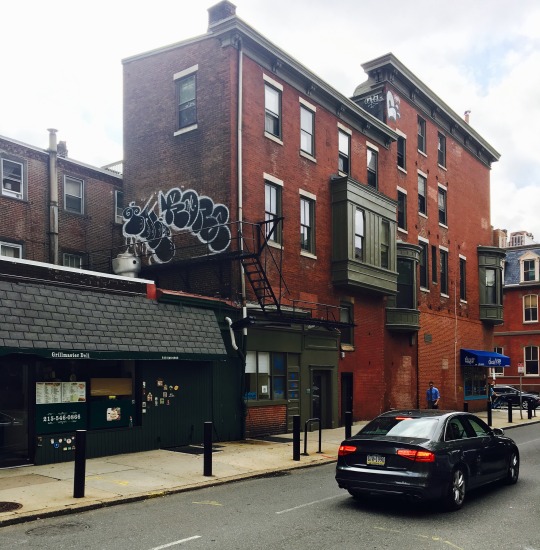
    My hotel happens to be two blocks away from my old apartment at 17th and Spruce. So I decided to do a walk-by while I waited for my room to be ready. My roommate and I had the entire second floor of this building:

    It was palatial, especially given the bargain price and its location in Rittenhouse Square

    The graffiti you see above is located on the north wall of the kitchen. I think that’s a recent addition. The fire stair you see provided access to the roof of the building (as well as the street, I hope). I’m not sure we were supposed to go up there, but we obviously used it for parties.

    Grillmaster Deli is still next door. They kept me fed when I was studying at home and too busy to cook. That was often. And across the street is the Italian restaurant with its sidewalk patio that I used to look out onto from my bedroom.

    This walk-up apartment was by no means fancy. Though it did have ensuite laundry, which was a nice improvement from my previous place. But it was unabashedly urban. My kind of place.

  • Is sprawl to blame (at least partially) for the flooding in Houston?

    What’s happening in Houston right now is devastating. Ian Bogost of The Atlantic is calling the flood a “disaster of biblical proportions.” Harvey has unloaded 9 trillion gallons of water.

    It is once again reminding us of the importance of resiliency when it comes to our cities.

    One emerging argument is that this is an almost inevitable outcome for Houston, brought on by the multiplicative effects of climate change, unfettered urban sprawl, and poor design decisions.

    The barriers to development are famously low in Houston, which allows the city to quickly add housing and people. There are many benefits to this. 

    But it also means that there has been, among other things, a dramatic increase in the amount of impervious surface.

    This matters because impervious surface creates runoff.

    According to The Texas Tribune, impervious surface in Harris County (third most populous county in the U.S.) increased by 25% between 1996 and 2011. 

    And it replaced things like the below prairie grass (switchgrass), which are highly absorbent as a result of their deep root system. 

    But much like climate change, not everyone believes this is to be blamed. 

    For more on this, check out The Texas Tribune’s full interactive piece. It’s called “Boomtown, Flood Town” and it’s worth a read.

    Image from The Texas Tribune

  • $2-billion real estate king

    The Globe and Mail just published a piece called: How Morguard CEO Rai Sahi became Canada’s $2-billion real estate king. It’s a Globe Unlimited piece, so some of you may not be able to access the article. 

    But here’s a snippet that talks about the moment Sahi left his job at the Bank of Montreal and went out onto his own as an entrepreneur:

    In 1981, Sahi spotted an opportunity: Advanced Extrusions Ltd., a small manufacturer of aerosol cans and toothpaste tubes based in Penetanguishene, Ontario. Along with several partners, he bought the business for $7 million. Quickly, Sahi and his partners kicked Advanced into high gear by installing a high-speed assembly line and taking advantage of the low Canadian dollar to boost exports to the United States. Revenues doubled, and CCL Industries Inc. bought the company in 1985 for a reported $22 million. He then used the proceeds from the Advanced sale as a launchpad to buy control of two transport companies, combined them, and sold them to Winnipeg-based Federal Industries for $70 million, much of it in shares.

    The reason for this Globe article is no doubt because Sahi’s Glen Abbey golf course is in the news right now. He acquired the course by buying ClubLink when they were in a cash crunch and has since put forward plans to redevelop the land. 

    On Monday night, Oakville city council voted unanimously to seek a heritage designation for the course.

    I don’t know much about golf courses, but I do think Sahi’s story is an inspiring one. Here is a guy who moved to Canada at the age of 24 and started out by selling insurance door to door. And today his net worth is estimated at $2 billion.

    Full disclosure: I used to work at Morguard.

    Photo by juan gomez on Unsplash

  • Supply, not foreigners

    The chief economist at the Canada Mortgage and Housing Corporation (CMHC), Bob Dugan, recently published a piece in Macleans called: why the foreign buyers tax isn’t making Vancouver more affordable.

    Here’s an excerpt:

    One year after the implementation of the foreign buyers tax, monthly sales to foreign investors now hover around 4 per cent of all sales. But our latest Housing Market Assessment, released in July, still shows a red flag for Vancouver—with particular concern given to overvaluation and price acceleration. Average prices in Vancouver have rebounded to where they were before the tax’s implementation. In between, there was a marked drop, but it appears to have been temporary. In short, Vancouver is largely right back to where it was before the tax.

    He goes on to argue that while there are many factors affecting home prices, “supply is by far the chief factor.” This, of course, is a refrain you hear from everyone in the real estate business, so I’m not going to belabor the point.

    But I would like to point out some of the percentages. 

    Before the tax, foreign sales in Vancouver (to buyers who do not have a permanent address in Canada) were thought to sit at roughly 10%. Immediately following the tax, when everyone was trying to assess the impact, this dropped to ~0.9%. And now it’s back up to somewhere around 4%, according to the article.

    Arguably, there has been a slight reduction. Though who knows how accurate these percentages are. There is now a strong incentive to hide foreignness. 

    Regardless, CMHC doesn’t believe it’s working.

  • Seattle vs. Vancouver

    A reader recently shared an article with me called: Why Seattle builds apartments, but Vancouver, BC, builds condos. Thanks for that.

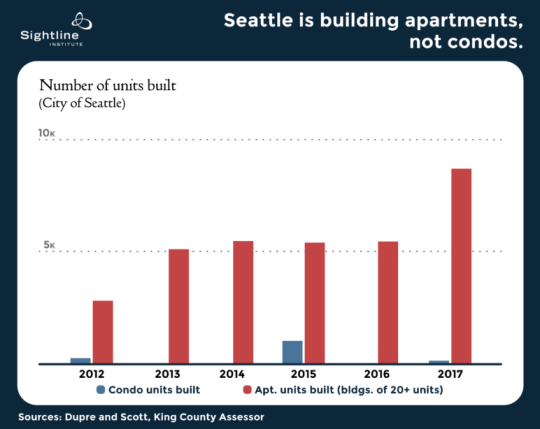
    It’s a good summary of the differences between these two markets and why over the last five years less than 4% of all new residential units built in Seattle have been condos. The story is obviously very different in Vancouver.

    It’s also a good reminder that incentives matter. Capital has a funny way of flowing to where the returns are greatest.

    Chart: Sightline Institute