Daily insights for city builders, delivered every morning at 6 AM ET. I’m Brandon Donnelly — a Toronto-based real estate developer and founder of Globizen. I’ve been writing here since 2013.

Tag: real estate investing

  • More retailers are buying real estate in New York

    Last week we spoke about how many businesses don’t want to own their own real estate, but that some do. We then spoke about Prada’s recent acquisition of 720 and 724 Fifth Avenue for $835 million. However, they’re not the only ones. According to New York’s The Real Deal (thank you John Bell for the article), last year saw the following transactions:

    • Swiss fashion house Akris bought a property from SL Green for $40.6 million
    • Japanese coffee retailer Geshary bought a property on Fifth Avenue from the Riese Organization for $38 million
    • And Dyson bought a building in Soho for $60 million

    Now, some, or a lot of this, is strategic. New York is New York, and global brands need to be there. Another part of this is that there was less competition last year. Fewer real estate companies wanted to buy retail and office buildings, and so end users seem to have stepped in at what they presumably saw as favourable prices.

    But it’s also not totally foreign for retailers to want to own their own real estate. Perhaps the most famous example is McDonald’s, which owns its own real estate and then leases it out to franchisees. Though as I alluded to last week, it’s important to know what business you’re ultimately in. And McDonald’s knows it’s in the real estate business.


  • How to manipulate attention

    This Toronto Life article about a 32-year-old who has managed to buy 10 homes in the city is very Toronto Life. At a time where many young people are struggling to afford housing, here is a millennial who has bought 10 of them (albeit with some partners). The underlying message: You’re not working hard enough.

    I am fairly certain Toronto Life writes these sorts of articles because they know they’ll enrage people. As Facebook has taught us over the last few years, getting people pissed off is good for engagement. And engagement is what drives advertising-based businesses.

    Here is an excerpt from a recent Time article by Roger McNamee (a former Facebook advisor):

    One of the best ways to manipulate attention is to appeal to outrage and fear, emotions that increase engagement. Facebook’s algorithms give users what they want, so each person’s News Feed becomes a unique reality, a filter bubble that creates the illusion that most people the user knows believe the same things. Showing users only posts they agree with was good for Facebook’s bottom line, but some research showed it also increased polarization and, as we learned, harmed democracy.

    If you take a look at the Twitter conversations surrounding the above Toronto Life article, you’ll see the reactions you would expect: Troll article. Yeah, but how much debt has he taken on? He had help from wealthy friends. Here’s how a 32-year-old is eroding housing affordability in Toronto.

    I appreciate all of this, but I will never understand the need to shit on other people because of their successes, regardless of whether they are self-made or were born with a competitive advantage. Billionaire isn’t a bad word in my books. I am a first generation real estate developer, but I wouldn’t be at all upset if my great-grandparents had decided that buying land in Toronto was a good idea.

    Here is a guy that moved to Canada for University. Lived in a basement with cockroaches after leaving his first job after school. Took some risks. And saved his money instead of doing bottle service at the club on the weekends. I can respect that.

    But again, these sorts of articles are bound to make a lot of people cranky. And Toronto Life knows that.

    Photo by Tiago Rodrigues on Unsplash

  • I can’t spend unrealized gains

    image

    Earlier this week the Wall Street Journal published an article claiming that the celebrated venture capital firm Andreessen Horowitz was lagging behind its elite peers in terms of returns.

    The firm then responded with a well-written blog post explaining why this accusation is off the mark. Their response was simply that you can’t measure returns on “unrealized gains.” Until there is a liquidity event – that is, the company gets sold or goes public – it’s just paper returns. And what matters is cash. 

    As the post clearly states: “I can’t spend unrealized gains.”

    But beyond just a rebuttal, the blog post is a great primer on how the venture capital industry works. We talk a lot about the tech space on this blog, so I thought some of you might find it interesting. 

    One of the reasons I like to follow the VC space is that there are many similarities to real estate development. Not only in the way that the funds are structured, but also in the way that the gestation periods are incredibly long.

    The post talks about this as a “J curve.” In the early years of a fund, the returns are negative. Money is going out the door to invest in immature and risky startups. And it’s not until the harvesting period (7+ years later) that the realized gains start getting paid out to investors (LPs).

    It’s also interesting to note that the exit timing for companies – at least according to Andreessen Horowitz – seems to be increasing (10+ years). This is yet another similarity to real estate development where it seems to be getting harder and harder to build and deliver new supply.

  • Should you buy or rent?

    image

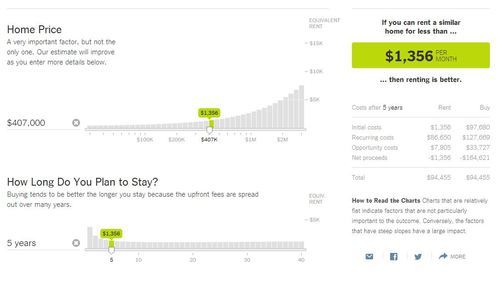
    The decision to buy or rent your home can be a big one–it’s both personal and financial. If you buy, you tie up capital that could be put to use elsewhere. But if you rent, you don’t get to participate in any of the upside should home prices appreciate.

    To help with this decision, the New York Times recently put together an online calculator. It takes into account the opportunity cost of your capital, inflation rates, the expected home price growth rate, and a myriad of other factors. It’s the most detailed of these types of calculators I’ve ever seen.

    If you’re thinking about this decision, you may want to take a look. Although, keep in mind that it’s a US model and in the US you can deduct the mortgage interest on your principal residence. You can’t do that in Canada.

    I also wrote a post a few months ago called: What I see as the fundamentals of real estate investing. You’ll find it interesting if you are, in fact, thinking about buying or investing in real estate anytime soon.