Daily insights for city builders, delivered every morning at 6 AM ET. I’m Brandon Donnelly — a Toronto-based real estate developer and founder of Globizen. I’ve been writing here since 2013.

Tag: real estate development

  • Learning about O-zones

    I spent this evening reading about Opportunity Zones, or “O-zones”, in the United States. 

    For a census tract to become an O-zone, it has to have a poverty rate of 20% or higher, or the median household income has to be less than 80% of the surrounding area. Governors are also only able to designate 25% of their eligible census tracts.

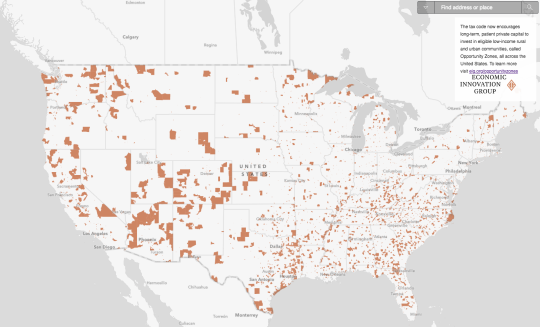
    Here is a map of the areas that have been designated as Opportunity Zones.
    image

    Here is how these O-zones work. (All excerpts taken from this Forbes article.)

    The law’s engine is a new breed of financial product, the opportunity fund, that offers investors a trifecta of attractive tax breaks. Here’s how it works. Investors who sell assets have 180 days to plow their taxable capital gains into an approved opportunity fund, which must hold 90% of its assets in Opportunity Zone projects. To put money to work fast, the law requires that the funds invest all of their cash within some specified time frame. (The Treasury Department is still deciding on that and other crucial details.) Tax on the original reinvested gain isn’t due until 2026, and the taxable gain is cut by 15%. Meanwhile the new opportunity investment grows tax-free, like a Roth IRA, provided it’s held for at least ten years. (If it’s sold earlier, it can be rolled into another opportunity fund and remain tax-free.)

    Here is how it could get the real estate industry to take action.

    For real estate developers, O-zones offer cheap real estate and unlimited, untaxed upside if a neighborhood takes off. Developers must do more than stash cash in crumbling property. To qualify for tax perks, they must make swift and significant upgrades (at least equal to the cost of the initial purchase). With real estate projects come new office buildings, industrial districts, restaurants and affordable housing—all of which can lay the groundwork for an economic boom. “The real estate aspect is a great catalyst to attract new businesses,” says AOL founder Steve Case, an early supporter of the O-zone initiative, whose Rise of the Rest Fund invests in backwater areas. “But it’s the startups that will be the real job creators.”

    And here is how it could influence where new businesses decide to locate.

    “If Facebook could have chosen to locate itself in an Opportunity Zone, like the Tenderloin in San Francisco, the investors would’ve paid no capital gains on their equity,” says Parker, who presumably would have been one of the big winners. The promise of mega-returns could send VCs, investment banks and private equity firms scrambling to launch their own opportunity funds to create incubators, scour second cities for overlooked talent or move portfolio companies into O-zones. “It wouldn’t surprise me if a lot of Silicon Valley VCs started to tell founders, ‘We’d like you to go over the bridge to Oakland, or we’d like you to go to Stockton,’” Parker says.

    If you’d like to learn more about Opportunity Zones, check out the Forbes article.

  • Construction costs are no joke right now

    I don’t know what it’s like in your market, but everyone is talking about it in the industry here in Toronto. Combine these rapidly rising hard costs with higher development charges and inclusionary zoning and you get significant upward pressure on condo prices and apartment rents. 

    This is also one of the reasons – perhaps it is the main reason – why you’re seeing some projects get cancelled. These are projects that maybe sold in one market (lower revenues) and are now trying to build in another (higher costs). The math no longer works. Sorry.

    I mention this today not to complain, although I’m always up for a good industry commiseration over beers, but because I often hear people lament that Toronto needs better design. Why aren’t developers using triple-glazed windows? Why aren’t developers thermally breaking the balconies?

    I will always advocate for better design. That is core to my belief system. But everything costs money. There are very real limits in this equation. And markets have a funny way of telling you exactly what those are.

    Photo by Filip Mroz on Unsplash

  • Toronto: 2000 vs. 2025

    Last week, Joe Berridge, Partner at Urban Strategies, gave a presentation at the Institute on Municipal Finance & Governance titled, Toronto: The Accidental Metropolis. I’ve seen Joe give similar presentations to this one before, and I always thoroughly enjoy his focus on Toronto’s position as a global city.

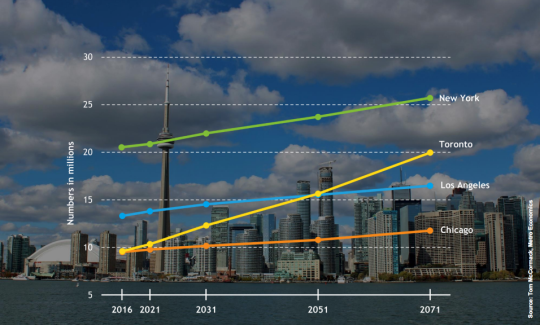
    Here is a slide from the presentation that projects out Toronto’s population to 2071 and compares it to the largest cities in the US.

    image

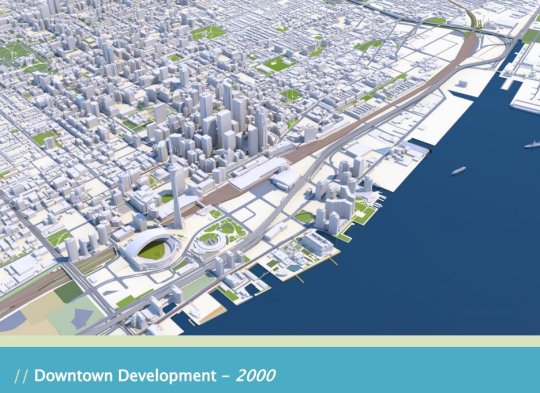
    But the two slides that have been really making the rounds online are the following ones. The first is a rendering of what downtown Toronto looked like in 2000. 

    image

    I remember this time clearly. Queen West seemed to end at Spadina. King West and Ossington weren’t things. And “Richmond and Adelaide” felt like the greatest club district in the world. (If you’re not from Toronto, these references will likely mean nothing to you. Sorry.)

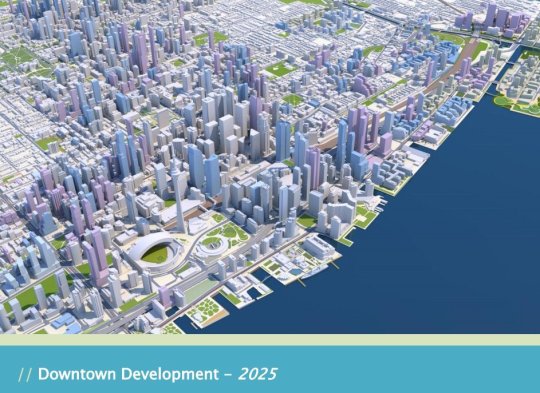
    The second slide is a rendering of what Toronto will look like in 2025. The transformation is just incredible.

    image

    I’ve seen some people comment that the Toronto of 2000 was relatively affordable; the Toronto of 2018 is unaffordable; and the Toronto of 2025 will be even more unaffordable with all of this new development.

    But I don’t understand that logic. Considering the growth rate shown in the first slide, imagine how unaffordable this city would be if we weren’t building new places for people to live and new places for people to work.

    For the full slide deck, go here. And for recent aerial photos of Toronto’s downtown core, check out my Instagram page.

  • We’re new here. Find your home.

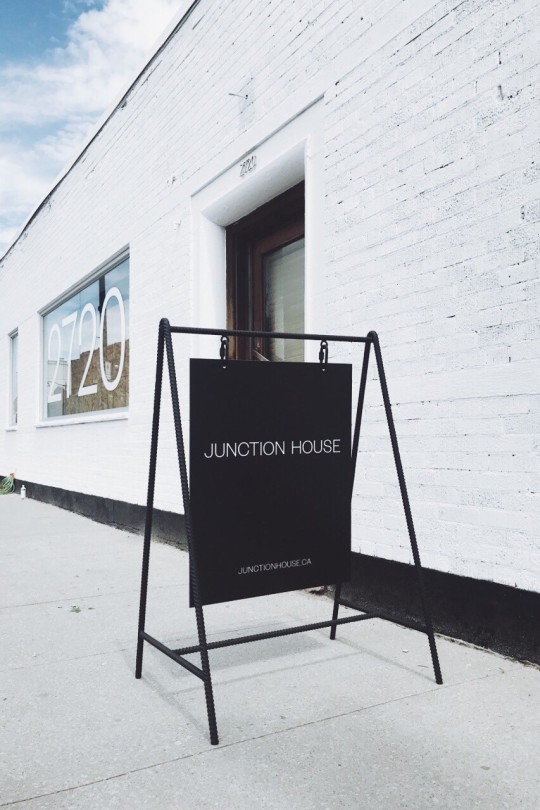
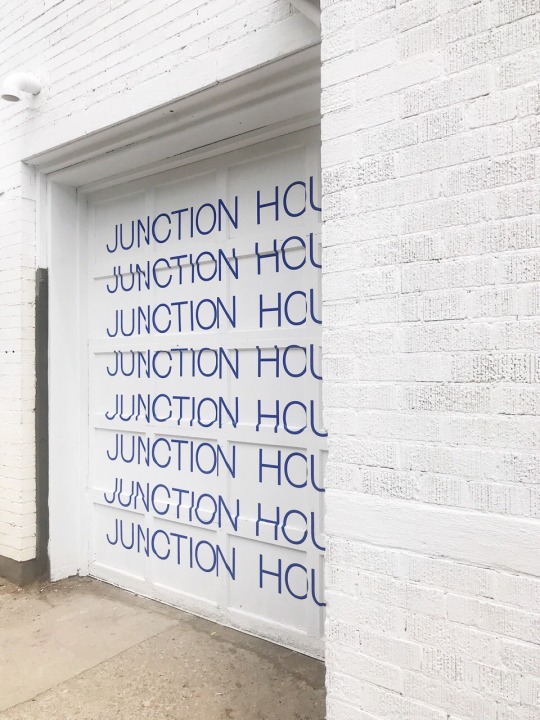
    A simple registration page is now live for our upcoming Junction House (condo) project. We also got this neat sign made:

    Of course, eventually there will be a full website, but this is for people who want to get on the early registrant list and tell us what they are looking for in a new home. Early registration. Early access to suites.

    We’re thrilled with the way the overall brand & identity is coming together for Junction House and we think it reflects the architecture and our project ambitions. 

    Hopefully you all like it as well.

    Photos by Vanderbrand

  • Anachronistic employment areas

    Today I was at the Land & Development Conference here in Toronto. I started live tweeting during the breakfast, but my vintage iPhone 6 couldn’t keep up, so I had to stop. Some insights throughout the day. But a lot of what you would expect. I suppose it’s more about the networking.

    I would, however, like to reiterate something that Ken Greenberg mentioned about Employment Areas/Lands in Toronto. For those of you who aren’t familiar, these lands are essentially intended to serve one, and only one, purpose: employment. And the process for introducing a mix of uses, including residential, is an onerous one to say the least.

    I appreciate why this is the case. But I agree with Greenberg in that this kind of single use zoning is antiquated. It does not reflect the realities of the market today. There are other mechanisms we can use to maintain and provide for employment, and ensure that we don’t end up with a city of all residential.

  • Could high low-rise infill buildings work?

    Dylan Reid recently wrote an interesting article about, what he calls, high low-rise infill buildings along Toronto’s main streets. 

    He describes the typology in this way: “These are generally 4-storey mixed-use buildings built quickly on one or two lots, replacing smaller previous buildings. They are often inserted beside existing, attached buildings.“

    Now, Reid acknowledges that this a challenging scale to develop at. He links to one of my articles in Urban Capital’s Site Magazine where I talk about exactly that: the diseconomies of scale associated with building small. (Though, I was talking about mid-rise, not high low-rise.)

    Reid addresses these challenges with a number of potential cost savings, including no parking minimums and no rezoning process. He also suggests that these projects may be better suited to existing landowners (who may own the land free and clear of a mortgage).

    Getting rid of parking minimums and streamlining approvals would certainly help, though I remain doubtful about overall feasibility. But what I wanted to comment on today was the last point about these projects being better suited to existing landowners.

    One problem with this line of thinking is that if we’re talking about land on a street where greater densities such as mid-rise are also permissible, the land is going to get valued based on mid-rise and not high low-rise.

    So when a prudent landowner thinks about developing their land, they may also consider the opportunity cost of simply selling their land based on its highest and best use.

    That thought process might go something like this. I own a piece of land. If I were to sell this land today and take on no development risk, I could make $X. If I were to instead develop this land, I could make $Y.

    If $Y is less than $X, then I’m obviously not going to develop. But if the spread between $Y and $X isn’t enough to compensate me for the risk of developing (and there’s lots of risk in developing), then I’m also not going to do it. (Developers run a similar test by marking the land cost in their pro forma to market.)

    And if $X is based on greater densities than $Y ($X is based on mid-rise densities and $Y is based on high low-rise densities) and if $Y is also being challenged by further diseconomies of scale, then I’m sure you can start to see how the math may not pencil.

    I say all of this not to shit on Reid’s article. It’s a good article. You should go read it. And we should all continue to think about ways to increase the supply of housing in this city and in others.

  • Hamilton’s Pier 8

    In December of last year, the City of Hamilton launched an RFP process to find a team (from the list of prequalified bidders) to develop a new urban community at Pier 8 along the waterfront. The ambition is somewhere around 1,500 new residential units and approximately 13,000 square meters of commercial and institutional space.

    That process has narrowed the pool to 4 teams and 1 will ultimately win the exclusive right to develop the new community. Here are the teams, along with a link to their submission materials, including a short video that I understand was a requirement of the RFP.

    – GulfDream (link)

    – Tridel (link)

    – Urban Capital / Core Urban / Milborne Group (link)

    – Waterfront Shores (link)

    This is a super exciting project for Hamilton. So I would encourage you to take a look at the presentation materials. At this point, you only have until Tuesday, April 17, 2018 to provide any comments to the City’s evaluators. If you’d like to view the boards in person, you can do that this Monday and Tuesday in the main lobby of City Hall.

  • Half of Toronto condos completed last year became new rental housing

    image

    Shaun Hildebrand (Urbanation) and Benjamin Tal (CIBC) published a report today called, “A Window Into the World of Condo Investors.” In it they revealed that last year (2017 data) no less than 48% of the Greater Toronto Area’s newly completed condo units were closed on by “rental investors.” In other words, almost half of the units became new rental supply.

    This stat was not surprisingly turned into clickbait-y type headlines like, “Half of Toronto condos bought last year were by investors”; whereas an alternate headline might read: “Half of Toronto condos completed last year became new rental housing.” Not as jarring, I know.

    In any event, there are a bunch of other interesting stats in the reports. Here are a few of them:

    – 80% of all new home sales in the GTA last year were condo.

    – Average resale condo prices (per square foot) increased by 26% last year and rents grew by 9%.

    – Over 20% of condo investors purchased their property with no mortgage.

    – Average down payment made by investors was 20%; non-investors were closer to 15%, likely because of mortgage insurance and other factors.

    – Out of the condo investors who took possession in 2017 with a mortgage, no less than 44% are in a negative cash flow position – meaning their rental income isn’t covering their carrying costs. 

    – The returns, which the report calls exceptional, have been coming in the form of price appreciation.

    – As a stress test for the market – what if all these negative cash flow investors suddenly sold their condos? – the report also estimates that if you took all of the rental investors who closed in 2017 with a mortgage and who are in a negative cash flow position greater than $500 per month, it would represent only 3.4% of the total annual supply of condos (both new and resale product).

    If you would like to check out the full report, you can do that over here.

    Photo by Scott Webb on Unsplash

  • What are the most important condo and rental building amenities?

    Last night I casually asked the

    Twittersphere

    what the most important condo amenity is, besides a gym. 

    That tweet got quite a few responses – everything from rock climbing to a proper facility for realtor lock boxes.

    Given the response, I thought it would be worthwhile to be a bit more rigorous in this analysis. So I have created an online survey that you can very quickly fill out by clicking here

    Here’s how this is going to work:

    – You have to enter your email address. Sorry, some friction. I figured that would make the data a bit more reliable. Don’t worry your email is safe.

    – You can select a maximum of 3 amenities. One of them can be “Other”, in which case you would then enter in an amenity not already found on the list.

    – The order of the amenities in the survey is being randomized so as to avoid any possible it’s-near-the-top-and-I’m-too-lazy-to-scroll bias.

    – You’ll be able to see the results of the survey after you’ve responded. I’ll also post the results to this blog so that it’s public and people learn things. Individual emails will, of course, never be published.

    Developers should be building what people actually want and will use. Now is your chance to tell us what that is. Click here for the survey.

  • It Will Never Work

    On March 31, RIBA North (Royal Institute of British Architects North) in Liverpool will be opening the doors on a new exhibition that explores 25 years of award winning work by the developer and self-described “regenerator”, Urban Splash. I love the name of the exhibition. It’s called: “It Will Never Work.”

    Here is a short description of the exhibition:

    Urban Splash profess to have started without a plan, purposefully ignoring advice and routinely rejecting accepted development processes. At every step ‘it will never work’ has been a call to action rather than a discouragement.

    The company’s maverick presence on the development landscape of the North has changed the way we live, work and play in our cities, and their continued success as ‘established innovators’ is helping to shape urban futures.

    If you aren’t familiar with the work of Urban Splash, I would encourage you to check them out. When I was first starting out in development and scouring the world for developers that actually cared about design and cities, these guys were on my shortlist.

    So I have been a longtime follower and I have developer friends here in Toronto who I know also admire their work. Sadly, I have no plans to be in Liverpool anytime soon. But maybe some of you do.