
Daily insights for city builders, delivered every morning at 6 AM ET. I’m Brandon Donnelly — a Toronto-based real estate developer and founder of Globizen. I’ve been writing here since 2013.

Tag: real estate development

  • The growth of branded residences

    A branded residence is, as the name suggests, a residential building with a known branded attached to it. Historically, these have tended to be hotel brands. But it really just needs to be any brand that people know, care about, and will pay a premium for. So it could also be a fashion brand, a car brand, or whatever else.

    This is a growing segment of the residential market. According to UK-based Savills, there were only 15 or so of these “schemes” in the 1990s (the UK uses scheme in lieu of project, which always sounds conniving to me), but by the end of this decade they expect the pipeline of branded residences to exceed over 1,200.

    I would also argue that projects designed by celebrated architects and/or designers are a form of branded residence. And this is not being captured in Savills’ number above.

    Whatever your definition, today, the branded residence capital of the world seems to be Dubai, which feels right. And the biggest brands, by what appears to be a long shot, are Four Seasons and Ritz-Carlton (hotel side), and YOO and Trump (non-hotel side). Here are the full rankings from Savills:
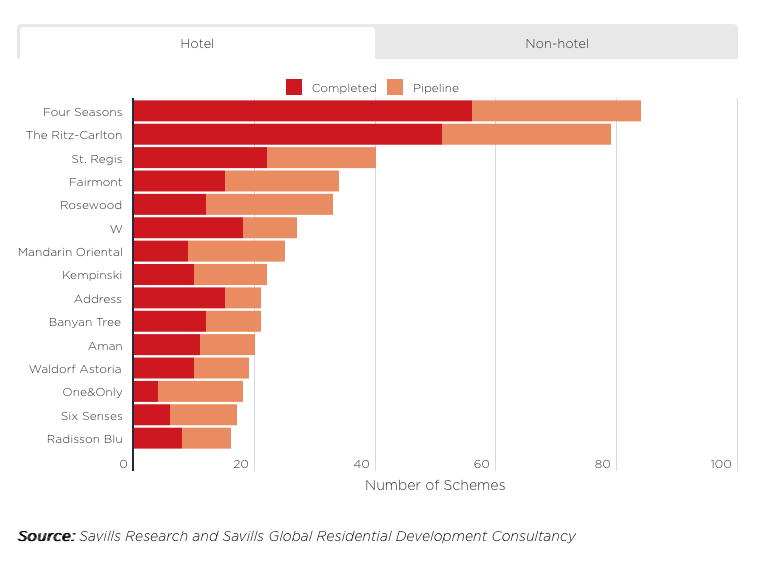
    This is an interesting part of the real estate business for a few reasons. One, it makes sense. A New Balance shoe that gets co-branded with Aimé Leon Dore unlocks additional value for both sides. ALD has a brand that certain people care about. So, of course the same would be true of real estate paired with the right brand.

    Two, it’s a growing market, and I think this is aided by the fact that development is an intensely local business — so it can be hard to grow a globally-significant brand on your own. Sometimes you just need to borrow someone else’s.

    And three, it’s usually a less risky approach to getting your name on buildings. Branded residences typically operate on a licensing model, which means developers pay for the right to use the brand. The brand may also capture some of the upside in the form of a percentage of sales. That’s less risky than putting up your own money.

  • So, what is Globizen doing?

    First, the why. The why is to build better cities. And it’s as simple as that. I love cities. The team loves cities. And we all feel a great sense of responsibility when it comes to doing our part to make them more prosperous, more beautiful, and overall better places to live and work.

    It is for this reason that Globizen refers to itself as a city builder. We obviously didn’t invent this moniker, but we do take it seriously. And our specific intent is to be both a city-building company and a city-building community.

    What this means is that we do the things that most companies do, including trying to make money. But in parallel to this, we also aspire to create a community of like-minded city builders.

    City building isn’t just about real estate development. It’s also about the artist that just painted a mural, the local restauranteur that just opened up a new concept, and the individual that just did something, whatever that may be, to improve their community.

    We would like to do our part to celebrate these actions and support more of them. This is how we want to build.

    As for what we actually do, we are developers of creative mixed-use infill projects. Currently, we are developing and managing projects on our own account (we invested our own equity) and on behalf of great partners. But in all cases, we have a consistent investment philosophy and approach to development:

    • Focus on fundamentals
    • Search for overlooked assets and opportunities
    • Embrace non-consensus views
    • Create value by innovating with design, culture, and technology
    • Execute with discipline and passion
    • Think long term

    We are actively looking for new development opportunities. We are also exploring/underwriting a number of income-producing asset strategies. If you’d like to pitch us a site or project, or you just want to grab a coffee somewhere cool, please feel free to send me an email (brandon.donnelly@globizen.com).

  • Forty-one

    Today is my forty-first birthday.

    I had aspirations of making it a slower day, but that didn’t really happen. I did, however, start my morning “on the Bench” for one of our development projects and that was pretty spectacular, especially with the weather we had. Today has to have been the nicest day of the year.

    I very much enjoy my birthdays, but the cadence of them seems to only speed up. It feels like just last month that I turned forty. And so in many ways, birthdays are a reminder to me that it’s important to be decisive and not waste time. Life keeps moving forward whether we like it or not — usually quickly. So it’s best to optimize accordingly.

    At the same time, this is probably one of my biggest faults. I’m bad at slowing down and living in the moment. I get restless. Neat B tells me that I am at my most relaxed when we are traveling in Paris and just sitting idly in a cafe somewhere. That sounds right. But I’d like to do more of this at home.

    So that’s my birthday wish (goal) for this year.

  • Real estate is a byproduct of economic growth

    I sometimes wonder if I wasn’t born and raised in Toronto if I still would have gone to architecture school and become a real estate developer. I mean, if I grew up in Paris, maybe I would have become a fashion designer. Or if I grew up in Park City, maybe I would have started a snowboard company, slash become a ski bum. I would enjoy doing all of these things. And places certainly do influence us, more than most of us probably appreciate.

    My point with all of this is that Canada likes to somewhat paradoxically over index on housing. I say paradoxically because we never seem to have enough of it for Canadians — certainly the affordable varietal — and yet:

    Canada relies heavily on its real-estate sector to power the economy. Housing investment in Canada as a share of gross domestic product reached 8.9% in 2022, according to the Organization for Economic Cooperation and Development, much higher than the 4.8% on average for the 38 member countries in the OECD.

    If you look at all of the industries that make up the Canadian economy, “real estate and rental and leasing” is at the top with 13.01% of GDP (as of 2020). And if you add “construction” on top of this, the total is about 20.09% (again, as of 2020). This feels suboptimal. And I say this as a developer and builder of real estate.

    Real estate is largely a byproduct of economic growth. When someone starts a business and then needs something like an office or a warehouse, that is a positive thing for the economy. Jobs are being created by the business and further jobs are being created by the people who will deliver the space they need. But if you aren’t creating new jobs in the first place, then just dealing in real estate will only take you so far.

    Immigration helps, but it can also create a mirage of growth and prosperity. If you look at real GDP growth across the G7 from 2019 to today, Canada looks pretty good. We’re second (+4.5%) only to the US (+8.9%). But if you look at GDP per capita over the same time period, we’re dead last (-2%), whereas the US remains on top (+7.2%).

    I’m not an economist; I just build things. But in my opinion, this is a problem. We should be doing everything we can to foster a stronger culture of innovation and entrepreneurship in this country. We have the talent. I mean, Ethereum has roots in this city! We just need more people turning this intellect into wonderful new companies.

  • Does every real estate developer really do this?

    I am not a lawyer. Nothing I write on this blog should be construed as legal advice. In fact, it is highly questionable whether anything I write here should be construed as any sort of advice. Still, Trump’s fraud trial is an interesting one for us to discuss. The case, as I crudely understand it, accuses him of “inflating his net worth to dupe banks” and “issuing false financial statements every year between 2011 and 2021.” And possibly some other things, too.

    Now there are some people who are saying that there’s nothing actually wrong with the way Trump conducts his real estate practice. Kevin O’Leary, for instance, was just on CNN saying, “every real estate developer everywhere does this.” His position was that if you’re going to fault Trump, then you need to go after every developer out there. Here’s the video interview where he says this:

    Let’s break this down. Kevin is right in that people who own real estate ordinarily want it to be worth as much as possible. This is true for individual homeowners and it’s true for large real estate companies. And there are various reasons for this. One reason is that it maximizes your debt proceeds. For example, if you buy a building for $100 and the banks are willing to give you a loan based on a LTV (loan-to-value) of 70%, then you will get $70 in debt proceeds and you will need to put in $30 of your own cash equity.

    However, if you buy a building for $100 and it ends up being worth ~$143, then this same 70% LTV will result in $100 of debt proceeds. This means that you won’t need to put in any of your own cash and that, for all intents and purposes, you just got a building for “free.” By most metrics, this would be considered a good real estate deal. (Of course, you could also buy a building for $100 and have it be worth only $50. And this would be much less fun than getting free real estate.)

    One important question, though, is how does the building end up “being worth $143?” Well, one scenario could be that you just bought really well. It was an off-market transaction (i.e. it wasn’t formally listed), the seller was highly motivated, and so you negotiated a below-market purchase price. You then went out and hired a reputable third-party appraiser who did a bunch of rigorous research and issued you a report that said, “your building is worth $143.” And this would be perfectly fine.

    But one can also imagine ways in which someone could lie and do nefarious things to try and convince people that their building is worth $143, even if it clearly isn’t. Now, at the end of the day, I don’t know the facts of this case. So I can’t comment directly. But I did want to use this as an opportunity to add some nuance to Kevin’s claim that “every real estate developer everywhere does this.” Ultimately, that depends on what “this” is. Are we talking about doing customary things to maximize value creation? Or are we talking about fraud?

  • There’s something to be said about hard assets

    Here is a recent post by Scott Galloway comparing Uber and WeWork. In it, he praises the virtues of asset-light business models:

    For most of business history, having assets was good, and having more was even better. However, one of technology’s tectonic unlocks has been elevating information (bits) over objects (atoms). In the information age, owning assets is one business, while operating them is another, and each demands distinct capital structures, management approaches, and operational skills. Businesses offering the greatest return on invested capital don’t have much capital (assets) and can scale up faster, as they don’t bind themselves to cars, apartments, or even inventory.

    We know this. Uber doesn’t own cars. Airbnb doesn’t own rental properties. And most hotels, as Galloway mentions, also don’t own their real estate. Generally speaking, hotels are brands that enter into fee-earning management contracts with people who own real estate.

    However, WeWork is not this. According to Galloway, WeWork had $47 billion of pre-IPO lease obligations. These ran/run through to 2038. In this regard, WeWork is more bank-like: they have a similar mismatch of short-term assets and long-term liabilities.

    Galloway also argues that asset-light businesses offer the greatest ROI because they can scale up faster. And this is certainly one of the virtues of tech businesses. In more asset-heavy businesses like real estate development, each project/asset is largely a discrete effort.

    But there are significant advantages to owning real estate; one of them being that, at the end of the day, you own a hard asset.

    Venture capitalist Fred Wilson once wrote on his blog that one of his big lessons from the dot-com bubble was that he learned to take his tech wealth and funnel portions of it into hard assets — namely real estate in New York City.

    This, of course, comes with its own set of risks. But clearly there is something to be said about owning real estate.

  • Real estate is a project-based business

    A friend of mine just sent me this blog post from the venture capital firm, Shadow Ventures. They specialize in the built environment (i.e. real estate and construction) and the post is called, “What McKinsey gets wrong about the built environment.” Here’s one of the points that they make:

    We are project based. While we are much larger, the most similar business is the movie industry. Project based, different source of funding/budget every time, the team changes (but we have our faves).

    This is very true. Oftentimes what happens in real estate is that you start with an opportunity. Something like, “buy this building, fix it up, and then sell it for more.” If the opportunity sounds compelling, a common approach is to then “get control of the asset and figure out how to capitalize it.”

    What this means is a conditional deal so that you can (1) do your due diligence and (2) figure out how to pay for it. This gets back to the three-legged stool that we’ve spoken about before. To do real estate stuff you basically need 3 things: a piece of real estate, relevant experience, and, of course, some money.

    This speaks to the entrepreneurial nature of real estate. But it also speaks to why it is maybe unfair to evaluate the architecture, engineering, and construction (AEC) industry as you might the automotive industry. The auto industry doesn’t capitalize and make each car slightly differently.

    This is one of the many things that makes real estate unique. And it’s why we have seen an enduring effort to figure out the “productization” of housing. It’s about being less project based.

  • Use-it-or-lose-it entitlements

    One of the things that cities often try and stamp out is speculation. Homes should not sit empty (enter vacant home tax). Storefronts should not sit empty (enter vacant commercial tax). And development land should not sit undeveloped. To correct this latter problem, one idea that is sometimes floated around is “use-it-or-lose-it” zoning.

    The way it works today in, I believe, most cities, is that if you do a site-specific rezoning on a property — and secure additional density — you get those special permissions forever. If you want to wait 100 years before starting construction, you are technically entitled to do that. Of course, in the interim, no new housing is actually being created. It’s all just on paper.

    The idea with “use-it-or-lose-it” entitlements is that — instead of these permissions lasting forever — they would expire after a certain period of time, which would mean that the entire rezoning process would need to be done all over again. These take time (at least a few years) and cost money (it’s in the millions). And so it has been suggested that this would incentivize developers to not sit on entitled land.

    While I do understand where this line of thinking is coming from, let me make a few points:

    • Generally speaking, most developers don’t just sit on entitled land for fun. They need things to happen, and to happen quickly, so that value can be realized. If there is a problem of too many developers not actually building, it could be a sign that there are other market factors impacting feasibility.
    • There is nothing wrong with rezoning a property and then “flipping it out” to another developer. This is often viewed negatively. But some developers only rezone properties and some developers only buy zoned sites. These can be different phases of the value chain. A rezoning can take years and millions of dollars, and so sometimes developers don’t have the wherewithal or desire to do both.
    • A use-it-or-lose-it approach unfairly punishes developers during market cycles and bear markets, like the one we are experiencing right now. There is no way to predict when the next global pandemic will hit, when construction costs might surge 40%, and when the fed could start rapidly increasing rates to calm inflation. Maybe waiting out the storm is all you can do.
    • If you’re building condominium housing in our market, you generally need pre-sales in order to secure a construction loan. Let’s call it 70% pre-sold. What happens if this takes longer than expected? And what happens if you sell 50%, your site-specific rezoning expires, and then you have to restart the entire process? At this point and in this current market environment, you would likely have to cancel the entire project and reboot it.
    • Timing is important. To give a specific project example, we had planned to launch condominium pre-sales for our One Delisle project in the fall of 2020. And we were ready to do that. But sentiment didn’t feel right. Too pandemic-y still, and so we waited until the spring of 2021. This turned out to be the right decision. But what would have happened had we had this timing gun to our head? (Truthfully, it always feels like there’s a timing gun to our head.)
    • I have written about this before, but go-to-market strategies are changing in this current environment. It is taking longer to start sales and construction because, among other things, developers are spending more time trying to pin down their construction costs. Would rezoning expiries take all of this into consideration and adjust accordingly?
    • Finally, if one is going to do something like force developers to pull all of their building permits within X months of receiving zoning approvals — or else suffer the consequences — then everything required to get there should also have a maximum timeline associated with it. In other words, cities would also need to do things like commit to issuing permits within Y months of receiving a submission — or else. It’s only fair that this cuts both ways. But just to be very, very clear, I do not think this is a good idea.

    What I am broadly saying is that (1) development is a pain in the ass and (2) developers are already heavily incentivized to move quickly and make things happen. It is not uncommon for projects to take 5-10 years from site acquisition to completion. And a lot of unexpected things can happen during that time period. Hopefully losing your entitlements doesn’t become one of them.

  • Buying condos with crypto

    If you happen to have made boatloads of money in crypto (which sadly isn’t me), one sensible thing you could do is put some of that money into luxury residential real estate. You know, to diversify your portfolio.

    According to this recent WSJ article, it is already happening, with some developers and some homeowners now accepting cryptocurrencies in lieu of US dollars and other fiat currencies. This is helpful if you’ve managed to accumulate a bunch of crypto and don’t want to convert it. It can also be easier when it comes to moving the funds around:

    Avi Dabir, vice president of business development at FTX US, said he sees real estate as a growing sector for the company because crypto transactions are faster and more efficient than traditional deals, which rely on an often-cumbersome banking system.“If I want to send a wire transfer today using my traditional bank account, it’s got to be banking hours, I need to make sure I hit that wire cutoff time and I can’t do it on the weekends,” he said. “That’s not a problem with cryptocurrency. It’s open 24/7.”

    But of course it is still early days for crypto. The article suggests that most developers and owners are arranging for any crypto received to be immediately converted into US dollars at closing. This is presumably because of how volatile cryptocurrencies tend to be — at least right now.

    To accept crypto, PMG had to partner with a regulated exchange that could quickly convert crypto to U.S. dollars, then convince an escrow agent to accept down payments from the exchange, rather than directly from the developer. Mr. Shear said most escrow agents looked at him like he was crazy, but “20 lawyers, one year later, and a lot of brain damage, everybody got comfortable.”

    There are also tax considerations (that I am really not an expert on). If you bought $100 worth of Ethereum and it is now worth $10 million, you are responsible for paying tax on this gain if/when you sell, trade, or otherwise dispose of the crypto. And it is my understanding that if you were to use this $10 million in Ethereum to buy something like a condo in Miami, it would also be considered a taxable event.

    Maybe all of this becomes commonplace or maybe it doesn’t. But it sure is interesting to see crypto already starting to flow into hard assets like real estate.

  • Being a real estate developer means asking a lot of questions

    I was having coffee with a developer friend of mine this morning and we got onto the topic of asking a lot of questions. We joked that that’s what we do all day.

    Development projects happen because of teams of very smart people all working together toward a common goal. It’s a beautiful thing. And as a developer, there are certain expertises and competencies that you should have.

    But for the most part, we usually sit in rooms as the least qualified person. We are not structural engineers. We are not geotechnical engineers. We are not architects (though I sometimes pose as a fake one). We are not planners. And we are not façade specialists, among many other things.

    But we are the ones taking on most of the financial risk and trying to bring everything together. And what that means is that you end up asking a lot of questions. You collect information, you try and consider what could go wrong, you lean on past experiences, and then you make a decision — often without perfect information or 100% certainty.

    This is how projects move forward. You have to rely on others and you have to make decisions. Because not making a decision is even worse. It burns time, which is why too many cooks in the kitchen can be the kiss of death for development projects.

    I’m sure the same thing can be said for many other things in life.