Daily insights for city builders, delivered every morning at 6 AM ET. I’m Brandon Donnelly — a Toronto-based real estate developer and founder of Globizen. I’ve been writing here since 2013.

Tag: real estate agent

  • Multiple representation

    house by Edoardo Panella on 500px.com

    https://500px.com/embed.js

    If you’ve ever bought a property, you might be familiar with something called “multiple representation.” It’s when one real estate agent represents both the seller and the buyer for a particular transaction. It may also be called “dual agency.”

    The reason this can happen is because, here in North America at least, real estate sales are typically done with two agents: a seller’s agent and a buyer’s agent. The real estate commissions are (directly) paid by the seller to the listing brokerage, but it’s usually split between both brokerages and agents involved in the transaction.

    However, if you’re an agent-less buyer and you happen to come across a property that you like on your own (perhaps by browsing around online), the selling agent will likely ask you to also sign a representation agreement with them. And that means entering the world of “multiple representation.”

    Here’s some of the wording that the Ontario Real Estate Association uses:

    MULTIPLE REPRESENTATION: The Listing Brokerage has entered into a Buyer Representation Agreement with the Buyer and represents
    the interests of the Seller and the Buyer, with their consent, for this transaction. The Listing Brokerage must be impartial and equally protect
    the interests of the Seller and the Buyer in this transaction. The Listing Brokerage has a duty of full disclosure to both the Seller and the Buyer,
    including a requirement to disclose all factual information about the property known to the Listing Brokerage.

    But I don’t understand how this can work.

    You now have a sole agent that is supposed to act as a neutral facilitator between (1) a party that is paying them all of their salary for the transaction (and which increases as the selling price goes up) and (2) a party that just came off the street (and where there’s no preexisting relationship).

    That’s why multiple representation scenarios always make me uncomfortable. Real estate already has too many information asymmetries for my liking and this feels like a conflict of interest in almost all of the cases. I guess that’s why they are not allowed in many states in the US.

  • 1 bedroom condo for sale

    image

    I’m hijacking Architect This City today to help my mother out and try something new.

    She is looking to sell her 1 bedroom condo in the Radiocity Condominiums, located at 285 Mutual Street in Toronto. It’s called Radiocity, not because the developers thought New York was cool (my pet peeve), but because the site used to be the headquarters of the Canadian Broadcasting Corporation (CBC) way back when.

    The 2-tower complex is located north of Carlton Street, between Church Street and Jarvis Street, and is adjacent to Canada’s National Ballet School (designed by KPMB Architects). It’s close to College Park and Yonge & College.

    It was completed/registered in 2005 and won a number of design awards, including one from the Royal Architectural Institute of Canada. Notable about the design is the way it integrates townhouses at the base, a public courtyard (with public art) between both towers, and the Ballet School. (A deal struck with the developer and the CBC allowed the school to buy their portion of the land for $1). 

    The buildings were developed by Context Development and designed by architectsAlliance, which is actually the same developer-architect duo behind the building I currently live and own in. I’m clearly a big fan.

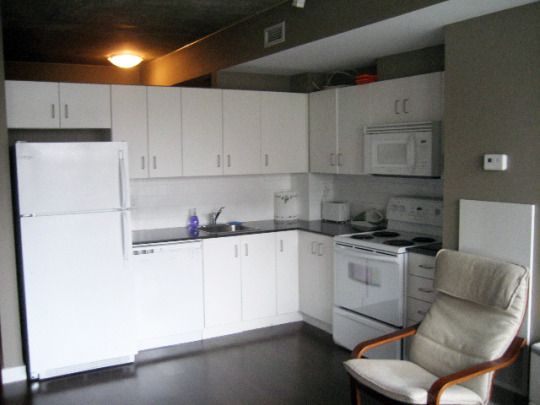
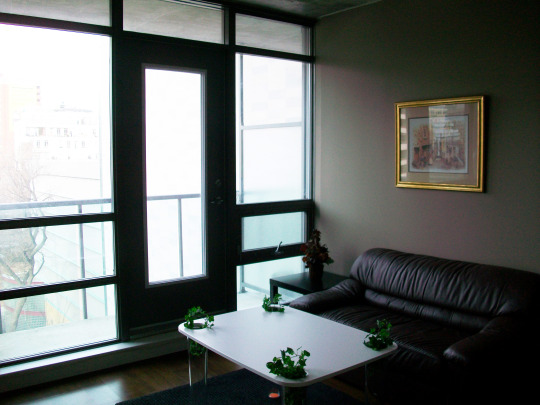
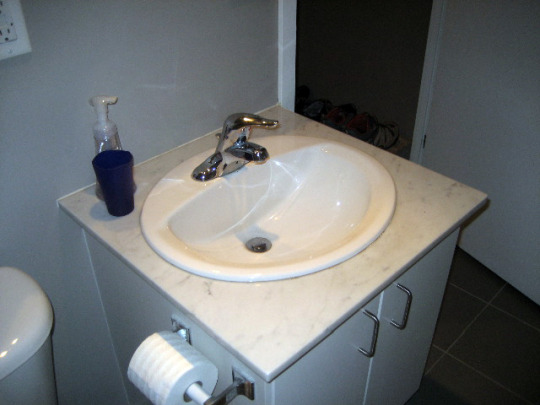
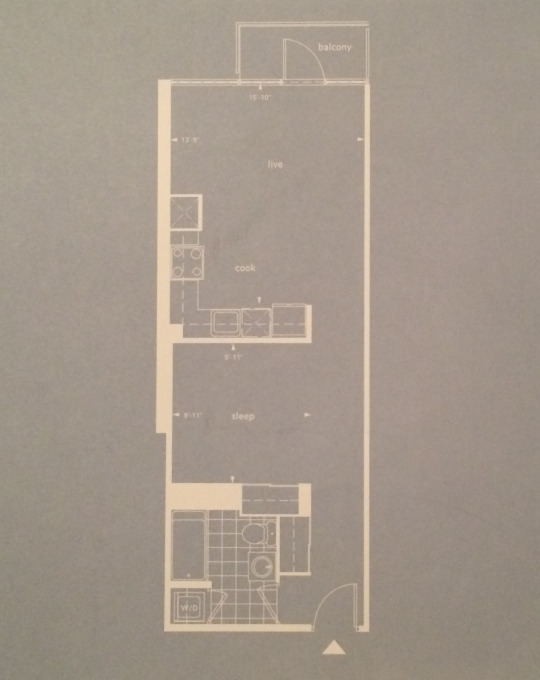
    The suite is about 560 square feet. It has 9’ exposed concrete ceilings. It has one full bathroom (tub), with a stacked washer and dryer. The bedroom is about 10’ x 10’ and is setback from the outside windows and enclosed with 3 x translucent sliding doors from C-Living. (I had them installed myself and they’re much better quality than the sliding doors you’ll find in most new builds.) The kitchen and living area is open concept, and there’s a north facing balcony that overlooks a quiet private courtyard. You basically get a view of trees, greenery, and the city. The suite is located on the 7th floor.

    Here’s the floor plan:

    image

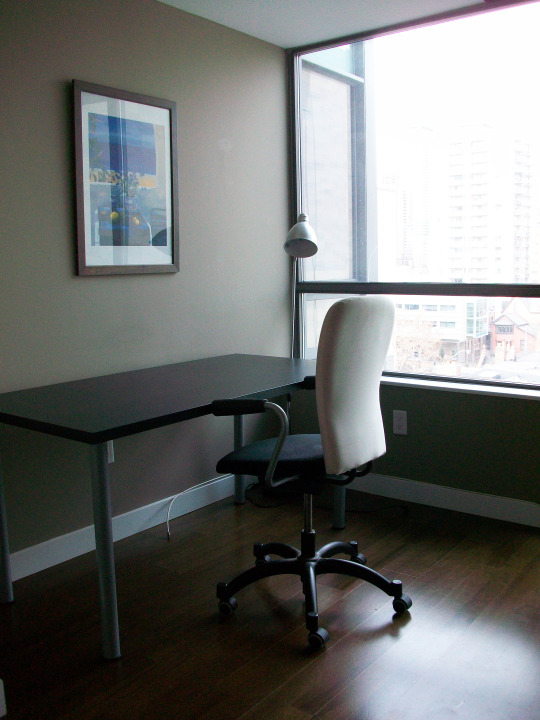
    And here are a few photos. They are all the right proportions and haven’t been stretched to make the space look bigger 🙂

    imageimageimageimageimage

    The building has 24-hour concierge, visitor parking, and 3 floors of amenities. The amenities include a gym, aerobics room, party room, saunas, media room, boardroom, multiple lounges, 2 x guest suites, a party room, and a billiard room. 

    College subway station is a 7 minute walk (600m).

    image

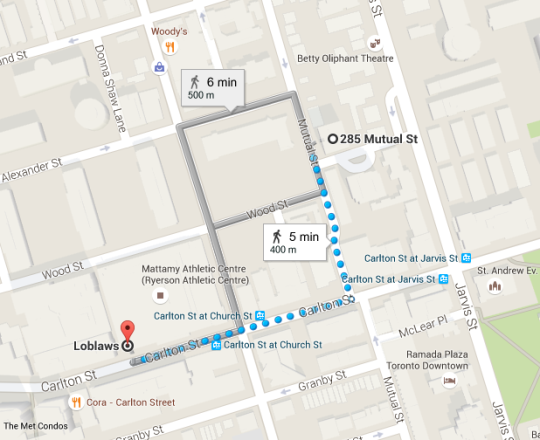
    The Loblaws grocery store at Maple Leaf Gardens (which is awesome and also includes an LCBO) is a 5 minute walk (400m). Though I’m fairly certain you could do it in 4 minutes.

    image

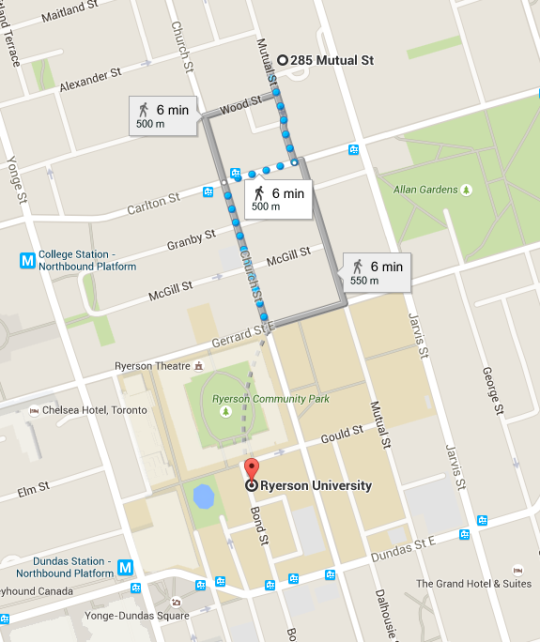
    And you’re a 6 minute walk to Ryerson University (500m).

    image

    The asking price is C$349,900. The maintenance fee is $426.64 per month and the property taxes are $2,039.19 per year.

    It’s a private sale, but she is willing to cooperate with buyer’s agents (2.5% commission). It’s currently furnished, but you can have it either way you want (unfurnished or furnished).

    If you have any questions or would like to book a viewing, please send her or me an email. If you’re an agent just looking for a listing, please don’t. Thanks for reading. Regularly scheduled programming will resume tomorrow.

    Image at the top of this post is from architectsAlliance.

  • Towards more publicness

    Back when the commercial internet first started to take off it was uncommon to use your real name online. Instead people relied on usernames and other pseudynoms to represent themselves. I honestly can’t remember what I used in those days, but I’m sure it was something ridiculous.

    Over time though that started to change. 

    Blogging started to take off in the late 1990s. And we started to become more comfortable sharing personal information online. Perhaps the biggest shift though, came with the introduction of Facebook in 2004 (over 10 years ago!). All of a sudden people – young college students initially – started sharing lots of personal information online, including photos of themsleves and their friends.

    But this wasn’t an overnight change. When Facebook first launched, privacy was an important component. It still is, but I would argue that it has become less central given how public a lot of other social media platforms are today. Twitter, for instance, is what it is today largely because of its publicness. 

    For my own social media accounts, I have made every single one of them completely public. From Twitter to Facebook to Instagram to Snapchat, nothing I post to social media is restricted in any way. And I do that because I believe we are headed towards a world with more – not less – openness, transparency and publicness.

    Of course, I’m not just talking about social media and tech. I’m talking about open data in general.

    Earlier this year, the Toronto Real Estate Board clamped down on real estate brokers who were publishing historical sales data online. Citing privacy concerns, TREB ordered them to stop or lose their access to the MLS system. 

    For those of you not from familiar with the Toronto real estate market, historical sales data for homes is not open and published online. You generally need to go through a realtor to get access to this data. Some think this is the right approach. And others think it is antiquated.

    But as I explained above, our conception of what should be private can, and will, evolve over time.

    Here are the details on my home:

    I purchased it in September 2012 for exactly $400,000 (Canadian). It’s a 650 square foot condo in the St. Lawrence Market neighborhood of Toronto. It has one bedroom, a 400 square foot terrace, one parking spot, and 10′ ceilings.

    Sooner or later, I believe this information will be freely available online. But since that’s not the case today, I figured I would just tell you. Sharing this information is not a big deal for me.

  • Biggest US real estate website to acquire 2nd biggest US real estate website

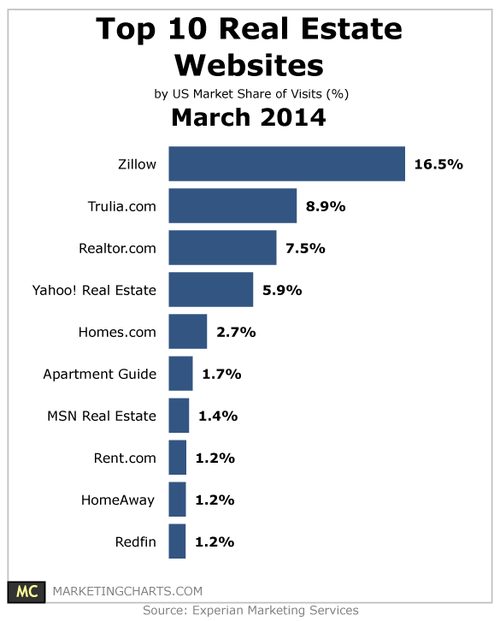
    Today it was announced that Zillow.com will be buying Trulia.com for $3.5 billion in a stock-for-stock transaction. Based on share of web visits, the biggest real estate website in the US has just acquired the 2nd biggest.

    image

    Both companies make the bulk of their money through advertising sales to real estate professionals (i.e. agents and brokers). But what was interesting to read in their press release is that, even with this merger, the combined revenue of both Zillow and Trulia still only represents about 4% of the estimated $12 billion that US real estate professionals spend on marketing each year. 

    Zillow says it’s because the real estate industry hasn’t fully made the switch to online and mobile – and thus it represents a huge market opportunity for them. And from my experience I would say that this is likely the case. But it could also be because the real estate community is putting their marketing dollars elsewhere online. 

    Whatever the case may be, Zillow.com (and its portfolio of companies) is now firmly positioned as the largest real estate website in the US. But even still, Zillow.com has never felt fully “net native” to me. It has never felt as if it were specifically built for the internet and that it’s only possible because of the internet. Instead, it feels like an offline model ported over to online. And the two are quite different.

    The reason I feel this way is because there’s an inherent tension to the way the online residential real estate market works today. Virtually every lead generation tool (that agents use) is intended to funnel buyers and sellers to them. That’s why so many real estate websites have sucked for so long. Because the goal wasn’t to keep you locked into a website, it was to get you to connect, in person, with an agent.

    Zillow and Trulia started to break with that tradition by offering a lot more information online. Before they came along, it was a lot harder for real estate consumers to do their own research. But at the end of the day, Zillow makes money when it’s an effective sales funnel for agents. And since that’s always been the way the market has worked, it doesn’t feel net native to me.

    If my gut is right, then it means there’s still lots of opportunities in this space.

  • Could a decentralized sales model work?

    image

    Since I started blogging last year, I’ve been getting regular emails from both people I know and from readers I don’t know (but hope to one day meet) asking for advice on buying real estate. Usually somebody sends me the link to a place they’re thinking about buying, and they want to know what I think about the property and the neighborhood.

    I’m more than happy to help when I can and I try to be brutally honest in terms of what I think. What’s interesting about this dynamic though, is that I don’t have a vested interest in any of the outcomes. Whether I tell that person I love the place or that it’s shit, I don’t stand to gain anything. And that means I can be brutally honest. It’s for this same reason that customer reviews on websites can work so well. 

    Because on the flip side, if I make money when you buy, then guess what, I’m going to want you to buy. That’s how it works for any industry–from financial services to real estate to retail. That’s why some stores will promote the fact that their sales people are not on commission. Although you could argue that those sales people are then less motivated to help you.

    In any event, all of this got me wondering if there isn’t some way to take customer reviews to the next level. Could a decentralized sales model work?

    Last year I had a conference call with one of the chief officers of one of the top 3 real estate websites in the US and I was told that they had actually tested a “social buying model.” It ultimately failed, but it strikes me as an interesting concept. Reviews are starting to feel a bit dated now on the social web, but I think the idea of crowdsourced input is here to stay.

    Image: Flickr

  • The high cost of transacting

    This past Sunday I was over at my father’s place for dinner and we were talking about the high transaction costs associated with buying and selling homes. That is, we weren’t talking about the high price of homes in Toronto, we were only talking about transaction costs and barriers to market liquidity.

    For example, let’s say for the sake of simplicity that you own a home that’s worth $1 million and you’d like to sell it and buy a different home that also happens to be worth $1 million. In this case, you’d be making an entirely lateral move. You’re not down sizing or up sizing, you just want a different home–perhaps because you’d prefer a different neighborhood.

    In order to do this, you’re going to be faced with a number of costs. But the 2 most significant are real estate commissions and Land Transfer Taxes (both provincial and municipal). You only pay Land Transfer Taxes in Toronto when you buy (take title) of a new property, but they’re unavoidable, unless you’re a first time buyer, in which case you’d qualify for a bit of a rebate.

    Real estate commissions are technically optional, but 70-90% of the market in North America still uses a a real estate agent to sell their home (based on the estimates I’ve found). Typically a seller pays around 5% of the sale price. So in this example, you the homeowner would be paying around $50,000 in real estate commissions.

    Land Transfer Taxes would be roughly $32,000, and so you’re looking at a total somewhere around $82,000 in order to make this lateral move. This, of course, does not include legal fees or any other moving costs you might incur. It’s a hell of a lot of money and it’s a significant barrier to transacting.

    But my hunch is that we’ll eventually see real estate commissions come down. No real estate agent wants to hear this, but I think it’s almost inevitable. The internet, as a disruptive force, is bound to make it happen.

  • How different generations buy and sell real estate

    I just came across the following generational home buying data from the National Association of Realtors in the US (via Curbed SF):

    It was initially published in July 2013 and so I think the data represents what happened in 2012. The report isn’t exactly clear about the timing. In any event, what I found more interesting is how the various generations perceive the utility of agents. There are different use cases.

    Millenials feel the need to have an agent help them navigate the purchasing process. This makes sense, as many of them would be first time buyers. However, Millenials are also almost 4x more likely to engage agents for “a limited set of services as requested by the seller”, as opposed to just a conventional full service brokerage agreement.

    On the other hand, older buyers like to have an agent help them identify property deficiencies and sellers over 32 years old use a full service broker more than 80% of the time. I find this interesting because it starts to speak to potential changes in the marketplace.

    Looking at a more recent report from the NAR (2013 Profile of Buyers and Sellers), I found it surprising to learn that the share of buyers who used an agent went from 69% in 2001 to 88% in 2013. Even with the internet disrupting so many industries, realtor market share has actually grown over the last decade.

    Not surprisingly, the percentage of sellers who used an agent is also 88%. This is because the dual-agency model requires that both sides of the marketplace be represented.

    Finally, the percentage of sellers who sold their home without an agent is roughly 9%. And 46% said it was because they wanted to save on commission. I’m assuming that the reason the math doesn’t add up (9% for-sale-by-owner + 88% agent) is because of estate sales, auctions and so on.

    The real estate marketplace is an interesting one. What do you think we’ll see in the future?