Earlier today it was announced that Metro Vancouver voted “no” to a 0.5% sales tax increase that would have been used to fund a $7.5 billion regional transportation plan.
Roughly 62% of respondents said “no”. And not surprisingly, the percentage of people who voted “no” increased as you moved outward towards the suburbs. But even the City of Vancouver itself sided slightly with “no” at 50.81%.
Since I’m not that plugged into the Vancouver scene, I’m not going to comment on this issue. But hopefully you all will in the comments below. I know that a lot of you are incredibly passionate about this.
Instead, I’d like to pose two questions.
Firstly, why is it that Asian transit operators seem to be so much better than North American transit operators at recovering their costs through fares? (Urban density and car ownership likely have something to do with it). And secondly, why hasn’t Hong Kong’s famous “rail plus property” transit model been exported to North America?
For those of you unfamiliar with Hong Kong’s Mass Transit Railway Corporation, here’s how much money they make (via The Atlantic from 2013):
The Mass Transit Railway (MTR) Corporation, which manages the subway and bus systems on Hong Kong Island and, since 2006, in the northern part of Kowloon, is considered the gold standard for transit management worldwide. In 2012, the MTR produced revenue of 36 billion Hong Kong Dollars (about U.S $5 billion)—turning a profit of $2 billion in the process. Most impressively, the farebox recovery ratio (the percentage of operational costs covered by fares) for the system was 185 percent, the world’s highest. Worldwide, these numbers are practically unheard of—the next highest urban ratio, Singapore, is a mere 125 percent.
In addition to Hong Kong, the MTR Corporation runs individual subway lines in Beijing, Hangzhou, and Shenzhen in China, two lines in the London Underground, and the entire Melbourne and Stockholm systems.
And here’s how they do it (also via The Atlantic):
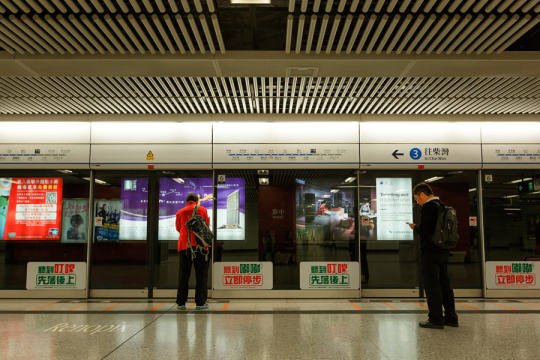
Like no other system in the world, the MTR understands the monetary value of urban density—in other words, what economists call “agglomeration.” Hong Kong is one of the world’s densest cities, and businesses depend on the metro to ferry customers from one side of the territory to another. As a result, the MTR strikes a bargain with shop owners: In exchange for transporting customers, the transit agency receives a cut of the mall’s profit, signs a co-ownership agreement, or accepts a percentage of property development fees. In many cases, the MTR owns the entire mall itself. The Hong Kong metro essentially functions as part of a vertically integrated business that, through a "rail plus property” model, controls both the means of transit and the places passengers visit upon departure. Two of the tallest skyscrapers in Hong Kong are MTR properties, as are many of the offices, malls, and residences next to every transit station (some of which even have direct underground connections to the train). Not to mention, all of the retail within subway stations, which themselves double as large shopping complexes, is leased from MTR.
I believe that we could do this too. So hopefully we can have a great discussion about it in the comment section below.