Daily insights for city builders, delivered every morning at 6 AM ET. I’m Brandon Donnelly — a Toronto-based real estate developer and founder of Globizen. I’ve been writing here since 2013.

Tag: public policy

  • How to spend city money

    This is an intriguing idea:

    Many cities around the world practice some form of participatory budgeting, but even among those that do, Cascais [Portugal] is an outlier. It spends prodigiously through the system: in Paris, five per cent of the city’s annual investment budget has been allocated to participatory projects in recent years, but in Cascais, more than fifteen per cent of the budget flows through the program, and the percentage can float higher if voter turnout rises. Cascais is surprising in another way: its mayor, Carlos Carreiras, is both a champion of participatory budgeting and a member of a center-right political party. Participatory budgeting is often considered a tool of the left, but its role in Cascais suggests that it could have a broader appeal; part of the theory behind it is that citizens can be better than officials at knowing how money should be spent.

    Of course, it won’t solve all of our problems:

    Even in the best of circumstances, participatory budgeting faces some structural limitations. Citizens can’t use it to raise the minimum wage, for instance, or to reconfigure affordable-housing policy, or to ban single-use plastics. As it stands, the approach “will never change the destiny of a poor neighborhood,” Giovanni Allegretti, a senior researcher at the Centre for Social Studies at the University of Coimbra, told me. Allegretti noted that participatory budgeting is mainly a competitive process involving limited resources with no long-term strategy; it doesn’t eliminate the need for other policy interventions. But when it functions effectively, participatory budgeting can give direct political power to those who might otherwise have very little of it.

    There is something very compelling about empowering people to come up with new ideas, compete with others for the best ones, and then participate in public decisions. It also strikes me as a possibly efficient way to force: “We only have this much money to spend. What should we spend it on? Spending on this means not spending on that. Time to make a decision.”

    And now it has me wondering: If we asked Toronto whether it wanted to spend over $1 billion to rebuild the Gardiner Expressway east or spend it on other things, what do you think it would say?

    For the rest of the above article, click here.

  • Smart sewers may soon analyze our poop

    On September 2, 2017, a research project by several MIT laboratories – called Gangnam Poop: Underworlds in Seoul – will debut at the Seoul Biennale of Architecture and Urbanism.

    Here’s an excerpt from the exhibition description:

    A vast reservoir of information on human health and behavior lies in our sewage, and this resource is untapped. We imagine a future in which sewage is mined for information that can inform policy makers, health practitioners, designers, and researchers alike. Such is the idea behind Underworlds: a cross-disciplinary data platform for monitoring urban health patterns, shaping more inclusive public health strategies, and pushing the boundaries of urban epidemiology.

    For this exhibition and “proof of concept”, they analyzed three distinct neighborhoods in Seoul, using an aptly named sewer robot called Luigi. 

    Gangnam-gu (shown above) is an upper-class high-rise residential area. Mapo-gu is an emerging artist and designer enclave. And Seongbuk-bu is a hillside village with detached houses and an older demographic.

    In each case, they mapped out the bacterial populations found beneath each neighborhood. Interestingly enough, the different areas revealed different bacterial occurrences. You can see those diagrams here.

    I often think of healthcare as being very reactive. A future like the one this exhibition is imagining would be far more proactive. And that would be a very good thing.

    Image and project by MIT Senseable City Lab. Gangnam Poop: Underworlds in Seoul. Commissioned by Seoul Biennale of Architecture and Urbanism

  • Introducing Tech:NYC

    Following the lead of San Francisco, a new non-profit, member-supported organization for New York tech companies has just launched. It’s called Tech:NYC. Here are their goals, taken from this blog post:

    Tech:NYC’s primary goals are to support the growth of the technology sector in New York City, to increase civic engagement by leaders of the New York tech community, and advocate for policies that will attract tech talent, jobs, and opportunity to NYC.

    Tech:NYC will advocate for policies that: 1) underscore a regulatory environment that supports the growth of technology companies and technology talent in NYC; 2) promote inclusivity; and 3) ensure access for all New Yorkers to connectivity, technology tools, and training.

    What makes something like this important is that many public policy issues are now rooted in the tech sector. Think about all the debate regarding ride-sharing, home-sharing, drone regulation, contract employees, and so on.

    But what is also clear is that many cities are struggling to deal with these issues. As I’ve argued before, just saying no to innovation that doesn’t fit neatly into our currently regulatory boxes is often shortsighted. 

    So how do we put in place policies that deliver the right results and that are balanced? How do we grow the tech base while at the same time managing the disruptive fallout? That’s what this group hopes to do.

    And it strikes me that every big city could likely benefit from an organization like this.

  • The Next Urban Renaissance

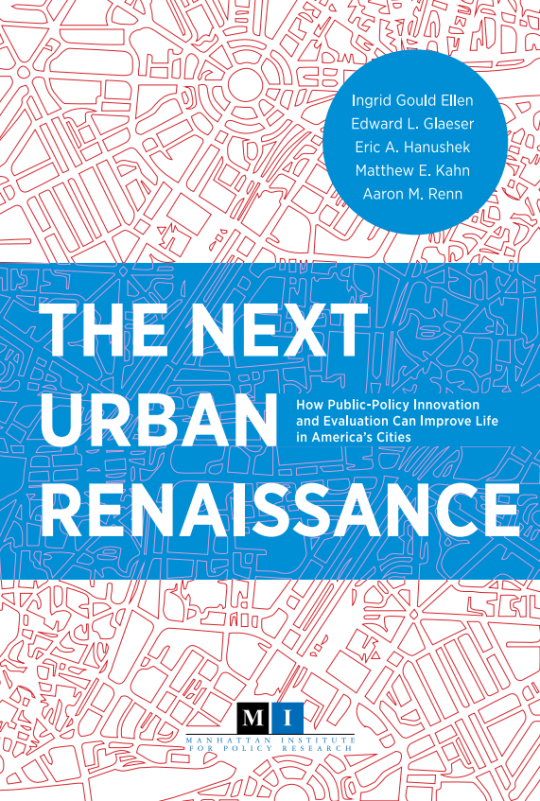
    The Manhattan Institute for Policy Research has just published a free book called, The Next Urban Renaissance: How Public-Policy Innovation and Evaluation Can Improve Life in America’s Cities.

    Here’s an excerpt from the foreword:

    This collection of essays brings together the best ideas from scholars with expertise across a broad spectrum of urban issues. The common theme of the papers is to innovate, evaluate, and leverage the remarkable private talent that is so abundant in America’s great cities. Public capacity is sharply limited; the ingenuity of urban entrepreneurs seems practically boundless. Local governments should be more entrepreneurial and do more to use the talents of the entrepreneurs around them.

    As a further preview, two of the ideas suggested in the book include: 1) reducing or eliminating parking requirements for new developments (which is something I’ve written about before on ATC) and 2) implementing a split-rate property tax for land and its improvements.

    If you’d like to download the free PDF, click here.

  • 50% of apartments in New York are under a form of rent control

    A friend of mine who lives in New York recently sent me this interesting article: “The Perverse Effects of Rent Regulation.” And he sent it to me, because he wanted me to take note of this stat:

    There are, effectively, two rental markets in Manhattan. Roughly half the apartments are under rent regulation, public housing or some other government program. That leaves everyone else to compete for the half with rents determined by the market.

    50% is a big number. I would never have guessed that the New York rental market would be split in such a way. But it is split because it’s fairly clear what would happen if it weren’t: 

    “Poor people would be priced out of Manhattan,” he says. “Period.”

    This, as the article argues, could threaten the diversity that has made New York the economic and cultural hub that it is today. But at the same time, there are a number of important questions: Is 50% the right split? And are the control mechanisms in place the right kind of mechanisms? Should rent controls be attached to people as opposed to apartments, which is how it’s typically done today?

    Diversity is hugely important and there will always be a portion of any city’s population that cannot afford market rents. But intuitively, and I could be wrong, 50% seems high. It seems high because these types of rent regulations achieve the exact opposite for the balance of the market that has to pay market rents: their apartments become more expensive.

    I’ve been having a lot of discussions lately about affordable housing and rent control always comes up. I think that in a lot of cities there needs to be some sort of intervention in the market to keep them from becoming homogenous playgrounds for the rich. But I also believe that many policies–which may sound great in theory–can have unintended market consequences. These need to be seriously looked at.