Daily insights for city builders, delivered every morning at 6 AM ET. I’m Brandon Donnelly — a Toronto-based real estate developer and founder of Globizen. I’ve been writing here since 2013.

Tag: public meeting

  • It’s decision time on fourplexes in Toronto

    We talk a lot about “missing middle” housing on this blog and, most recently, we’ve been talking about Toronto’s proposed amendments to allow fourplexes across the city and to do away with density maximums (among other things).

    Well, it’s now time to make a decision. These proposed changes are headed to Planning and Housing Committee on Thursday, April 27th. If you’d like to attend in person or virtually, here’s a copy of the public meeting notice.

    The other option is to make a written submission. The good people over at “More Neighbours Toronto” have created this website which will allow you to quickly write the Committee.

    There’s an auto-generated response in support of legalizing multiplex housing — and that’s what I used for my boring email submission — but, of course, you’re free to edit the text as you’d like.

    If you check the agenda, you’ll see that there are already hundreds of email submissions in to the Committee, many of them coming from More Neighbours. Clearly this is a topic that, one way or the other, many people feel very strongly about.

    Click here to make an email submission.

  • No more floor space index maximums

    I am positive that it had absolutely nothing to do with this post about fourplex feasibility, but I was happy to receive this notice in the mail yesterday:

    It is a public meeting notice for the City of Toronto’s proposed multiplex policies (defined as duplexes, triplexes, and fourplexes). And as you can see from the highlighted section, they’re looking, among other things, to make this form of housing exempt from floor space index maximums.

    Good.

    I don’t like this “where applicable” business, but I’m going to conveniently ignore that for now and just say that this is positive. Removing density maximums is a mandatory ingredient for helping to make this type of housing feasible.

    No FSI maximums. No DCs. And let’s modernize how HST is charged on new rental housing.

  • Small-scale retail is set to return to Toronto

    Progress is happening slowly but surely.

    Over the years we have spoken a few times about this nice little coffee shop on Shaw Street here in Toronto. It is a good looking and widely visited coffee shop that has made many guest appearances on urbanist Twitter.

    The problem, though, is that it was a real battle to get it approved, thanks to the opposition of a single neighbor. That’s all it takes to hold up a new project. In this case it was a coffee shop. But it could also be thousands of new homes.

    But that was then. Today if you look on the City of Toronto’s website you’ll actually see this exact coffee shop on a page that speaks to the benefits and the historic role of small-scale retail, service, and office uses.

    Right now these uses are only permitted in low-rise neighborhoods on major streets and through an amendment to the Zoning By-Law (unless the nonconforming use already exists). This is a lot of unnecessary work (see above) and it has translated into a steady decline in these sorts of uses across the city.

    Thankfully, the city is now looking to change this and permit these uses on an as-of-right basis. So it looks like the good fight was worth it.

    For more info, head over here. And if you’d like to attend the public meeting to talk about how brilliant this is, you can do that on July 5 over at City Hall.

  • Sea-level rise projections in the Florida Keys

    Monroe County, Florida, which is the county that includes the Florida Keys, held a public meeting at the end of last month to discuss what they are going to do to respond to climate change. The agenda can be found over here. According to this article in Grist, it was a seven-hour public meeting and the overall tone was something along the lines of this:

    “The water is coming and we can’t stop it,” said Michelle Coldiron, mayor of Monroe County, which encompasses the Keys. “Some homes will have to be elevated, some will have to be bought out. It’s very difficult to have these conversations with homeowners, because this is where they live. It can get very emotional.”

    In attendance at the public meeting was a scientist from the National Oceanic and Atmospheric Administration (NOAA), who outlined that they are expecting an additional 17 inches of sea level rise by 2040. This is the “intermediate high” scenario based on the below chart.

    Which is why the county is looking to spend $1.8 billion over the next 25 years to raise some 150 miles of roads and deploy a bunch of other fixes that include things like new drains, pumping stations, and vegetation — all of which are of course intended to mitigate the impacts of sea level rise.

    One problem, which shouldn’t be all that surprising, is that the county doesn’t have the money to pay for all of this. And as the quote at the beginning of this post suggests, part of “this” includes buying out many of the homes. Presumably these are the higher risk homes where there are no clear alternatives.

    This is a problematic situation. Because as time goes on, one would expect the tax base here to start to decreasing. Both as homes get bought out and as overall housing demand weakens. There are also financing and insurance considerations. Already the Keys have some of if not the highest insurance premiums in Florida.

    As I understand it, the Florida Keys are one of the most vulnerable areas in North America when it comes to sea level rise. And so unfortunately, the public meeting that took place two weeks ago could very well be considered a leading indicator for what’s to come.

  • Positivity at a public meeting

    I’ve been reading the blog 5 Kids 1 Condo for, I think, about a year now. It’s written by Adrian Crook who is a single dad of 5 kids, living in a 2 bedroom condo in downtown Vancouver. And his blog is about just that.

    A few days ago he posted a video of himself speaking at a public meeting in support of a new purpose-built rental building at 18th and Commercial Drive in Vancouver. The proposal includes 110 secured market rental units; 37% of which will be 2 or 3 bedroom apartments. (More information on the project, here.)

    It’s rare to see people come out in support of a project at a public meeting. Usually people only show up when they’re grouchy and upset. So today I’d like to share his speech (click here if you can’t see the video below).

    [youtube https://www.youtube.com/watch?v=q-ENWu__HdM?rel=0&w=560&h=315]

    I’m curious to know what was shouted right at the beginning after he said that he was in favor of the proposal. I listened a few times but couldn’t figure it out. 

    In any event, Adrian’s speech touches on a number of important points that transcend this specific development proposal and that are relevant to many of the topics that we discuss here on this blog.

  • Event: Community Consultation for Mirvish Village

    image

    One June 13, 2016 from 6:30 to 9:00 pm, the City of Toronto will be hosting a community consultation meeting for the proposed redevelopment of Honest Ed’s / Mirvish Village

    The meeting will be held at the Bickford Centre Auditorium at 777 Bloor Street West (across from Christie Pits Park).

    The purpose of the meeting is to present Westbank’s revised development proposal, which was submitted to the city last month. Their first proposal was submitted last summer (July 2015). 

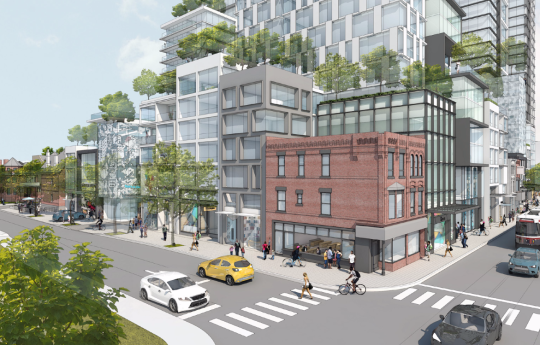
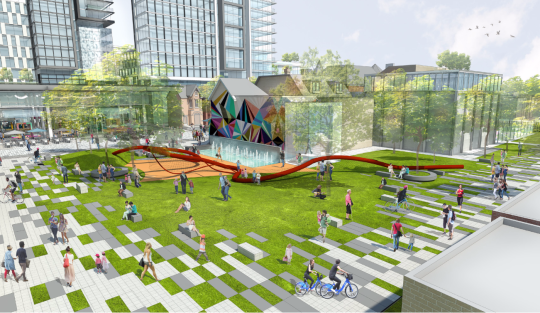
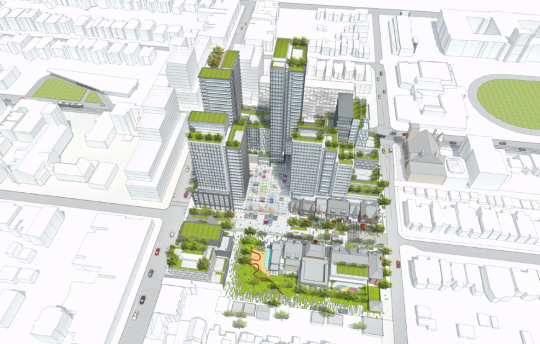
    Some of the key changes include a new on-site public park, the retention of additional heritage buildings (now 21 in total), more pedestrian porosity, and the retention of Honest Ed’s alley in its current location.

    I consider Westbank to be one of the most thoughtful developers in the city and so I’m pretty excited to see this one evolve. I’m planning to attend the community meeting and maybe I’ll see you there.

    Below are a couple of other renderings to give you a taste.

    imageimageimage

  • Public consultation is broken

    Public consultation is broken. And by that, I mean that the way in which municipalities, developers, and other city builders solicit feedback from communities is fundamentally flawed.

    For new developments, the process works more or less like this: The developer makes an application to the city. The city reviews it and then agrees to move towards a public/community meeting (the goal of which is to solicit feedback on the proposal). Once a date is set, notices go out, and the developer secretly hopes that no one will show up. 

    Because what often ends up happening is that it’s only the people with the time or a bone to pick who actually go to these things. Rarely do people go simply to voice their support for a project. That’s why the benchmark for success is usually no community opposition – it’s rarely about support.

    But from writing Architect This City, I know that many of you care deeply about your community and about cities in general. The problem, is that I don’t think most of you get a chance to voice your opinions. How many of you have actually gone to a community meeting in order to show your support for a development project or city initiative? I’d be curious to know, but I suspect most of you haven’t.

    The result is a system whereby the voice of a few (often naysayers) have a disproportionate amount of weight. They set the tone. But that’s not how community input works best. It needs to be representative of a broad and diverse cross section of the population. It needs to be inclusive. Everyone in the community should have a say.

    So today I was thinking that there’s an opportunity for somebody out there to create an online platform for community feedback. Developers would post up their project and then everyone in the community, as well as in the larger city, would have an opportunity to vote on it and provide their feedback.

    To make it fair, you could assign higher weights to people the closer they live to the project. But the idea would be to make it as easy as possible for everyone to provide feedback – whether they’re on their smartphone or at the regular community meeting. 

    Obviously this would require greater openness, but I don’t think that pulling back is the answer to this problem. The solution isn’t to hide from the potential naysayers; it’s to galvanize the supporters. 

    If your community already has a platform like this, please share it in the comment section below. I’d love to see it.