Daily insights for city builders, delivered every morning at 6 AM ET. I’m Brandon Donnelly — a Toronto-based real estate developer and founder of Globizen. I’ve been writing here since 2013.
“Complete streets” are streets that are designed to be safe for all users: people who walk, bicycle, take transit or drive, and people of varying ages and levels of ability. They also consider other uses like sidewalk cafés, street furniture, street trees, utilities, and stormwater management.
Right now, the city is in the public consultation phase. If you’d like to provide your feedback, you can do that here. You have until October 30th. The online tool is also pretty neat. You can drop comments on specific areas of the street. And already the map has been totally filled up.
This is an important and busy artery in midtown. I use it all the time as a pedestrian, cyclist, and driver. It’s not the best street, though. Yesterday it took me 45 minutes to drive from one end of it to the other. Along with better street design, this part of the city could use better transit.
I’m looking forward to seeing how Dupont ultimately gets designed.
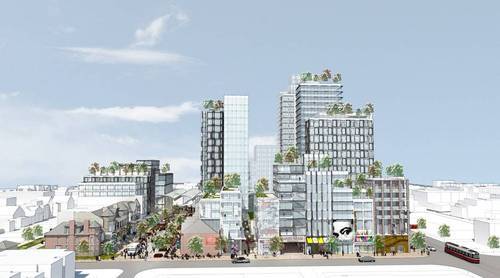
Last night Westbank went public with their first design for the southwest corner of Bloor and Bathurst in Toronto (the Honest Ed’s site).
There’s no name for the project yet and they haven’t even submitted a development application to the city, but I can tell you that there was a lot of excitement in the room last night. Over 500 people showed up at the Park Hyatt. And I think it only partially had to do with the fact that they were offering up free grilled cheese sandwiches.
If you’d like to get a feel for last night’s open house, check out #BloorAndBathurst on Twitter. And if you’d like to learn more about the project, check out Alex Bozikovic’s piece in the Globe and Mail. It’s pretty exciting stuff. I’m not going to repeat all of the project details here because Alex has already eloquently done that. All of the developer’s information boards can also be found online, here.
What I instead want to talk about is Westbank’s community engagement process. In Toronto, it’s quite rare to see this level of public consultation pre-application. And that’s because the city only requires it once a development application has been formally made.
But I’m of the opinion that the status quo isn’t actually the optimal strategy for city building. In fact, I’ve argued before that public consultation is broken.
And the reason I think that is because the typical process doesn’t allow fora critical mass of community feedback, both early on and throughout the process (think lean startup methodologies). In-person public meetings are too much friction for a lot people and getting feedback only once an application has been submitted means that a lot of work has already been done, which is the opposite of lean.
Now, part of the reason that many developers don’t adopt this model is because of fear. There’s a belief that many communities just don’t like change, period. But is that really the public opinion? Or do we simply not have enough data and enough feedback loops built into the city building process?
Time will tell how this approach works out for Westbank, but I have a pretty good feeling that they’ll do just fine.
Image (Sketchup model + watercolor): Westbank via Globe and Mail
Public consultation is broken. And by that, I mean that the way in which municipalities, developers, and other city builders solicit feedback from communities is fundamentally flawed.
For new developments, the process works more or less like this: The developer makes an application to the city. The city reviews it and then agrees to move towards a public/community meeting (the goal of which is to solicit feedback on the proposal). Once a date is set, notices go out, and the developer secretly hopes that no one will show up.
Because what often ends up happening is that it’s only the people with the time or a bone to pick who actually go to these things. Rarely do people go simply to voice their support for a project. That’s why the benchmark for success is usually no community opposition – it’s rarely about support.
But from writing Architect This City, I know that many of you care deeply about your community and about cities in general. The problem, is that I don’t think most of you get a chance to voice your opinions. How many of you have actually gone to a community meeting in order to show your support for a development project or city initiative? I’d be curious to know, but I suspect most of you haven’t.
The result is a system whereby the voice of a few (often naysayers) have a disproportionate amount of weight. They set the tone. But that’s not how community input works best. It needs to be representative of a broad and diverse cross section of the population. It needs to be inclusive. Everyone in the community should have a say.
So today I was thinking that there’s an opportunity for somebody out there to create an online platform for community feedback. Developers would post up their project and then everyone in the community, as well as in the larger city, would have an opportunity to vote on it and provide their feedback.
To make it fair, you could assign higher weights to people the closer they live to the project. But the idea would be to make it as easy as possible for everyone to provide feedback – whether they’re on their smartphone or at the regular community meeting.
Obviously this would require greater openness, but I don’t think that pulling back is the answer to this problem. The solution isn’t to hide from the potential naysayers; it’s to galvanize the supporters.
If your community already has a platform like this, please share it in the comment section below. I’d love to see it.
Earlier this week a friend of mine was live tweeting a public consultation meeting for the revitalization of Berczy Park in the St. Lawrence Market neighborhood of Toronto. And since I live in the neighborhood, it’s a project that I’ve been following particularly closely–although anything related to the built environmental generally fascinates me.
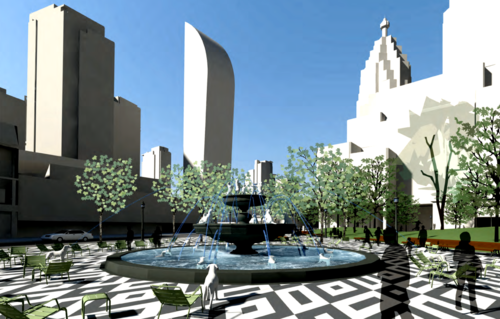
As soon as I saw the pictures he was tweeting out, I was immediately excited. And after reviewing the full design package (which you can download here), I must say that I think it’s going to be a brilliant change for the neighborhood.
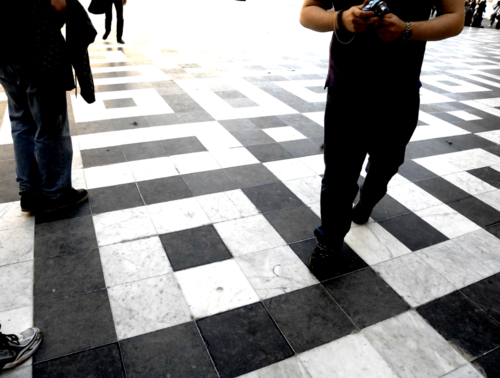
On an entirely superficial level, I like the paving motif they’ve chosen; even if it does appear to be be a copy from somewhere else (see above photo). I don’t think one should underestimate how small details, like paving, can have a huge impact on how one feels in a space, whether inside or out. It all counts.
But beyond just cosmetic changes, there are a couple of significant design changes being proposed.
First, a larger kid-friendly green space is being proposed on the west side of the park. And what was interesting to see was how the community overwhelmingly expressed a need for this play area. I’d like to believe that this speaks to the growing acceptance of raising kids downtown. There are certainly lots of families in the St. Lawrence.
Second, the south portion of the park is being “opened up” with a much larger hardscape area. The result will be a bigger promenade along Front Street, as well as, what I hope, will become an “urban stage” for people to hang out, breakdance, busk or try and sell me things I don’t need.
But equally exciting is the fact that along with the revitalization of Berczy Park will come a public art competition. It’s already in the works, but there aren’t any pretty images to share, just yet. Regardless, I think the topic of public art is an interesting discussion.
In a lot of cities around the world, there are mechanisms in place to encourage or mandate public art. Commonly, it comes in the form of a “Percent for Art” program, which means that, in the case of a new construction project, 1% of the construction costs would or should go to public art.
But the fact that we, at least in some cities, have programs to mandate it, should immediately signal to you that public art is not something universally believed in. And certainly it’s one of those things where it’s hard to measure the return-on-investment.
But that doesn’t mean it doesn’t or can’t exist.
In fact, I would argue that in today’s information and digital age it’s only going to become more important. We are living in a world of too much information and too little time. We’re living in a noisy world and, whether you’re a corporation or a city, the only way to stand out is to be remarkable. You need to bring delight to people.
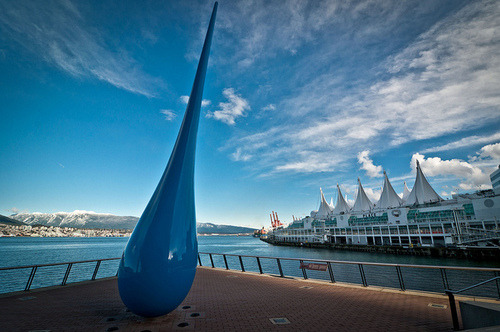
Because when you do, you get noticed (and probably shared on Facebook, Twitter, Instagram, Tumblr, Snapchat, Vine, 500px, Flickr and maybe even Google+). As one example, how many of you recognize the public art piece below? It’s in Vancouver and I’ve seen it pop up a number of times in my social news feeds. It’s something that brings delight to people.
But at the same time, it’s something that speaks to and creates a sense of place. What could be more Vancouver than a giant blue raindrop along the waterfront? And that’s really one of the ironies of today’s digital world. Despite the fact that, no matter where we are, we’re all hyper connected through technology, more and more of us are gravitating back towards cities. We want to live close to other people and we want to feel a sense of place.
When done properly, public art can help cities achieve that. Whether it’s the famous LOVE sculpture or Richard Serra’s controversial Tilted Arc, public art can make you stop and take notice of your environment. It can give you that sense of familiarity or it can take you by surprise. Either way, it gives you a sense of place.