
Daily insights for city builders, delivered every morning at 6 AM ET. I’m Brandon Donnelly — a Toronto-based real estate developer and founder of Globizen. I’ve been writing here since 2013.

Tag: psychology

  • Developers are optimists

    I started a new French class his week. Most of my classmates are regulars, but since we have a new teacher, we were all asked to introduce ourselves. And to spice things up, we were asked to talk about whether we’re glass half full or half empty kind of people.

    When it came to my turn, and before I could answer, one of my classmates jumped in and said “Brandon est un optimiste.” And you know what, this made me happy. I took it as a great compliment.

    Because to be a real estate developer, I think you need to be an optimist. I have argued this before on the blog.

    This is not to say that you don’t need to carefully manage risk, and think about all of the things that can and probably will go wrong. It is say that the inertia working against you is so great, that you really need to believe in the future you are trying to create. If not, you’re liable to not make it.

    So this morning, when my partner Lucas showed me the below quote from Nobel Prize winner Daniel Kahneman, I immediately thought, “yeah, this is going on the blog.”

    “If you are allowed one wish for your child, seriously consider wishing him or her optimism. Optimists are normally cheerful and happy, and therefore popular; they are resilient in adapting to failures and hardships, their chances of clinical depression are reduced, their immune system is stronger, they take better care of their health, they feel healthier than others and are in fact likely to live longer.

    Optimistic individuals play a disproportionate role in shaping our lives. Their decisions make a difference; they are the inventors, the entrepreneurs, the political and military leaders – not average people. They got to where they are by seeking challenges and taking risks. They are talented and they have been lucky, almost certainly luckier than they acknowledge… the people who have the greatest influence on the lives of others are likely to be optimistic and overconfident, and to take more risks than they realize.”

    This excerpt is from Kahneman’s book, Thinking, Fast and Slow. I haven’t read it. But now I want to.
  • Uninterrupted flow

    Adam Grant’s recent NY Times article about languishing — the psychological middle state that exists somewhere in between depressed and flourishing — has been making the rounds online. Perhaps it is because COVID sucks and many of us can relate.

    Either way, three points in the article really stood out to me (at least one of which, in my mind, directly ties back to real estate).

    Firstly, I found it helpful to hear him describe what flourishing is. In his words, “flourishing is the peak of well-being: You have a strong sense of meaning, mastery and mattering to others.” This resonates with me. I know that I am at my best when I’m accomplishing things and making progress.

    Secondly, he puts forward a possible solution to languishing — it’s the concept of “flow.” Flow is when we are absorbed in meaningful and challenging work and where, again in his words, “your sense of time, place and self melts away.” This also resonates with me. I am a big fan of a flow (even if I didn’t know what it was called).

    Thirdly — and this one is important as we all think about the future of work/office space — focus is paramount to doing exceptional things! Here’s an excerpt that I immediately paused on as I was reading the article:

    Fragmented attention is an enemy of engagement and excellence. In a group of 100 people, only two or three will even be capable of driving and memorizing information at the same time without their performance suffering on one or both tasks. Computers may be made for parallel processing, but humans are better off serial processing.

    For the rest of Grant’s article, click here.

  • Internal locus of control

    Before bed last night, I came across this New Yorker article from 2016 that I thought was fascinating and broadly useful for both life and business. In it, Maria Konnikova talks about how people learn to become resilient. And she starts by citing the work of a developmental psychologist and clinician who spent decades studying why some people seem to manage stress and trauma far better than others. Here is an excerpt talking about why that might be the case:

    From a young age, resilient children tended to “meet the world on their own terms.” They were autonomous and independent, would seek out new experiences, and had a “positive social orientation.” “Though not especially gifted, these children used whatever skills they had effectively,” Werner wrote. Perhaps most importantly, the resilient children had what psychologists call an “internal locus of control”: they believed that they, and not their circumstances, affected their achievements. The resilient children saw themselves as the orchestrators of their own fates. In fact, on a scale that measured locus of control, they scored more than two standard deviations away from the standardization group.

    It immediately reminded me of something that Steve Jobs once said in an interview back when more people wore buttoned up jean shirts. His comment was that one of the most powerful things you can learn in life is that much of what surrounds us was created by people who are no smarter than us. His point being that everything can be altered. We all have that ability. We are “orchestrators of our own fate.”

    The article goes on to argue that one of the ways we can exhibit a strong internal locus of control is by learning to view and respond to situations in a productive way. Put differently, whether or not we are subjected to shitty experiences matters less than how we ultimately react to and view those shitty experiences. If you can reframe and place in positive terms, then you can reduce any perceived stresses and become more resilient.

    The good news is that, supposedly, these are skills that can be learned. So if this topic is at all interesting, I would encourage you to check out the full article. It certainly caught my attention before bed last night.

  • Personalities and places

    Here is an interesting study about personalities and places (Journal article here and study here). It is interesting because so many of us are working from home and away from our regular environments. But it is also interesting because a lot of us, here on this blog, are in the business of creating spaces. And these environments have an impact on all of us.

    The researchers for this study started by assessing the personalities of some 2,000 university students. The objective was to determine their baseline temperaments according to the “Big Five” personality traits: openness, conscientiousness, extroversion, agreeableness, and neuroticism. Once that was established, the students were sent out into the world with a location-based app on their phone.

    Four times a day, the participants were asked to enter their current location, as well as answer a few questions about their current state of mind. The big takeway from this study is twfold and is as follows: “People actively select their environments, and the environments they select can alter their psychological characteristics [both] in the moment and over time.”

    The first bit is perhaps not all that surprising. We all have different personality traits and we choose environments that suit what we like. Extroverts, for example, tend to spend less time at home and more time at restaurants, bars, clubs, and at friends’ places. (Presumably this means that quarantine was a lot harder for extroverts.)

    The second part of this finding suggests that once we have actively chosen where we want to be, that environment then impacts how we feel at that exact moment, as well as over a certain period of time. You’ll have to read the study for the nuances around this. But it is fascinating to me because it helps me explain why I feel different now that I’m mostly working from home.

    Beyond poor video call connections and the lack of in-person collaboration, there also seems to be the psychological impact of not being in a particular environment. Not having to commute is a nice feature, particularly for some, but it also means not being around colleagues and not being able to meet for that impromptu craft beer. Turns out those things matter for our mental state.

  • If man had developed a third arm, where might this arm be best attached?

    Roman Mars of 99% Invisible recently published an excellent episode called The Mind of an Architect. It has to do with a set of research studies completed in the late 1950s by an organization at the University of California, Berkeley known as the Institute of Personality Assessment and Research (IPAR).

    IPAR was founded by a personality psychologist named Donald MacKinnon. He initially worked for the precursor to the CIA and founded IPAR with the intent of studying “combat readiness and efficiency.” But over fears of how creative the Soviets were getting, the focus of IPAR shifted to instead studying creativity.

    And architects were deemed to be an ideal test subject (from 99percentinvisible.org):

    “Researchers saw architects as people working at a crossroads of creative disciplines, a combination of analytic and artistic creativity. As professionals, architects had to be savvy as engineers and businessmen; as aesthetes, they also acted as designers and artists.”

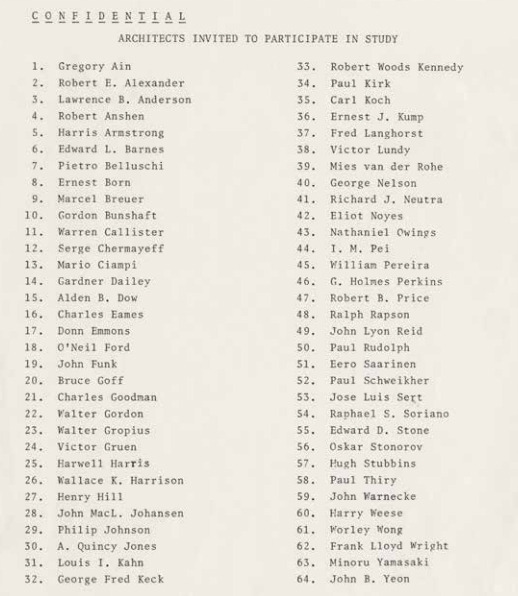
    So over a series of weekends in the late 1950s, some of the most celebrated minds in architecture – including people like Philip Johnson, Richard Neutra, and Louis Kahn – were studied and picked apart. 

    image

    They were asked to do quick sketches, create mosaics, and they were asked questions such as this one: “For the next 45 minutes we would like you to discuss this notion: if man had developed a third arm, where might this arm be best attached?”

    In the end, here’s what they concluded:

    The researchers began to notice certain patterns across creatives of all professions and genders, including a tendency to nonconformity and high personal aspirations. They also found many creatives shared a preference for complexity and ambiguity over simplicity and order. Creatives could make unexpected connections and see patterns in daily life, even those lacking high intelligence or good grades.

    In short: IPAR found that creative people tend to be nonconforming, interesting, interested, independent, courageous and self-centered, at least in general. Many of these traits may seem obvious today, but they were not necessarily obvious prior to these studies. Back when their tests were being conducted and findings presented in the 1950s and ’60s, the very idea of a “creative personality” was a novelty in academic and public discourse.

    The findings may not be groundbreaking to us today, but the documents and recordings produced during the study are certainly interesting. If you’re into this topic, there’s also this book you can pick up.

    Oh, and if we are to have a third arm, I would like mine to run almost parallel to my existing dominant arm (right). That way I could double up on my most potent dexterity. It would also be far less intrusive than an arm on one’s head or in the middle of one’s back. Then again, it would ruin our symmetry as humans. And perhaps that third arms need to be celebrated instead of being masked.

    What would you suggest?

    Image: Institute of Personality and Social Research, University of California, Berkeley / The Monacelli Press (via 99% Invisible)

  • The psychological benefits of third places

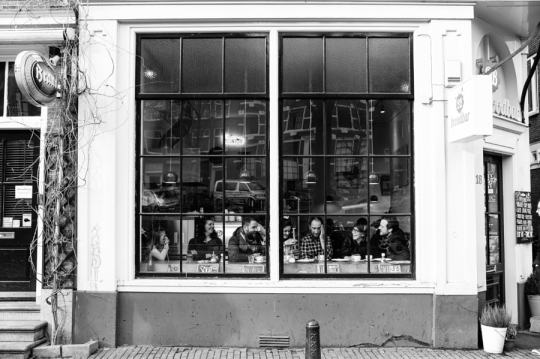
    Photograph - by rinatus (rinatus) on 500px

    – by rinatus (rinatus) on 500px

    Today I’m thinking about extraversion and third places within cities.

    As many of you I’m sure know, the idea of a third place is that after your home (first place) and your work (second place), cities have what are known as third places. This could be a coffee shop, a barber shop, or a public space (to name only a few examples).

    This, of course, is not a new idea. For decades people have been arguing that third places are essential for establishing a sense of community, place, and belonging. In fact, this emphasis on third place is one of the ingredients that made Starbucks so successful.

    But with the rise of the internet and freelancing, third places are becoming even more important. That’s why coffee shops have become arguably the best example of a third place in today’s cities. They’ve even become the new second place for some (many?) people.

    But beyond just a place to meet and socialize, I’ve been thinking today (while I was at a third place) about the psychological benefits of these spaces.

    For example:

    One of the key differences between extraverts and introverts is where they draw their energy from. For introverts, they tend to draw it from within. In order to recharge, they often feel the need to retreat and be left alone. Extroverts, on the other hand, draw their energy from the outside world. They charge up by being around other people.

    When I was completing my MBA at Rotman, one of the things they had us do at the beginning and at the end of the program was complete the Myers-Brigg personality test

    In both instances, I was as extroverted as they come (I am consistently what is known as an ENTJ). And from experience, I can say that I definitely feed off the energy of other people.

    But the interesting thing about this – to tie both of these topics back together – is that there appears to be a clear correlation between extroversion and a preference for living in urban centers. And given what I just said, that probably makes sense to you.

    So if you too classify yourself as an extroverted person, then third places are more than just a busy coffee shop or a vibrant public space. They are where you derive your energy and where you feel alive. And that’s a pretty powerful thing in my view.

  • Prospect Theory

    I just read an interesting chapter from Tim Smith’s book, “Pricing Strategy: Setting Price Levels, Managing Price Discounts and Establishing Price Structures.” It’s Chapter 5: Psychological Influences on Price Sensitivity.

    The chapter covers a number of pricing phenomenons, such as why prices ending in .99 tend to convey a discount and why whole prices ending in 0 tend to speak more to quality. It’s for this reason that art work is typically priced using simple round numbers.

    But one of most interesting theories from the chapter is that of Prospect Theory. Not only because of its impact on pricing strategies, but because, I think, it also applies to the real estate development business.

    Prospect Theory essentially describes the way people make decisions in the face of uncertainty. The two big takeaways for me are (1) that potential losses carry more weight than potential gains and (2) that both losses and gains experience diminishing returns.

    What this effectively means is that people, when faced with risk, tend to focus more on the negatives, and the potential losses, than on the positives. This means that the gains just can’t match the losses, they have to be significantly greater if you’re going to inspire action (a purchasing decision, a change in behaviour, or whatever).

    The second point basically means that these gains and losses become muted after a certain point. If you hit someone with enough of either, eventually they reach a point where they become desensitized in a way. Each additional amount of gain or loss produces less and less impact.

    Besides the obvious point of making sure that your product or service results in lots of gain for your customer, there are a couple of other things you can do to respond to this theory.

    The first is to “bundle losses” and “unbundle gains”. In other words, hit people with all the losses at once and then spread out the gains. What this does is maximize the psychological perception of gains and minimize the perception of losses because, remember, after a while people start to discount the losses.

    The other thing you can do is transfer losses, which is often just the cost itself, from direct to indirect. Big box stores, as an example, are great at this. They offer low prices (a direct cost) in exchange for greater indirect costs: higher transportation costs to the user, greater environmental impact, and so on. Studies show that people feel direct costs much more than indirect costs.

    There are a bunch of things you can do based on this theory, but again, one of the most fascinating things for me was how it also applies to the real estate industry. There’s a well known acronym in the industry called NIMBY. It stands for Not In My Back Yard, and it’s used pejoratively to refer to people who oppose development in their community.

    However, if you look at NIMBY’ism through the lens of Prospect Theory, you realize that it’s almost an innate human reaction. Development and construction is disruptive and the end result is change in somebody’s community. And I suspect that most residents view it as a risky and uncertain situation. Therefore, it’s no wonder that they’re first reaction is opposition. They’re weighing the potential losses more than the potential gains.

    So maybe we developers just need to apply a little Prospect Theory. We need to get better at producing and communicating gains.