
Daily insights for city builders, delivered every morning at 6 AM ET. I’m Brandon Donnelly — a Toronto-based real estate developer and founder of Globizen. I’ve been writing here since 2013.

Tag: property development

  • Operating at the margins

    image

    I’ve been thinking about land markets as of late and so today I thought I would share a post by Toby Lloyd that I recently discovered called: Understanding and adapting the land market is key to solving our housing crisis (2014). It’s from the London School of Economics’ British Politics and Policy blog.

    His argument, as the title suggests, is that we need to dig deeper and look at how our land markets are functioning if we want to address some of the challenges facing our cities today.

    The post is obviously written from a UK perspective, but many of his points will probably ring true for a lot of you in the industry. One remark that stood out for me was his point about developers always operating at the margins:

    “The result of the land auction process is that the worst scheme, the one that offers the least to the community, the poorest quality homes, and charges the most for them, is generally the one that will happen, because this is the one that offers the most cash up front to the landowner. As a result, development is always already at the margins of viability. Even a relatively small shock can see construction grind to a halt rapidly, because there is simply not enough margin left after the landowner’s cut has come out for the developer to want to build.”

    When it comes to building, most people tend to think about the developer, the architect, and so on. But what I think many people overlook is that this entire process starts with a land input and a landowner. And the cost, availability and usability of that land input has a significant impact on everything that happens downstream.

  • It sold for what?

    Today I spent the day at the Land & Development conference here in Toronto. If there was one running theme throughout the day, it was: “Holy shit, I can’t believe that X piece of land sold for $Y million. How will they (the developer) ever make the numbers work?”

    Outside of the real estate development community, there’s often the perception that developers are building everywhere and that there’s lots of land left in cities, like Toronto. When you see all the cranes in the skyline, it naturally seems like we’re building a lot. Things seem easy.

    But the reality is that it’s extremely difficult to find “land” in markets like Toronto and Vancouver. And by “land”, I mean properties that can be feasibly acquired/assembled, entitled, developed, and then brought to market. The way the speakers today spoke about land it’s as if it were a rare precious commodity.

    I say all this, not to complain about how tough things are, but simply to shed light on the process. A developer’s job is to take a piece of property and figure out a way to create additional value. But to do that, they need to find a suitable piece of real estate. “Land” is an input.

    This has implications for consumers, because inputs turn into outputs. And if one of the inputs is becoming scarcer, then it’s pretty safe to assume that the outputs, such as new housing, are also becoming scarcer.

  • I’m writing a book on becoming a real estate developer

    typerwriter closeup by Sean Gladwell on 500px.com

    https://500px.com/embed.js

    One of the most common questions I get from readers of this blog is: How do I become / get into real estate development?

    In fact, I get it so often that I’ve decided to write a book as my response. It may be a short one or it may end up a long one. If you’ve emailed or messaged me with this question and I haven’t responded, I’m sorry. There’s a lot of you out there. But I do want to help and that’s why I’ve decided to take on this hobby book project.

    As part of the book, I’ll be talking about my own journey, as well as the actual nuts and bolts of development. But I would also like to feature some much more established players in the business. In order to do that, I’ve decided to crowdsource some of the content for this book. 

    So here’s my ask to you: If you’re a real estate developer and would like to share your story, please complete this short questionnaire. You can be located anywhere in the world.

    My plan is to select a handful of developers from around the world and then feature their stories, one-by-one. I’m confident that there will be a lot of interest in hearing how successful developers established their careers and/or own businesses.

    I’ve been thinking about doing this for quite awhile now. It feels good to get started. 

  • Flux launches Austin Preview to help streamline development

    image

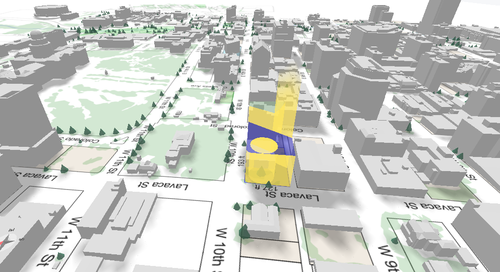
    I recently wrote about a startup called Flux.io in a post titled: How technology could completely change the real estate development industry. Given that I received a lot of positive feedback on this post, I thought I would let you all know that, as of today, you can now test out the product yourself for free online.

    Here are a few snippets from today’s announcement:

    At Flux we believe that data, analytics, and visualization can help bridge understanding between stakeholders and result in smarter growth and faster development and faster building. The Austin Preview of Flux Metro is an important first step in this direction.

    Flux Metro aggregates geographic data from public and private sources to build a three dimensional visualization, starting with downtown Austin. Alongside a rendering of the existing landscape, Metro shows what can be built on a lot or parcel under the zoning code. It considers more than 10,000 code sections for land use guidelines, height limits, floor area limits, setbacks, and view access rights as well as the locations of protected trees and daylight shadows to project what can be built and how it fits into the existing environment.

    We believe that everybody should be able to understand what a zoning code means for their city and that visual representations are the best way to create a shared understanding.

    Click here to signup and give it a try. It is based on Austin’s development code and on the same building site that was shown in the video I shared in my post.

    Image: Flux

  • How technology could completely change the real estate development industry

    If you’re involved in the built environment in any way, shape, or form – as a developer, architect, policy maker, and so on – I would highly recommend you watch the video below. My friend Candice Luck, who I went to Rotman with, sent it to me this morning with a link starting at the 24 minute mark. I haven’t yet watched the whole thing, but given how interesting this short section was, I plan to.

    The video is a talk by Steve Jurvetson, who is a venture capitalist with DFJ. He was one of the founding investors in Hotmail and currently sits on the board of companies like SpaceX and Tesla Motors. At the 24 minute mark he talks about a startup called Flux.io that hasn’t yet launched their product, but is working towards “reimagining building design”. They’re a spin-off from Google X and plan to officially launch in early 2015.

    Rather than try and describe the video here, I will just say that it’s an incredible example of how technology and digitization could completely change the real estate development industry. If you can’t see the video below, click here. The video starts at the Flux.io section.

    [youtube https://www.youtube.com/watch?v=IPgyb6euISs]