Daily insights for city builders, delivered every morning at 6 AM ET. I’m Brandon Donnelly — a Toronto-based real estate developer and founder of Globizen. I’ve been writing here since 2013.

Tag: progress

  • Vuja de

    image

    Most of us know what déjà vu means. Quite literally, it means: already seen. What you may be less familiar with is the idea of “vuja de.” 

    The term was coined by the late comedian George Carlin (above), but it has been appropriated by design and innovation firms such as IDEO, as well as many others. 

    Here is one way to describe the difference (taken from a blog post by Andrew Chen):

    Deja vu is when you see something new, but feel like you’ve already seen it before.

    Vuja de is when you’ve seen something a million times, but see it like it’s the first time.

    Why vuja de is valuable is because it can help you and I spot opportunities. If the best ideas are indeed the ones that are non-consensus (they sound stupid at first), then it pays to see things differently, with fresh eyes.

    I also think it’s a valuable concept because – as Andrew explains in his post – we have a natural tendency over time toward becoming more, as opposed to less, closed off to new ideas.

    As we gain more life and work experiences, we start to become entrenched in how we view the world. We believe that we know what will work and what will not work. Nobody will rent their home to strangers. Nobody will get out of their car and ride a bike to work. And so on.

    But the problem with that thinking is that it leads to consensus, rather than non-consensus, outcomes. And as we’ve discussed before, those aren’t as valuable (or cool, depending on what we’re talking about).

    So vuja de is not just a great platform for telling jokes. It is something worth working on in business and in life.

    Image: HBO
  • Why Google is worried about being welcoming to employees who want to build new businesses

    Here on ATC, we’ve talked a lot about the changing nature of work and what that could mean for cities. 

    We talk (and debate) about the value of density and of being in close proximity to others so that ideas can percolate – whether that means open office floor plans or community coffee shops.

    But alongside all of this, there are some fascinating structural changes taking place within organizations. Below is an excerpt from a recent New York Times article called, How Larry Page’s Obsessions Became Google’s Business

    But corporate success means corporate sprawl, and recently Google has seen a number of engineers and others leave for younger rivals like Facebook and start-ups like Uber. Mr. Page has made personal appeals to some of them, and, at least in a few recent cases, has said he is worried that the company has become a difficult place for entrepreneurs, according to people who have met with him.

    Part of Mr. Page’s pitch included emphasizing how dedicated he was to “moonshots” like interplanetary travel, or offering employees time and money to pursue new projects of their own. By breaking Google into Alphabet, Mr. Page is hoping to make it a more welcoming home for employees to build new businesses, as well as for potential acquisition targets.

    What I find interesting about the statements I’ve bolded is that they represent a radically different approach to business and employment. Of course, it’s not really a new thing. Google has been encouraging its employees to work on personal projects since, I think, the very beginning. 

    But as you read the above article, you really get the sense that Page believes that this kind of organizational culture is fundamental to the long term competitiveness of the company. It’s something he is genuinely worried about.

    As counter intuitive as it might seem to encourage employees to work on other things besides the core business, one could argue that it’s almost essential in a world of rapid and constant innovation. Would you rather an employee or a competitor discover what’s next in your industry? If it’s the former, you have a chance of absorbing it into your current business. If it’s the latter, you’re already too late.

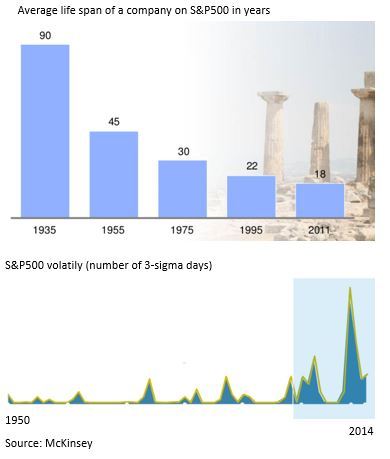
    If you go back to the article I posted earlier this week, you’ll see that creative destruction is happening a lot faster than it did in the past. The average life span of many, or most, companies seems to be decreasing.

    The tech sector seems to be ahead of most other industries with respect to this kind of thinking. But I believe that it will continue to percolate through the economy. And when it does, it will probably have many impacts on the kinds of spaces we design and build in our cities.

  • Riding an escalator for the first time

    image

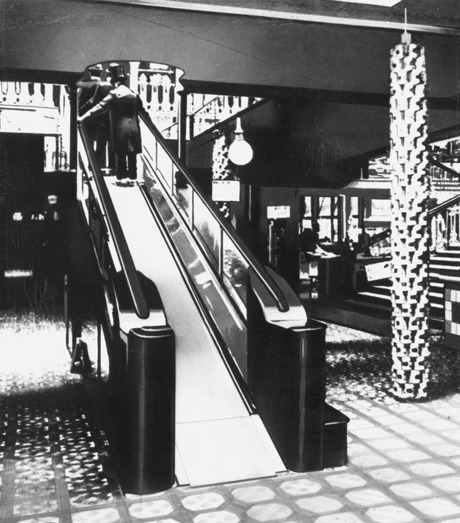
    On Wednesday, November 16th, 1898, Harrods department store in London opened up the first escalator – or moving staircase as it was called – in England. The first escalator-like machine in the world had actually been patented many decades before in the US, but this was the first real application in England and likely one of the first in the world.

    At the end of the 1800s, this was a big deal. Victorian England had never seen or experienced anything like this before and people were genuinely concerned about its use. More specifically, people worried what such a rapid change in elevation would do to the body. It was believed that it could discombobulate your inner workings. People were unnerved.

    Which is why when it was first introduced at Harrods, people were offered brandy and other substances at the top of the escalator in order “to revive them after their ordeal.” Riding an escalator was no small feat for these people.

    Now to us today, this sounds ludicrous. Most of us probably ride a few escalators a day. They’re ubiquitous. But I tell this story because I think it clearly underlines how disruptive the new and unknown can feel, and how difficult it can be for us to accept sometimes.

    If you go back throughout history, you could easily replace escalators for many other new technologies: the printing press, the automobile, the internet, and so on. And in some cases we were wrong to worry, and in other cases we were right to worry.

    Cars, for example, have had a pretty dramatic impact on our lives and the way we build our cities. And since the very beginning, they had no shortage of critics. But does that mean we should have never invented the car? I don’t think so.

    As I said earlier this week week, the goal in my mind is to find the right balance between preservation and progress. Just as we shouldn’t be so quick to erase our architectural history, we shouldn’t be so quick to erase our way of life.

    But at the same time, it’s important to remain open minded to what’s coming. I’m optimistic about the future. Change can be a great thing, even if it may feel as uncomfortable as riding an escalator for the first time. Maybe you just need a bit of brandy to calm your nerves.

    Image: Pinterest

  • A walk down memory lane in the St. Lawrence Market

    I recently got lost looking through the Toronto Archives for old photos of my neighborhood. I’ve blogged about what the St. Lawrence Market neighborhood looked like in the 70s, but I wanted to go back even further. I wanted to see what exactly had been demolished and lost over the years.

    But by the end of it, I was just sad. As a lover of cities, it always makes me upset to see great buildings disappear. I think you too will be surprised at what I found.

    The following picture depicts the north side of Front Street East, about 2 blocks east of Yonge Street. I don’t know what year it is, but look at how stunning these buildings are. It looks like Soho, New York meets some glamorous European capital.

    Can you imagine what we could do with these buildings today?

    image

    If there’s any doubt in your mind that this is Toronto or that it’s Front Street East, take a look at the spire in the far left hand side of the picture. It belongs to the Toronto Board of Trade Building, which used to sit at the north east corner of Yonge Street and Front Street. When it was built in the late 1800s, it was considered one of the first “skyscrapers” in Toronto. It was demolished in the 1950s.

    Here’s a picture of the Board of Trade Building so that you can compare. Again, take a look at the spire.

    image

    For those of you who might not be familiar with the area, here’s a map to help you out. The Board of Trade Building is shown on the bottom left hand corner. And the buildings in the first picture are in the triangular land area between Wellington and Front.

    image

    Now, let’s fast forward to the late 1960s. Those same buildings shown in picture number one have been demolished and in their place is the following parking lot. It’s a bit less glamorous looking. There are still heritage buildings on the south side of Front Street, but the balance of the area seems to have been blown out. What a shame.

    image

    Finally, here’s an aerial view of the area. It’s also from the late 1960s or early 1970s. You can see the same triangular land area, with only the Flatiron Building still standing at the very tip of it.

    image

    Obviously the St. Lawrence Market has come a long way since the 70s. That triangular area has since become Berczy Park, which is actually in the midst of being completely revitalized, and all of those parking lots have been filled in. But I still can’t help but wonder what the neighborhood would be like today had we preserved all of those heritage buildings. 

    I think cities work best when you can figure out that delicate balance between preservation and progress. It’s not always the simplest approach, but as most things in life, the right decisions are often the toughest ones to make.

  • Mirvish+Gehry and the story of 4 heritage buildings

    I am a real estate developer and I believe in progress. But I also fundamentally believe in balancing progress and preservation. I’ve said this before.

    This morning, Alex Bozikovic of the Globe and Mail, published a piece on the epic Mirvish + Gehry proposal for Toronto’s Entertainment District. It’s called, “Frank Gehry and David Mirvish’s tall order in Toronto.

    Now, I’ve said before that I like this project. I don’t mind the height and I don’t buy the argument that there aren’t enough public spaces in the area. There’s David Pecaut Square directly to the south that could use a few more warm bodies in it.

    But as I also said before, I think the key concern here is one of heritage. There are 4 heritage designated buildings on the site dating back to as early as 1901. Here’s where they sit:

    image

    The Anderson Building (1915) is particularly unique. Here’s a larger photo (via blogTO):

    image

    So while I’m excited by the prospect of a real Gehry project in Toronto, I think we need to figure out a way to find a balance. Preserve the facades, build on top, or relocate them. Do something besides wipe the slate clean.

    As Bozikovic rightly points out in his article, “Toronto has a sophisticated culture of working with heritage buildings.” There are lots of great examples of how we managed to move forward as a city, without erasing our past.

    And in many ways, I see this ability to work with and build upon heritage buildings as an emerging Toronto vernacular. I mean, what could be more appropriate for the most diverse city on the planet than an architectural style—of our own—that blends and layers history with disparate design ideologies.

    I sense an opportunity.

    We could have Gehry’s white sinuous curves drape over the heritage buildings. Make them become a literal unveiling of Toronto’s past and a metaphor for the sophisticated way in which we build upon legacy.

    It’s too easy to just demolish everything. We’re better than that.