
Daily insights for city builders, delivered every morning at 6 AM ET. I’m Brandon Donnelly — a Toronto-based real estate developer and founder of Globizen. I’ve been writing here since 2013.

Tag: privacy

  • “Alexa, play some Miles Davis”

    Over the weekend I received an Amazon Echo as a gift. I set it up in my kitchen on Sunday morning and had it playing music and telling me the weather in no time. I also setup a couple of “routines” so that when I say things, such as “good morning”, it cycles through the weather, the news, and some other things that I might find valuable at the start of my day. It is pretty neat.

    The truth is that I have actually been avoiding voice assistants since they were first launched. As much as I consider myself an early adopter, I have been generally uncomfortable with the idea that my voice commands, and perhaps other things, are being stored by Amazon. There are ways to delete that history, but I am not yet sure if that’s enough for me. Am I going to be served an ad because of something I mention in my own home?

    Now that I’ve been trying it out for a few days, I will say that it is incredibly useful. I immediately see the value. I use it to control some of my lights. I ask it things when I’m cooking and my hands are dirty: “Alexa, how badly are the Raptors going to beat the Bucks this Thursday?” And I use it to play music. But is all of this a fair exchange for the creepy feeling that they create?

    I’m not sure. But it certainly feels like the future.
  • #DeleteFacebook

    Earlier this week I deleted my Facebook account. If we were friends on the service and you can no longer find me, this is the reason why. 

    Part of why I did this certainly had to do with privacy. I read Brian Acton’s (WhatsApp cofounder) account in Forbes this week. And I have been following many of the discussions over the past year:

    Privacy legislation is perhaps the only thing that could pose an existential threat to a business that’s entirely powered by watching and recording what people do at vast scale. And relying on that scale (and its own dark pattern design) to manipulate consent flows to acquire the private data it needs to profit. –Natasha Lomas

    But at the same time, I’m still on and use Instagram and WhatsApp (both Facebook companies), and I use Twitter pretty much every day.

    So I am certainly not in a position to be smug about this decision. Hopefully this post does not come across that way.

    The simple truth is that I had more or less stopped using the service. I had long ago turned off mobile notifications and so it had become more of a hassle than anything else.

    Every now and then I would go on and find notifications and messages that I wasn’t responding to. 

    So it had finally reached a point where I thought to myself: Why keep my data here (by the way, you can download all of your data from the site) and why check it sporadically if I’m not really deriving any value out of it? Simplify.

    I enjoy Instagram because taking photos is one of my primary passions outside of real estate and design. And I enjoy Twitter as a source of news and mostly civil conversation. 

    I am easy to get ahold of. I don’t need Facebook for that. Any of the social links at the top of this page (if you’re reading this post on the web), will get you there.

  • Puerto Rican migration during and following Maria

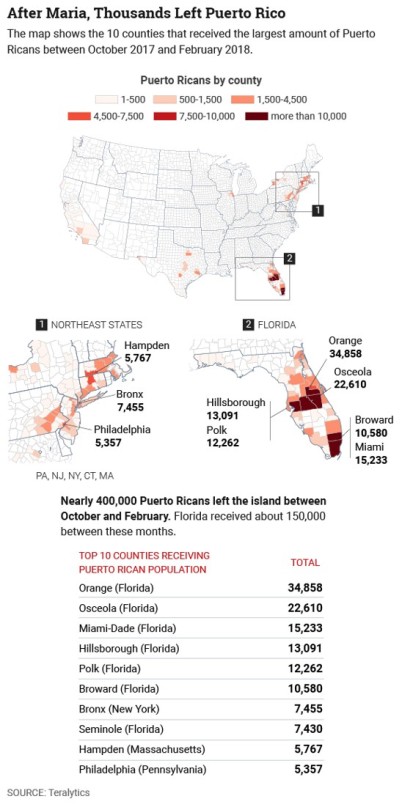
    Teralytics recently looked at data from 500,000 smartphone users to determine how, when, and where Puerto Ricans moved between August 2017 and February 2018 during and following Hurricane Maria – generally considered to be the worst natural disaster on record for the area. 

    CityLab published the data here and along with the following maps:

    image

    It shows the locations and the top 10 counties that received Puerto Rican population during the above time period. Florida and the Northeast are at the top of list, which isn’t all that surprising. Privacy concerns aside, it is once again an example of the kind of granular data that we now have access to. Prior to this data being available, all we apparently had was estimates.

  • People you may know

    If you’ve ever wondered how Facebook figures out all of the people you may know, here is some reading material. 

    The short answer is that Facebook doesn’t just know the things you’ve told it about yourself, it also knows what other people have told it about you. 

    One of the ways in which this is done is through its so called “shadow profiles". These are profiles that get created when other people share information about you with Facebook. 

    For example, you may not want to share your work email address with Facebook, but if it’s sitting in someone’s phone and that person decides to share his/her address book with Facebook, then it could show up in your shadow profile.

    And if there’s a common data point, such a phone number, then Facebook can fairly easily link that work email address back to you and start suggesting people from your work that you may know.

    The scary part, of course, is that Facebook is getting your information without you explicitly sharing it with them. It could be coming from that person you gave your business card to at the bar.

    It goes to show you just how fierce the competition is for our attention. It may be an assault on our privacy, but more Facebook connections means a higher likelihood that we’ll stay engaged on the platform.

    Over the past year I have been growing increasingly intolerant of this demand for my time. Slowly but surely I have been turning off all nonessential notifications on my phone. 

    Very few now remain, which is why if you’ve been trying to reach me on Facebook, WhatsApp, LinkedIn or some other platform, and I’m not responding, it’s because there’s a good chance I’m not seeing the notifications.

    And let me tell, it feels liberating.

  • What Facebook knows about you

    Here is an eye-opening article from data scientist Vicki Boykis outlining the number of ways in which Facebook collects data about its users. It’s called: What should you think about when using Facebook?

    One of the more surprising tidbits from Boykis’ article is that Facebook collects keystrokes. That means if you start typing a status update but never actually post it, that information is still fair game.

    Facebook previously used this data for a study on self-censorship. That sounds like like a fascinating study, but I’m sure the thought is also scaring many of you if you care about privacy.

    Here is a quote from the article that gets at the core of what is going on:

    “The fundamental purpose of most people at Facebook working on data is to influence and alter people’s moods and behaviour. They are doing it all the time to make you like stories more, to click on more ads, to spend more time on the site.”

    A worthwhile read. And in case you didn’t already know, if you go to Settings -> Download a copy of your Facebook data, you can get a pretty good dump of your activity, including every private message you’ve ever sent on the platform.