Daily insights for city builders, delivered every morning at 6 AM ET. I’m Brandon Donnelly — a Toronto-based real estate developer and founder of Globizen. I’ve been writing here since 2013.

Tag: pritzker prize

  • Who should win the 2021 Pritzker Prize?

    The winner of the 2021 Pritzker Prize — which is often considered to be the highest honor in the world of architecture — is expected to be announced sometime in “early March.” In anticipation of that, ArchDaily is asking its readers to opine on who they think should win the prize. This is something they usually do each year. I just casted my vote (for someone who happens to be pictured above). If you’d like to do the same, click here. And if you’d like to see who the jury members are for this year, go here.

    Image: ArchDaily

  • Yvonne Farrell and Shelley McNamara receive the 2020 Pritzker Architecture Prize

    Yvonne Farrell and Shelley McNamara, co-founders of Grafton Architects, have just been named the 2020 laureates of the prestigious Pritzker Architecture Prize. They are the first recipients from Ireland. If you’d like to read the full press release, you can do that here. But here is a copy of the jury’s citation.

    Yvonne Farrell and Shelley McNamara have practiced architecture together for forty years in a way that clearly reflects the objectives of the Pritzker Prize: to recognize the art of architecture and consistent service to humanity as evidenced through a body of built work.

    Co-founding their professional practice, called Grafton Architects, in Dublin, Ireland in 1978, they have consistently and unhesitatingly pursued the highest quality of architecture for the specific location in which it was to be built, the functions it would house and especially for the people who would inhabit and use their buildings and spaces.

    They have an oeuvre that includes numerous educational buildings, housing and cultural and civic institutions. Pioneers in a field that has traditionally been and still is a male-dominated profession, they are also beacons to others as they forge their exemplary professional path.

    Many of their buildings are located in their home country of Ireland, but through competitions, they have won major commissions for other places around the world, such as Italy, France and Peru . With a profound understanding of place gained through their research, keen powers of observation, open and ever curious explorations and deep respect for culture and context, Farrell and McNamara are able to make their buildings respond to a setting and city most appropriately, while still being fresh and modern.

    This deep understanding of “spirit of place” means that their works enhance and improve the local community. Their buildings are “good neighbors” that seek to make a contribution beyond the boundaries of the building and to make a city work better. Their North King Street Housing in Dublin (2000) is one example of this: it creates an inner courtyard and a welcome respite from the adjacent busy streets.

    Their approach to architecture is always honest, revealing an understanding of the processes of design and construction from large scale structures to the smallest details . It is often in these details, especially in buildings with modest budgets, where a big impact can be felt . For example, the Urban Institute of Ireland (Dublin, 2002) employs what the architects call a “crafted skin” to create a visually interesting building through changes in materials responding to openings, folds, needs for shade and other concerns.

    At the same time, it employs common sense, good-practice environmental control methodologies for an efficient, sustainable building . On a particularly sensitive site in Dublin, the masterful Offices for the Department of Finance (2009) attests to their knowledge and care in the selection of materials and construction techniques with a carefully handcrafted bronze railing and gate and sanded limestone on the facades.

    The architects are skilled and successful working at many scales—from large institutional buildings to a house of only a little more than 100 square meters . Without grand or frivolous gestures, they have managed to create buildings that are monumental institutional presences when appropriate, but even so they are zoned and detailed in such a way as to produce more intimate spaces that create community within . In their large buildings such as the University Campus UTEC (2015) in Lima, Peru or the School of Economics Building (2008) at Universita Luigi Bocconi, they have achieved a human scale through the composition of spaces and volumes of different sizes . The dialogues they create between buildings and surroundings demonstrate a new appreciation of both their works and place.

    A constant in their approach, the architects have an understanding of how to design complex sections of buildings in such a way that views connect deep interior spaces with the larger exterior realm and allow natural light to penetrate and animate spaces deep inside a building . Often light streams from skylights or upper story windows throughout the interiors of their buildings, providing warmth and visual interest, helping the inhabitants easily orient themselves in the spaces, and providing the ever necessary connection to the exterior.

    For their integrity in their approach to both their buildings, as well as the way they conduct their practice, their belief in collaboration, their generosity towards their colleagues, especially as evidenced in such events as the 2018 Venice Biennale, their unceasing commitment to excellence in architecture, their responsible attitude toward the environment, their ability to be cosmopolitan while embracing the uniqueness of each place in which they work, for all these reasons and more, Yvonne Farrell and Shelley McNamara are awarded the 2020 Pritzker Architecture Prize.

    Photo: University Campus UTEC Lima, photo courtesy of Iwan Baan

  • 2019 Pritzker Architecture Prize Laureate: Arata Isozaki

    This week it was announced that Japanese architect Arata Isozaki has received the 2019 Pritzker Architecture Prize. The prize is generally viewed as architecture’s highest honor. (You also get $100,000.)

    He’s the 46th laureate and 8th Japanese architect to receive the honor. (As a side note, the only Canadian on the list is Canadian-born American architect Frank Gehry.)

    Here’s an excerpt from the announcement:

    Not only did he extend efforts to physically reconstruct his native hometown [after World War II] with buildings including Ōita Medical Hall (1959-60) and Annex (1970-1972 Ōita, Japan), and the Ōita Prefectural Library (1962-1966 Ōita, Japan, renamed Ōita Art Plaza in 1996), but also redefined mutual exchange between eastern and western societies, allowing Japanese vision to inform European and American design, particularly in the 1980s.

    His first international commission outside of Japan was the Museum of Contemporary Art in Los Angeles, which was completed in 1986. He was also one of the first Japanese architects to start working in the West at this time.

    For the full media release, click here.

  • Balkrishna Doshi

    On Friday evening, here in Toronto at the Aka Khan Museum, this year’s Pritzker Architecture Prize was awarded to Indian architect, Balkrishna Doshi. He is 90 and will receive US$100,000, as well as the honor of being the first Indian to receive architecture’s Nobel Prize. This year was also the first year it was awarded in Canada.

    Alex Bozikovic of the Globe and Mail sat down with Doshi while he was in Toronto. Article here. Doshi also lectured at the Daniels Faculty at the University of Toronto earlier in the week. 

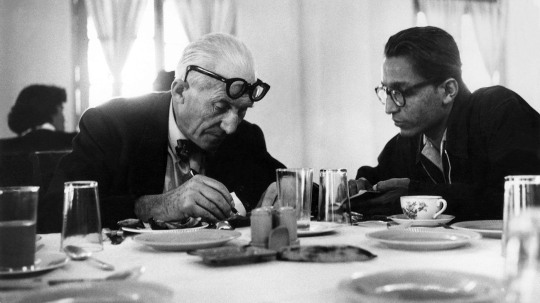
    Some of you will probably recognize the name because of his collaborations with Le Corbusier and Louis Kahn. But as Alex quoted in his article, this year’s prize is about, “expanding the scope of architecture’s usefulness.” Doshi’s architecture is less about objects and more about the public good it creates.

    For more on Doshi, check here.

    On a related note, I was happy to see worlds collide in my Instagram feed this morning with this photo from the event. It’s a picture of Jeanne Gang, Meg Graham, and Andre D’Elia of Studio Gang and Superkul, respectively. 

    We are thrilled to be working on projects here Toronto with both firms.

    Photo via The Pritzker Architecture Prize

  • Zaha Hadid dies at 65

    Today the world lost one of the most important architects of our time: Zaha Hadid. She was only 65.

    But the thing about architects, particularly famous “starchitects” such as Zaha Hadid, is that when they pass, they leave behind a rich legacy through their buildings. So probably the best way to write a sad post like this one is to just share her work. Courtesy of the Guardian (she was an Iraqi-British architect after all), here are: Zaha Hadid’s 10 best buildings in pictures.

    I did, however, want to add a few more thoughts. 

    When I found out about her death I was sitting in the St. Lawrence Market having lunch. I had my phone out and the news had completely flooded my social feeds. I immediately started messaging a few people because, well, she was Zaha Hadid – a figure you don’t go through architecture school not talking about. But it also hit me because she was only 65. This is the age that some people retire at. It’s the age that some people work their entire lives for.

    Whenever this happens I can’t help but think to myself: Why are we so afraid of risks? (I know that this is part of the reason.) And are we even focused on the right risks? So many of us are afraid of sticking our neck out and potentially failing, and yet we all have an expiry date, which means there’s the big risk of potentially dying without having done all the things we want to do. Logically, this should probably be the greater risk.

    I realize that this may sound a bit trite, but it feels appropriate. Zaha Hadid took big risks. Her architecture was way out there and that meant she struggled early on. Not only was she a female in a male dominated industry (she was the first woman to win the Pritzker Prize), but her work carved out an entirely new architectural language. She embedded technology into the world of architecture – something we talk a lot about on this blog.

    The sad thing about death – besides the obvious death part – is that it can take someone dying to remind you of the shortness of life. So to end, I’m going to leave you all with an excerpt from a recent essay by Paul Graham aptly called, Life is Short.

    “If life is short, we should expect its shortness to take us by surprise. And that is just what tends to happen. You take things for granted, and then they’re gone. You think you can always write that book, or climb that mountain, or whatever, and then you realize the window has closed. The saddest windows close when other people die. Their lives are short too. After my mother died, I wished I’d spent more time with her. I lived as if she’d always be there. And in her typical quiet way she encouraged that illusion. But an illusion it was. I think a lot of people make the same mistake I did.”

    I promise that tomorrow’s post will be less sad.

  • From art to framework

    Chilean architect Alejandro Aravena has just been awarded the prestigious Pritzker Prize – the highest honor in the world of architecture. 

    Alex Bozikovic of the Globe and Mail has a fantastic write up about it that focuses on how choosing Aravena – an architect known for his social housing – is quite a departure from the “starchitects” of prior years. 

    One of Aravena’s most famous works is known as the “half of a good house”, which I think is an incredibly clever project. The idea here was to literally provide half of a good house but then design in the flexibility for owners to expand as they have the means. 

    The rationale behind this was to get around the fact that poorer Chileans would not be able to afford a full good house, unless of course they went far out of the city. But rather than physically disconnect these people from the opportunities of the city, this was deemed as a better solution. I think that makes a lot of sense.

    But beyond being hyper practical, it also pushes architecture away from being a work of pure art that shouldn’t be meddled with, towards more of a housing framework that is supposed to altered and built upon. 

    Many architects wouldn’t like to give up this kind of control over their capital A, Architecture. But for Alejandro Aravena, he’s clearly about something quite different. 

    Congratulations on winning the Pritzker Prize!

    (I apologize for not having any links or images in this post. It’s because I wrote it from my phone on a flight.)

  • Why food trucks won’t destroy Toronto’s restaurant scene

    Yesterday City Council voted 34 to 3 in favor of allowing more food trucks on the streets of Toronto (125 of them to be exact).

    Food trucks will be allowed to roam and park in pay-and-display spots on city streets as well as in private lots. However, the total number of trucks can’t exceed 125; they’re not allowed to park for more than 3 hours in one spot; and they can’t park within 50 metres of a restaurant.

    Most supporters of food trucks in this city are calling it a baby step forward. A lot of the reforms that they had been advocating for were not achieved with this vote. Frankly, I find it surprising how long this discussion has been going on for and how we’re still at the point of baby steps.

    But perhaps even more surprising, is the fact that I agree with Rob Ford on this issue:

    Mayor Rob Ford advocated for less regulation, arguing that people who make a date to go to a restaurant don’t change their mind and buy a hot dog when they pass a cart. “I think putting all this red tape around people, that’s not very friendly,” he said. “This is free enterprise. This is capitalism. Let them sell what they want and let the customer decide.”

    The concern from the other side is that food carts are going to threaten Toronto’s restaurant industry and turn our streets into the wild west of food service–hence the 50m rule. But I actually think the opposite could end up proving to be true. I think food trucks could end up empowering entrepreneurs.

    When I used to live in Philadelphia, which is a city with a thriving food truck scene (people publish food truck guides), I practically lived off the things. For breakfast I would go to this couple who barely spoke English and they would make me an egg and cheese sandwich for $2.50. And for lunch, I would go to the guy some people called the “nice little Mexican boy” for a burrito. It was somewhere around $5. And his food truck was so small that I had to duck while ordering food so I didn’t hit my head.

    At first I actually found it odd to be consuming egg sandwiches and burritos from trucks that would pack up and leave at the end of the day. I kept thinking I was going to get sick. But I warmed to the idea and learned to love them. As does everybody else.

    In fact, we loved our food trucks so much that when Renzo Piano–the Italian Pritzker Prize-winning architect–came to Penn to talk about how he had been retained to redesign the School of Design’s building, somebody stood up and asked: “How are you going to accommodate the food trucks in your design?” Renzo responded perfectly and said something along the lines of: “I’m Italian. Don’t worry, I will provide for the food.”

    But my point of all this is to say that instead of looking at food trucks as a threat to our restaurant industry, we should be looking at them as a way to empower more entrepreneurs to take the risk on starting something for themselves–many of which could end up being new Canadians. The “nice little Mexican boy” also barely spoke English and looked young enough to be in high school. But he was a business owner.

    Starting a restaurant is a risky proposition. You need to lease space, you need to buy equipment, and so on. And everybody knows the failure rate is high. But what if you could test that killer recipe of yours on a few hundred people at lunch in front of First Canadian Place? That sounds like a much easier proposition to me.

    So what I hope happens is that people in Toronto start to see food trucks, not as a threat to our restaurant scene, but as an opportunity to get more entrepreneurs into it and make our city even more vibrant. Because if we do that, I’m positive we’ll end up with an even better restaurant scene than what we have today in our great city.