
Daily insights for city builders, delivered every morning at 6 AM ET. I’m Brandon Donnelly — a Toronto-based real estate developer and founder of Globizen. I’ve been writing here since 2013.

Tag: policy

  • Bill 23 is more homes built faster

    The government of Ontario is trying to encourage the construction of a lot of new housing over the next 10 years. More specifically, the plan is for 1.5 million new homes from now until 2033. To have a chance at hitting this target, the province has rightly recognized that some things will need to change around here and so they’ve been busy coming up with legislative changes such as Bill 23 (the More Homes Built Faster Act, 2022).

    The Bill is really long, so I personally appreciate it when the act name itself does a good job of summarizing what it’s all about: more homes, built faster. But if you’d like to read the entire thing, you can do that over here. I also attended a breakfast this morning — put on by Goodmans — that provided a great summary of the key points. I took all of my notes on Twitter through a live stream, so if you’d like something more digestible, click here.

    At a very high level, I would say that there are some obviously good changes in the Bill and some other things that will need refinement, such as the proposed changes around third-party appeals. The devil is in the details. And that was actually one of the key takeaways from the breakfast: This government is not afraid of being bold, moving quickly, and then working iteratively with stakeholders. It’s a less typical approach for government, but done is better than perfect, right?

  • France clamps down on “dark stores”

    One way to shop for things is to make a list of all the things you want and/or need, and then go to a location that sells as many of those things as possible. As I understand, this is more or less what people do when they go to a place like Costco.

    Another way to shop is to just order things piecemeal, and have them delivered to you when you want them and in the least amount of time possible. And it turns out that this latter option is pretty popular.

    It is popular because it involves (1) not going anywhere and (2) not having to make a list and think proactively about the things you may want and/or need in the future. But it does mean that we need specific infrastructure to support this method of consumption. Generally speaking you need urban spaces close to where people live and work, and you need people to transport the goods.

    I mention all of this because it has translated into two areas of concern within our cities: (1) we now have “dark spaces” that are embedded into urban areas but don’t have any public-facing components and (2) we now have throngs of delivery vehicles starting to annoy local communities.

    In fact, France has already responded with a new federal policy that is expected to reclassify “dark stores and “ghost kitchens” as warehouses. This is intended to give local municipalities the power to shutter these sorts of spaces. Part of the thinking is that we all did just fine before delivery apps, so why not just go back to doing what we were doing?

    My own view is that this shift in consumption is here to stay. And so we would be better served by figuring out how to respond in a way that is both sensitive to communities and that maintains the vibrancy of our urban environments. We also managed without things like refrigerated food and mobile phones, but I’m pretty happy to have these tools available to me.

  • Inclusionary zoning is coming to Ontario

    On Monday the province of Ontario posted a draft regulation intended to establish a framework for inclusionary zoning. It builds on a bill that passed last year allowing municipalities – should they choose – to require affordable housing in new developments and redevelopments.

    Below are some, but not all, of the things that are being considered in the draft regulation. Some of these items were recommendations made by the development industry through the Ontario Home Builders’ Association (OHBA) and the Building Industry and Land Development Association (BILD).

    – The total number of affordable units or gross floor area dedicated to affordable housing units would not exceed 5% of the total units or 5% of the total gross floor area (excluding common areas). This number increase to 10% in high density transit station areas.

    – The affordable period would be a minimum of 20 years but no greater than 30 years.

    – There may be opportunities to provide the inclusionary zoning units off-site.

    – The policies would only apply to developments / redevelopments with 20 or more units.

    – The affordable component could not be used to determine community benefits under Section 37. Section 37 would also not apply if the proposed development (with IZ) is in a location where a development / community planning permit is used.

    – Municipalities would be required to offer incentives to help offset the IZ cost burden, but only if the development is not subject to a development / community planning permit. The incentives could include a waiver or reduction in application fees, parkland dedication fees, development charges, and so on. These offsets are very important to the industry and the affordability of the market rate units. But interestingly enough, increases in height and/or density are not being contemplated as a possible incentive or financial contribution.

    – The financial contribution would be based on the following formula: (A – B) x 0.4. A is the total sum of the average market price for all of the affordable housing units and B is the total sum of the affordable price for all of the IZ housing units. In other words, the intent is that municipalities would be required to offset 40% of the costs associated with providing the affordable units.

    Click here for the rest of the draft regulation. The OHBA also published this media release following the draft. They like the “partnership model” but were advocating for a 50/50 public/private cost share on all government-mandated units.

    If you’re looking for more reading on inclusionary zoning, check here, here, and here.

    Photo by Omair Khan on Unsplash

  • Introducing Tech:NYC

    Following the lead of San Francisco, a new non-profit, member-supported organization for New York tech companies has just launched. It’s called Tech:NYC. Here are their goals, taken from this blog post:

    Tech:NYC’s primary goals are to support the growth of the technology sector in New York City, to increase civic engagement by leaders of the New York tech community, and advocate for policies that will attract tech talent, jobs, and opportunity to NYC.

    Tech:NYC will advocate for policies that: 1) underscore a regulatory environment that supports the growth of technology companies and technology talent in NYC; 2) promote inclusivity; and 3) ensure access for all New Yorkers to connectivity, technology tools, and training.

    What makes something like this important is that many public policy issues are now rooted in the tech sector. Think about all the debate regarding ride-sharing, home-sharing, drone regulation, contract employees, and so on.

    But what is also clear is that many cities are struggling to deal with these issues. As I’ve argued before, just saying no to innovation that doesn’t fit neatly into our currently regulatory boxes is often shortsighted. 

    So how do we put in place policies that deliver the right results and that are balanced? How do we grow the tech base while at the same time managing the disruptive fallout? That’s what this group hopes to do.

    And it strikes me that every big city could likely benefit from an organization like this.

  • Thoughts on inclusionary zoning

    Ontario is looking to pass legislation that would allow municipalities in the province to implement something known as inclusionary zoning. If passed and should municipalities decide to use this tool (Toronto almost certainly would), developers would then be required and/or incentivized to include some percentage of affordable housing in their new market rate developments. 

    Politically, inclusionary zoning tends to be popular. It’s believed to be a way for governments to create new affordable housing using relatively small public subsidies. Not surprisingly though, the development industry generally hates IZ. It’s another cost that needs to be added to the development pro forma – though some municipalities rightly offset these additional costs with additional density, breaks on levies, and so on.

    What I always think about when this topic comes up is the broader economic impact of the land use policy. Because I’m suspect that it’s as simple as: mandate affordable housing; get more affordable housing for free. Generally there are always trade-offs.

    So here’s some reading material for you all this morning.

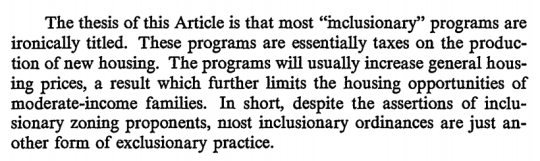
    In a classic paper (1981) by Yale Professor Robert C. Ellickson – called The Irony of Inclusionary Zoning – he argues that these practices can actually increase general house prices:

    image

    As a counterargument Owen Pickford over at The Urbanist argues that IZ simply reduces land prices as a result of the new tax. Land, after all, is the residual claimant. Therefore, he believes it’s an effective affordable housing policy. (I’m not so sure I believe that land prices would decrease in practice.)

    There’s also debate about the effectiveness of inclusionary zoning to actually deliver affordable housing at a meaningful scale. City Observatory wrote a post that looked at the total number of units produced (through IZ) across a number of American cities and the results were spotty. It should, however, be noted that not all inclusionary zoning policies are mandatory.

    Finally, the Furman Center for Real Estate & Urban Policy at New York University published a housing policy brief back in 2008 that looked at this exact topic. While they admit that the data is scarce, they come to the conclusion that IZ had no meaningful impact on the prices and production of single-family housing in San Francisco, but that IZ seems to have slightly decreased production and slightly increased pricing in the suburbs of Boston.

    What this last point suggests is that inclusionary zoning policies are not all created equal. So like all difficult questions, the answer to this one is likely: it depends. If anyone can point me to better data on inclusionary zoning, I would love to see it.