Daily insights for city builders, delivered every morning at 6 AM ET. I’m Brandon Donnelly — a Toronto-based real estate developer and founder of Globizen. I’ve been writing here since 2013.

Tag: placemaking

  • What drives attachment to cities

    The Knight Foundation recently published a report looking at what attaches people to the place in which they live. To get this information, they surveyed over 11,000 Americans, some of which live in urbanized areas and some of which just live in metro areas across the United States. This is interesting information to know at any time point in time, but you could argue that it’s even more important at a time like this, where everyone seems to be questioning everything about cities.

    Here are two of their key findings:

    • People who spend more time in the principal or main city of a metro area — whether as residents or as frequent visitors — tend to be more attached. This is is true both in terms of how they feel, but also in terms of how they act, such as how much they give back to the community. I suppose you could debate whether going to the city creates attachment or whether attached people tend to go to the city, but this association does seem somewhat intuitive to me. I am imagining a greater sense of place in principal cities.
    • People who choose to live in a place because of its quality of life tend to express more attachment than people who live in a place for other reasons — such as for work. About 40% of Miami transplants cited the climate as the primary factor for moving. Sounds right. Weather is pretty hard to control, but there are lots of other things that cities can do to improve quality of life. And it seems to be one of the stickier factors. Similarly, access to cultural activities and recreational amenities seem to lead to greater attachment.

    More specifically, here are how some people feel about their metro areas:

    This chart is showing the “perceived accessibility to quality features.” The left column is what they believe to be the national average. And the other columns are for Akron, Charlotte, Detroit, Macon, Miami, Philadelphia, San Jose, and St. Paul. Looking at one row in particular — affordable housing — we see that about 50% of Americans surveyed believe they have access to it. In comparison, only 29% and 12% of residents in Miami and San Jose, respectively, feel the same way.

    For a full copy of the report, click here.

    Chart: Knight Foundation

  • Toronto should placemake a “sports alley”

    Being a sports fan is like having a bipolar disorder. The highs are high. And the lows are low. But right now — with the Toronto Raptors having clinched their first ever NBA Finals appearance — we are all on a high. Though the job is far from over, this city has waited 24 seasons for this moment. Turns out, all we were missing was one of the greatest basketball players of all time.

    It’s pretty amazing to see how far we have come both as a franchise, and as a global city. When Scotiabank Arena was completed in 1999, it, and the surrounding area, looked like this. On Saturday night after the win, it looked like this, a veritable “sports alley.” I have long thought that Bremner Boulevard should be placemade into a sports alley connecting Scotiabank Arena (on the east) and the Rogers Centre (on the west).

    From now until this Thursday, all is right in the world. Enjoy it Toronto, and Canada. Masai Ujiri made a bet that I think most, if not all, of us would agree has paid off. Had it not, Raptors fans across the country would be criticizing him for trading away our franchise player. But that’s par for the course in this bipolar world of sports fandom.

  • From retail to logistics

    Over the past few weeks we’ve been talking about the future of the mall on this blog. It’s a topic that I’m very interested in.

    Yesterday the Wall Street Journal published an article talking about the trend of converting retail/shopping facilities to logistic centers. 

    Here’s an excerpt:

    “In Mesquite, Texas, FedEx Corp. next month will open a 340,000 square-foot distribution facility on what once was the site of the former Big Town Mall. Located along U.S. Highway 80 in Texas, the mall declined after newer malls were built nearby. It was demolished in 2006 and the land was later rezoned for industrial use.”

    It turns – and we’ve talked about this – that good retail locations are also good distribution locations. They are usually located close to humans and infrastructure.

    Here’s another example from the article:

    In North Randall, Ohio, Amazon.com Inc. is considering the site of the former Randall Park Mall as a fulfillment center, according to Port of Cleveland, a local government agency focused on spurring job creation and economic growth in Cuyahoga County. Amazon didn’t immediately respond to requests for comment.

    For a short time when it opened in 1976, Randall Park Mall was the largest shopping center in the world and had been “a thriving heartbeat” for the local economy, according to Mr. Davis. But the mall closed in 2009 as stores struggled with fewer shoppers.

    Assuming this trend continues and people continue to buy things online, one has to wonder about the placemaking that should or needs to happen in these areas.

  • World’s best city brands

    Resonance Consultancy – they do brands and strategies for places and products – has just released a new report called: World’s Best City Brands – A Global Ranking of Place Equity.

    With all of these sorts of rankings, it really depends on the research methodology being used and the rigor in which it is being applied. In this case, they evaluated each city based on “six pillars of equity”:

    1. Place: Perceived quality of a city’s natural and built environment
    2. Product: A city’s key institutions, attraction and infrastructure
    3. Programming: The arts, culture and entertainment in a city
    4. People: Immigration and diversity of a city
    5. Prosperity: Employment, GDP per capita entertainment in a city and corporate head offices
    6. Promotion: Quantity of articles, references of a city and recommendations online

    What’s perhaps unique about this study is that it combines measurable statistics with “visitor perception metrics” – data that they mined from social media. Here’s an excerpt from the methodology page:

    “Our team became interested in the way visitors and citizens themselves influence the identity and perception of cities. Increasingly, they do it through their evaluation of experiences on social media and via the comments, images and reviews they share with family, friends and people around the world. These opinions and attitudes, much more than traditional marketing, influence the way people perceive places today.”

    This is a fascinating shift for city brands and is something that we have discussed before on this blog. All of us are now involved in telling the story of the places in which we live and visit.

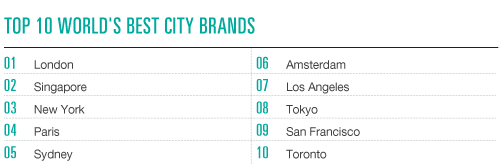
    The entire report is well done and worth a read. It’s also a free download (you’ll need to enter your contact info). But below are the top 10 world’s best city brands. Not really any surprises for me. What about for you?

    image

  • Preserving place

    I was recently asked: How do you go into a neighborhood, build new, and not erase and/or sterilize what makes that neighborhood interesting in the first place? 

    Gentrification is a controversial topic in city building. Too often I think we ignore what happens when we don’t invest in communities, but that doesn’t mean we shouldn’t be deliberate when we do make investments.

    Development is filled with tensions. We are constantly trying to navigate through constraints and balance out the wants of each and every stakeholder. It becomes an art. It doesn’t always work out as planned.

    To state the obvious, I would say that it starts with caring. If you’re not interested in community and city building, then the default response will be to simply replicate what worked on the last project.

    But every place has a local culture. And if city builders are to have any hope of preserving and building upon what makes that place unique, we have to first understand it. What made it successful in the first place? What is its DNA?

    Because then you’re in a position to think about both built form and programming in a way that is culturally sensitive.

    One example that comes to mind is the proposed redevelopment of Honest Ed’s / Mirvish Village here in Toronto. 

    The “micro tower” design is intended to create the sense that the area was built up organically over time. And the fine grain retail (50-60 individual retail spaces) is intended to house local retailers, micro retail startups, and pop-up shops. To me, both of these elements speak to the history and fabric of the area.

    Adopting a unique approach can also sometimes mean rethinking how you measure ROI. If all you care about is who will pay you the highest rent – right now – then you’re going to make a decision based on that metric.

    Maximizing revenue is not a bad thing. That’s what businesses are supposed to do. But sometimes there is or should be a larger vision at play. And sometimes you need to take a longer view.

    In Toronto’s Distillery District, the developers made the decision to eschew large chains and franchises (in favor of more local retailers) so that they could create a very particular place. Ultimately that particular place became a great place to sell condos, but they suffered early on for it.

    I like how Gary Vaynerchuk put it when he asked: What is the ROI of your mother? Sometimes you may not be able to measure it, but that doesn’t mean the ROI isn’t there.

    Any other suggestions?

  • Does urban authenticity matter?

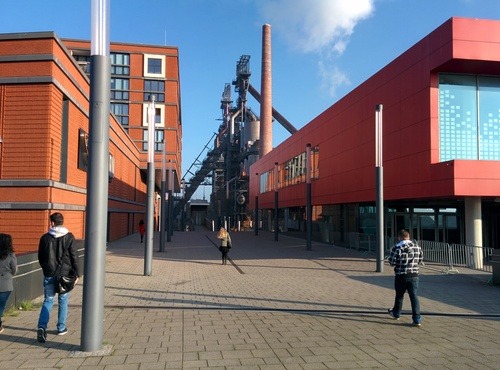
    After yesterday’s post on Belval in Luxembourg, I started thinking more about authenticity. I ended the post by talking about some of the industrial elements – blast furnaces and so on – that will be preserved in the neighborhood and argued that those types of things are great for creating a sense of place. But I also said that it’s always better when those things are authentic.

    But what does it mean to be authentic? What if some savvy developer created new blast furnaces and inserted them into their new neighborhood in order to simulate the feel of an old industrial steelworks? Would that change how you felt about the space and area?

    Another example is Intrawest’s ski resorts. Intrawest is quite famous for creating attractive ski villages that give you the impression of being in some old European mountain village. They include a mix of uses and many people visit them even if they don’t intend to ski. But does it matter that it’s not really an old European ski town or that many of them look the same?

    Clearly, in both of these examples, one is more “authentic” than the other. But all that really changes is the story. In one case, you get to tell yourself, and others, about an old steel mill that used to be where you now have your Scandinavian desk and Retina display MacBook. And in the other case, all you get is a simulacra or imitation of some blast furnace thing.

    While this may seem immaterial to some, I don’t think it is. I’m not saying that customers always demand 100% authenticity. We don’t. But let’s not forget how much we all love a great story.

    Image: Belval (Fräntz Miccoli)