Daily insights for city builders, delivered every morning at 6 AM ET. I’m Brandon Donnelly — a Toronto-based real estate developer and founder of Globizen. I’ve been writing here since 2013.
Below is a good discussion with Aaron Renn about how to brand a city. I fully agree with two of the points he makes: (1) Not enough cities are thinking holistically about this topic and (2) tech startups, bicycle lanes, and craft breweries aren’t going to cut it as a strategy. Every city is focusing on that sort of stuff these days. Zero differentiation. Find something germane to your city and start building on it. If you can’t see the embedded podcast below, click here.
Tourism Toronto launched a new campaign this week and with it came a great video that has been making the rounds online. It feels authentic. It actually feels like Toronto. Watch it here if you can’t see it embedded below.
But why exactly is it a successful example of place branding?
Resonance (place branding consultancy) wrote a post about it and also spoke with Tourism Toronto’s EVP and Chief Marketing Officer. Here’s an interesting excerpt about the two things they wanted to achieve in the campaign/video:
“The campaign—and certainly this video—is trying to achieve two things,” Andrew Weir, Tourism Toronto’s executive vice president and chief marketing officer, tells Resonance. “First, international visitors tend to think of destinations by country, so we had to connect Toronto to the Canadian story.” He says the sprawling, wild country is still generally known for mountains, forests and wilderness, and Toronto wasn’t connecting to that narrative. Enter the “Canada’s Downtown” identity as a way to both incorporate the destination in a national context and differentiate from it. “Toronto is home of the country’s stock exchange, the center of media, the big sports teams are here, we have the long-run theater productions,” Weir rhymes off. “It is the urban center of Canada.”
The second objective for the campaign (and one held high throughout the commercial) was to be unabashedly proud of the city’s unique alchemy, diversity and inclusivity.
“We’ve seen the foundation for local pride laid by people and brands like Drake and the Raptors and we wanted to build on that, to separate ourselves from other cities. We tapped into that energy that’s embedded in Toronto’s identity and sense of place.”
Pride—and a devotion to inclusivity and openness—jumps off the screen. Given the current political direction towards closed borders and suspicion, the goosebumps pop often while viewing.
At the end of the day though, I think it comes down to the fact that it feels like it captures the zeitgeist of Toronto. As I said at the beginning of this post, it feels authentic. And good place branding doesn’t invent identity. It takes things that are already latent and then exploits them.
It’s either that or I just like seeing the Chinese food place I go to at 3am featured in a video.
With all of these sorts of rankings, it really depends on the research methodology being used and the rigor in which it is being applied. In this case, they evaluated each city based on “six pillars of equity”:
Place: Perceived quality of a city’s natural and built environment
Product: A city’s key institutions, attraction and infrastructure
Programming: The arts, culture and entertainment in a city
People: Immigration and diversity of a city
Prosperity: Employment, GDP per capita entertainment in a city and corporate head offices
Promotion: Quantity of articles, references of a city and recommendations online
What’s perhaps unique about this study is that it combines measurable statistics with “visitor perception metrics” – data that they mined from social media. Here’s an excerpt from the methodology page:
“Our team became interested in the way visitors and citizens themselves influence the identity and perception of cities. Increasingly, they do it through their evaluation of experiences on social media and via the comments, images and reviews they share with family, friends and people around the world. These opinions and attitudes, much more than traditional marketing, influence the way people perceive places today.”
This is a fascinating shift for city brands and is something that we have discussed before on this blog. All of us are now involved in telling the story of the places in which we live and visit.
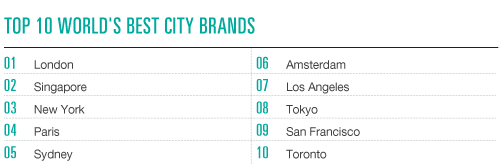
The entire report is well done and worth a read. It’s also a free download (you’ll need to enter your contact info). But below are the top 10 world’s best city brands. Not really any surprises for me. What about for you?
There’s something powerful about seeing/hearing cities being depicted in film, TV, and other kinds of pop culture. It creates familiarity and does a lot to drive the brand of that place.
But how often are you just seeing one city disguised to look like another? Actually quite often.
Here’s an interesting video that talks about how the 3rd largest film production city in North America never actually plays itself.
I know that there are real economic benefits to being a cheap place to film movies, but I would love to see Canadian cities play themselves. There are also big benefits to that.
More so than any other genre of music, there seems to be a longstanding tradition in hip hop of promoting the city in which you’re from. From Los Angeles to Atlanta to New York, I’ve always admired the way that hip hop artists promote and showcase their cities.
For a long time in Toronto we didn’t have that. Our hip hop scene was too embryonic and we just didn’t have artists who were both big enough and willing to take the lead. Or at least, that’s what I was lead to believe as an outsider who candidly doesn’t really follow the scene.
But all that has changed.
Earlier this month, Pitchfork published an interesting article by Jamieson Cox called: Views From The 6 – Inside Drake’s Toronto. It talks all about Drake’s love affair with this city and it even has a map of all the areas of Toronto that have been featured in his videos.
But at one point in the article Jamieson argues that – like many hip hop cities – Drake’s depiction of Toronto is more fantasy than reality:
His mythological Toronto is a metropolis where everyone knows your name and exes are always lurking around the corner, a forest of penthouses with a panoramic view, a park-studded playground where the skies are free of ambient light and the highways are always clear. Like many hip-hop locales, it’s a city closer to the realm of theory—and fantasy—than reality.
However, at the end of the day, I don’t think that matters. Similar to how your mind actually believes that wine tastes better out of an expensive glass, I think a big part of city branding has to do simply with how you’re supposed to feel. What is Toronto supposed to be like? How am I supposed to experience this?
I love what Drake is doing. Because if everyone thinks it’s supposed to be a certain way, eventually that becomes a self-fulfilling prophecy.
Most people would agree that branding is a powerful and important exercise in the world of business. We recognize that brand equity is something that pays dividends in the future.
When you walk around a city with a Starbucks, Tim Hortons, or some other coffee cup in hand, you are sending signals about who you are as a person and consumer. So, you could argue that you’re consuming the cup, as much as you are consuming the coffee.
But one area that still feels like it’s in its infancy is place branding. That is, the branding of nations, regions, cities, and places. I’ve talked a lot about the business of cities and how impressions are created around cities, but I’ve never explicitly talked about place branding.
But at the same time, there are more grassroot ways in which a place brand can emerge. Think about the number of times Jay-Z has referred to himself as the Brooklyn boy or Drake has promoted Toronto in one of his videos. It’s hard to measure the impact of these sorts of things, but I am sure there is one.
Here’s another example – a 4 minute video of Drake talking about why he loves Toronto. Click here if you can’t see it below.
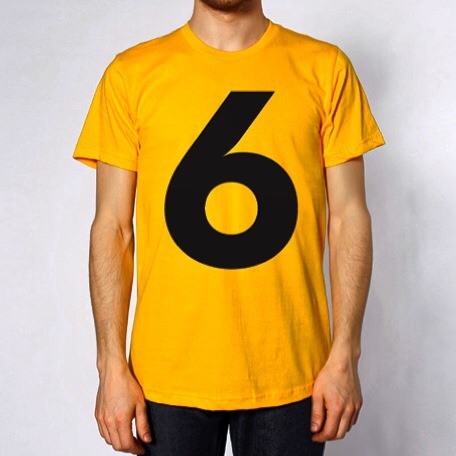
Recently, you may have heard that Drake is about to give Toronto a new moniker: The 6. Some think it is in honor of our two main area codes 416 and 647, and I think that’s probably a good guess.
But whatever the reason, I thought it was an interesting exercise in place branding. So I decided to partner with Toronto-based design firm Badd Press and make a “The 6” t-shirt (shown at the top of this post). You can get yours for $30 by visiting shopATC.