Daily insights for city builders, delivered every morning at 6 AM ET. I’m Brandon Donnelly — a Toronto-based real estate developer and founder of Globizen. I’ve been writing here since 2013.
The photo is of Hong Kong and it was taken using a drone. Click here for other photos from his “Urban Jungle” drone series.
If you remember the maps from yesterday, you might remember that Hong Kong had a peak residential density of around 111,100 people per square kilometre (2013).
I may never do another “Tweet of the Week” on ATC, but I couldn’t resist sharing this one of New Year’s Eve on Well Street in Manchester’s city centre.
So much going on this pic of New Year in Manchester by the Evening News. Like a beautiful painting. pic.twitter.com/szKKRM4U4i
But then Roland Hughes of the BBC remarked that its composition was similar to a Renaissance painting and that the guy in blue laying in the middle of the street, reaching for his beer, could be thought of as a parody of the reaching God in Michelangelo’s The Creation of Adam. So he tweeted it out. Since then it has gone viral.
For those of us who weren’t in Manchester on New Year’s Eve, we clearly missed one epic party.
I’ve only been to Dubai once. I had a lot of fun, but it’s not my favorite city in the world. That’s largely because I tend not to be drawn to cities where you feel like you need to drive in order to properly experience it.
But boy, this time-lapse video sure makes the city look cool. Click here if you can’t see the video below.
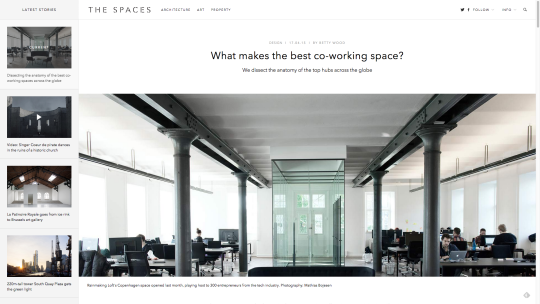
At some point in the past, I preregistered for a site called The Spaces. I don’t remember doing it, but I’m sure that the site seemed promising when I landed on it and so I gladly handed over my email address. I’m always on the lookout for new and interesting things.
Today that site has (soft) launched. And if you like architecture, design, art, and/or property, I am certain you will love it. I am already a fan.
Based in London, The Spaces is about exploring the new ways in which are we living and working. Spaces ranging from residences to coworking spaces and everything in between. It’s about unique and progressive spaces and the people behind them. I love the concept.
Since this is still a soft launch, I am sure the team is looking for feedback from the market. So if you have some, please share it in the comment section below. I will make sure they read it.
Click here to check out The Spaces. Happy Friday all 🙂
As far as videos and photos go, it’s probably as close as you’re going to get to actually being there. And if you’ve never been to Rio de Janeiro (which I haven’t), it’s a great way to see and understand the city’s built environment. I loved looking at all of the details.
One of the projects that I’m most excited about here in Toronto is the renovation and addition to One Spadina Crescent. The building sits in the middle of a roundabout along Spadina Avenue and occupies what is easily one of the most ceremonial positions in the city.
But for as long as I can remember, the building hasn’t been living up to its full potential. So much so that in the 1960s it was going to be demolished in order to make way for the proposed Spadina Expressway. That would have been an absolute tragedy. Thankfully, our friend Jane Jacobs stopped that one.
Today, exciting things are happening at One Spadina Crescent. The Daniels Faculty of Architecture, Landscape, and Design at the University of Toronto is in the midst of renovating and expanding the building, and will eventually relocate there from its current location on College Street.
When it’s all said and done, One Spadina Crescent will look something like this (via Daniels).
From the south:
From the west:
From the north:
What’s most exciting to me about this project are the following 3 things:
First, it’s an opportunity to connect One Spadina Crescent to the surrounding urban fabric. Today, it feels very much like an island in the middle of the street.
Second, it’s a wonderful example of the new layering on top of the old, which is something that I believe we should aspire to do in our cities. The University of Toronto has become quite good at doing that on campus.
Yesterday morning I went for a swim at the new Regent Park Aquatic Centre. I used to swim regularly when I was in grad school in the US, but it fell off when I moved back to Toronto and there wasn’t a convenient place for me to walk to. Having to drive to a gym or to a pool can really cut hurt how often you’re able to go.
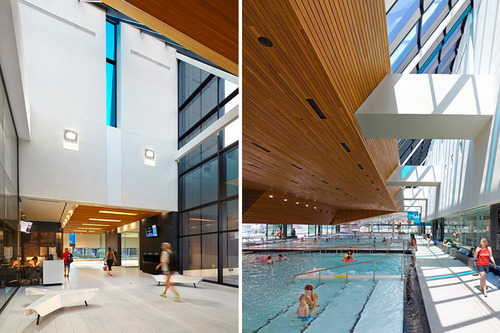
In any case, the pool was fantastic. On the west side of it are glass sliding doors that face the park. And since yesterday was such a beautiful day, they were all open while everyone was swimming lanes. The wooden ceiling also gives the space a nice, warm feel.
The biggest surprise for me though was the universal change rooms. I had never been in a co-ed change room before – or one that was completely open and visible to the pool (there are small private rooms so you can actually change). For families, it makes a lot of sense. Everyone can go in together and it’s easy to watch your kids in the pool from within the change room.
After my swim, I rode my bike around Regent Park and tweeted this out:
What’s happening in Regent Park is incredibly exciting. To me, it feels like a return to the fundamentals of city building. They’ve reconnected the old street grid – which had previously been removed to create the old “towers in a park” scheme – and they’re clearly working towards a proper urban neighborhood with retail at grade and buildings pushed right up against the street.
A big measure of success, though, will be how animated the streets become and how well the retail does. Because all of that isn’t quite there yet. But we’re on our way. And already I feel like we’re about to forget what the old Regent Park used to be like. Toronto may have lived with that neighborhood for over 60 years, but future generations will barely know it existed.
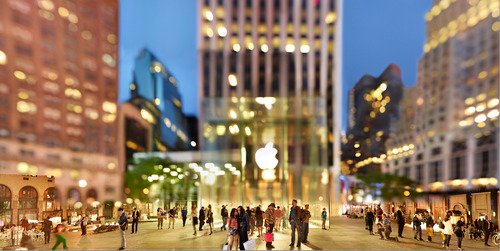
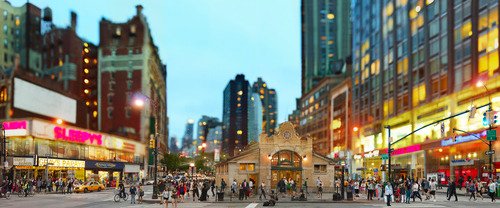
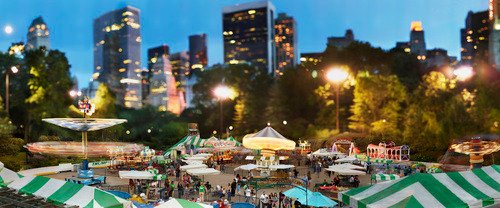
New York photographer Jeff Chien-Hsing Liao has an upcoming solo exhibition at the Museum of the City of New York next month called Assembled Realities. I just heard about it through CityLab.
Pushing the boundaries of traditional documentary photography, Liao (b. 1977) creates large-scale panoramas by combining multiple exposures of the same location taken over the course of several hours. The resulting composite photographs are often fantastical; complex, hyper-real views that no single shot—or the eye—could capture.
I love how his photos begin to distort reality and how they focus your attention – in many cases – on New York’s vibrant street life. I thought you might all enjoy them as well.
Yesterday, I discovered a Jerusalem-based Italian photographer by the name of Vittoria Mentasti. She has an ongoing project called “A Woman With Two Names”, that’s exploring the identity of Canada’s Inuit community in Iqaluit, Nunavut. Click on the photo below to see the entire gallery.
Here’s her language on the project:
“Iqaluit, the capital of Nunavut, is a city of 7000 people surrounded by tundra and the sea. The only way to get in or out of Iqaluit is from the air. I was interested in the cultural identity shift the Intuit community is experiencing and its consequences. The community, especially its younger members, are trapped between two worlds; they are losing touch with their past and are headed towards an uncertain future.
The process of forced assimilation carried out by the Canadian Government and the Church during the first half of the 20th century, deprived the Inuit of their social and spiritual customs. The transition away from their nomadic roots to modernized living has led to alcoholism, domestic violence and unemployment; symptoms of a society that is floating between its past and present.
Photographing off-moments of everyday life, I was looking to depict the sense of isolation, their ancestral connection to a harsh land, and the feeling of not belonging to “The South”, the way Inuit refers to the rest of the world.”
As one of the most remote and sparsely populated regions in the world, it’s easy to overlook what’s happening here in our country. But there are real problems in our north. In 2011, the Globe and Mail published a Focus Feature on Nunavut where it asked: Is Nunavut a failure of Canadian nation building?
“The rate of violent crime per capita in Nunavut is nine times what it is in the rest of Canada. The homicide rate is around 1,000 per cent of the Canadian average.”
I’m not an expert on this matter, but it seems like everybody is picking up on the same phenomenon. We’ve created an in-between society. A society that’s completely ill-equipped to compete in the modern world, but that’s too far removed from its roots to turn back now. They were nomads and now they’re not.
This is hugely problematic and it’s only going to get worse. Already we’re seeing rising income inequality within “The South.” The returns to being smart are being amplified and twenty somethings with a killer app are turning down billion dollar acquisition offers.
What do you think this does to the north? I’d bet it makes it much worse.
In light of my upcoming trip to Detroit, I thought I’d share a (photography) book that was recently recommended to me called The Ruins of Detroit. It’s by photographers Yves Marchand and Romain Meffre. You can check out some of the photos here.
The imagery is absolutely incredible and I really like their description of the project. Here’s a part of it:
“Detroit, industrial capital of the XXth Century, played a fundamental role shaping the modern world. The logic that created the city also destroyed it. Nowadays, unlike anywhere else, the city’s ruins are not isolated details in the urban environment. They have become a natural component of the landscape. Detroit presents all archetypal buildings of an American city in a state of mummification. Its splendid decaying monuments are, no less than the Pyramids of Egypt, the Coliseum of Rome, or the Acropolis in Athens, remnants of the passing of a great Empire.”
I particularly like the last line: “…remnants of the passing of a great Empire.” When I look at their pictures, I like to try and imagine what those spaces would have been like teeming with people. Do you think anyone, at the time, could have possibly imagined that those good times were going to end?
Clearly most did not, because look at the money that was spent on what are beautiful buildings. As derelict as those buildings are today, each one of them was presumably built with economics in mind. Developers were making money, tenants were paying rent and people were occupying the spaces. Now look at them.
There’s something really powerful about witnessing this kind of abandonment, particularly because it feels so recent. It’s one thing to look at relicts like the Coliseum and dismiss it as being eons ago. But this wasn’t that long ago. For me, it’s a stark reminder of how ephemeral things in life can be. Just because you’ve got it today doesn’t mean you’ll have it tomorrow.