Daily insights for city builders, delivered every morning at 6 AM ET. I’m Brandon Donnelly — a Toronto-based real estate developer and founder of Globizen. I’ve been writing here since 2013.

Tag: philip johnson

  • The Aluminaire House finds a permanent home in Palm Springs

    In a few days, a new exhibit, called the Aluminaire House™ Exhibit, will open in a parking lot of the Palm Springs Art Museum. It will form a new part of their permanent collection. Now, museum goers won’t be able to go inside of the house due to accessibility limitations, but they’ll be able to look at it from the outside. And this alone is a big deal because this house is a big deal.

    Initially constructed in 1931, the house was designed by A. Lawrence Kocher (then the managing editor of Architectural Record) and Albert Frey. Albert was a Swiss-born architect who had just immigrated to New York from Europe, after having worked for the famous Le Corbusier in Paris. And so he was a practitioner of the International Style and this house was a clear representation of that.

    Erected in only 10 days, Aluminaire House is thought to be the first all-metal house ever constructed in the United States. Well, metal and glass. And at the time, the overarching objective was to build something cheap, modular, and durable. Something that many are still trying to accomplish to this day.

    Not surprisingly, the house was polarizing. Supposedly, architect Philip Johnson picketed in front of it. But this house would go on to become an icon, and it was eventually featured in MoMA’s 1932 exhibition, “The International Style — Architecture Since 1922” — an exhibition that has been largely credited with introducing European-style modernism to the US.

    Albert also ended up moving to Palm Springs later in life, and became known for pioneering something known as “desert modernism.” So it’s only fitting that this house ultimately end up here. Even if all-metal maybe isn’t the best choice of material for a hot desert. If you find yourself in Palm Springs, you should definitely go check it out, or picket in front of it.

    Images: Surface Magazine & Palm Springs Art Museum

  • Building on rooftops in New York City is really tough

    Hedge fund manager Bill Ackman is a pretty wealthy guy and so it is fairly safe to assume that he could choose to live almost anywhere. For some people the ideal might be a low-rise house with a backyard in the suburbs.

    But since 2018, Ackman has chosen a kind of penthouse apartment on the roof of a 1920’s co-op building in Manhattan’s Upper West Side. It was formerly the home of author Nancy Friday and Ackman supposedly purchased it for $22.5 million.

    He is now looking to demolish the penthouse and build a new two-storey residence designed by architect Norman Foster. The design looks like this, which kind of reminds me of Philip Johnson’s The Glass House:

    Today it was in the news that Ackman has been having a fun time trying to convince his co-op board that a new set of glass boxes on the roof their building is a good idea. FT reported that the project has created “an atmosphere of fear and distrust among residents in the building.”

    I’m not exactly sure what it is about this proposal that is causing fear and distrust but Ackman is on record saying that he thinks this isn’t about heritage preservation or architectural integrity; it’s about people not wanting the disruption that comes along with construction. Fair.

    One way to test this, I suppose, is to propose something more traditional or similar to what’s already there. But I suspect that the other dynamic at play here is simply that he is a rich guy with a starchitect trying to build something cool.

    Building things is tough.

  • If man had developed a third arm, where might this arm be best attached?

    Roman Mars of 99% Invisible recently published an excellent episode called The Mind of an Architect. It has to do with a set of research studies completed in the late 1950s by an organization at the University of California, Berkeley known as the Institute of Personality Assessment and Research (IPAR).

    IPAR was founded by a personality psychologist named Donald MacKinnon. He initially worked for the precursor to the CIA and founded IPAR with the intent of studying “combat readiness and efficiency.” But over fears of how creative the Soviets were getting, the focus of IPAR shifted to instead studying creativity.

    And architects were deemed to be an ideal test subject (from 99percentinvisible.org):

    “Researchers saw architects as people working at a crossroads of creative disciplines, a combination of analytic and artistic creativity. As professionals, architects had to be savvy as engineers and businessmen; as aesthetes, they also acted as designers and artists.”

    So over a series of weekends in the late 1950s, some of the most celebrated minds in architecture – including people like Philip Johnson, Richard Neutra, and Louis Kahn – were studied and picked apart. 

    image

    They were asked to do quick sketches, create mosaics, and they were asked questions such as this one: “For the next 45 minutes we would like you to discuss this notion: if man had developed a third arm, where might this arm be best attached?”

    In the end, here’s what they concluded:

    The researchers began to notice certain patterns across creatives of all professions and genders, including a tendency to nonconformity and high personal aspirations. They also found many creatives shared a preference for complexity and ambiguity over simplicity and order. Creatives could make unexpected connections and see patterns in daily life, even those lacking high intelligence or good grades.

    In short: IPAR found that creative people tend to be nonconforming, interesting, interested, independent, courageous and self-centered, at least in general. Many of these traits may seem obvious today, but they were not necessarily obvious prior to these studies. Back when their tests were being conducted and findings presented in the 1950s and ’60s, the very idea of a “creative personality” was a novelty in academic and public discourse.

    The findings may not be groundbreaking to us today, but the documents and recordings produced during the study are certainly interesting. If you’re into this topic, there’s also this book you can pick up.

    Oh, and if we are to have a third arm, I would like mine to run almost parallel to my existing dominant arm (right). That way I could double up on my most potent dexterity. It would also be far less intrusive than an arm on one’s head or in the middle of one’s back. Then again, it would ruin our symmetry as humans. And perhaps that third arms need to be celebrated instead of being masked.

    What would you suggest?

    Image: Institute of Personality and Social Research, University of California, Berkeley / The Monacelli Press (via 99% Invisible)

  • For Sale: Breuer House II

    image

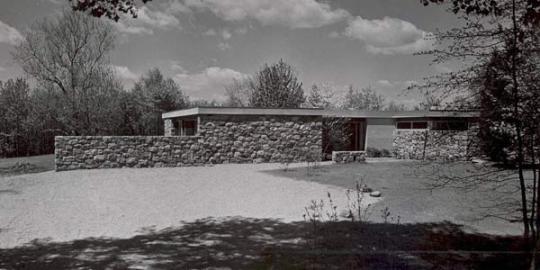
    Breuer House II is currently on the market in New Canaan, Connecticut for $5.85 million. The house has 4 bedrooms, 4 full bathrooms, and 2 half bathrooms. It is 4,777 square feet and sits on 3.11 acres of land.

    Originally built in 1951, the house was designed by the Hungarian-born, Bauhaus-trained, and Harvard-teaching modernist architect, Marcel Breuer. It served as their family home until 1975, after which time it was sold and almost demolished. Thankfully it was instead purchased, restored, and expanded (by another Harvard architect).

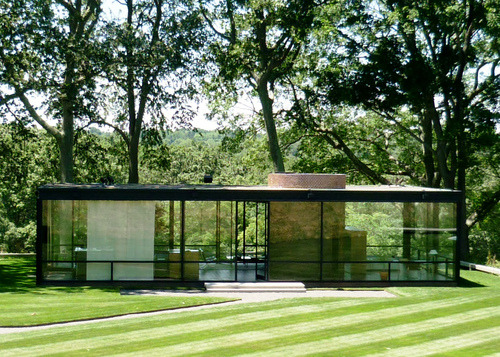
    Marcel Breuer was a member of what is known as the Harvard Five. They were a group of five architects who either taught at or went to the Harvard Graduate School of Design and who had moved out to New Canaan to build experimental modern homes starting in the 1940s. Homes like Philip Johnson’s Glass House.

    Seeing the Breuer House II listed for sale this morning reminded me of how cool it must have been at the time for a bunch of radical architects to move out to a sleepy New England town and start building modernist boxes. I’m sure it pissed off more than a few people.

    Does anyone know of anything similar to this happening today? 🙂

    Image from Modern Homes Survey

  • A labor of love

    image

    We’ve taught generations of architects to speak out as artists, but we haven’t taught them how to listen.

    This is a line from a recent New York Times op-ed that has been making the rounds online today called: How to Rebuild Architecture

    The premise of the article is that architects have marginalized themselves by being pompous elitists who increasingly serve only the rich and don’t respond to public opinion about architecture.

    For too long, our profession has flatly dismissed the general public’s take on our work, even as we talk about making that work more relevant with worthy ideas like sustainability, smart growth and “resilience planning.”

    The author’s recommendation is that architects need to get better at listening to their clients and listening to the public. 

    Reconnecting architecture with its users — rediscovering the radical middle, where we meet, listen and truly collaborate with the public, speak a common language and still advance the art of architecture — is long overdue. It’s also one of the great design challenges of our time.

    What’s interesting about this viewpoint is that it’s precisely the sort of thing that entrepreneurs and business people are trained to do today. The mantra is that you should never build your product or service in isolation. Get out of the building. Talk to customers. Get feedback. Adjust. And iterate.

    But architects don’t like to do this. Why is that?

    The answer, at least partially, comes down to taste. As the author correctly pointed out, the kinds of buildings that architects like are often not the same ones that the general public likes.

    I don’t have any hard data to support this claim, but I suspect that most people out there – particularly those with money – would prefer their home to look like something that Robert Stern designed as opposed to a glass box designed by Philip Johnson.

    And yet the latter is what architects and architecture students make pilgrimages to. I certainly did when I was in architecture school. 

    In fact, I think you’d have a difficult time getting into any architecture school right now with a portfolio of work as traditional as the work of Robert Stern. It’s simply not part of the architectural discourse at this stage.

    So to many architects, it can be difficult – even painful – to listen to what the public wants. Architects are not trained in terms of market size and profit maximization. It’s about passion. It’s a labor of love. And when you’ve already fallen in love, it can be hard to change your mind.

    Image: Flickr