
Daily insights for city builders, delivered every morning at 6 AM ET. I’m Brandon Donnelly — a Toronto-based real estate developer and founder of Globizen. I’ve been writing here since 2013.

Tag: people

  • People stay the same

    Andrew Chen recently delivered a keynote at StartCon in Australia called: What’s Next in Growth? You can find his entire talk, here, on his blog. 

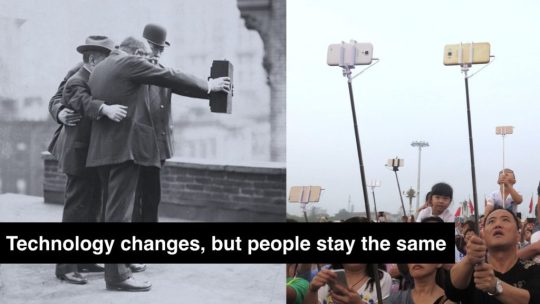
    One of the themes of his talk is that, “technology changes, but people stay the same.” I like that. See above.

    But more specifically, his presentation focuses on 3 techniques for growing businesses and products: customer referrals, viral content, and bootstrapping marketplaces. All of it is interesting, but I’m particularly fascinated by the last one.

    Marketplaces are all around us. Uber is a marketplace that pairs drivers and riders. Bars are a marketplace that try to pair people together. Finding, trading, and transacting (whatever that might mean for the marketplace in question) seems so fundamental to humans. And cities really empower that.

    The challenge with marketplaces is that they’re hard to start. There’s always a chicken-and-egg problem and so one side of the marketplace usually needs to be “hacked” at the beginning.

    Uber is a perfect example of this. At the outset, it didn’t have enough liquidity in its marketplace to compete with incumbent taxis. That is, it took longer to get an Uber than to get a taxi. 

    So instead, the value proposition was not about speed (or cheapness); it was about luxury. Uber was “everyone’s private driver.” That made waiting acceptable. You were getting a different level of service. The first Uber I ever called in Toronto took 20 minutes to get to my place in midtown.

    But obviously as liquidity increased, Uber was able to move downmarket and capture more (most) of the taxi market. Marketplaces are powerful once they get going. Network effects.

    I say all of this because, as many of you know, I have spent a lot of time wondering about the future of real estate marketplaces

    At the same time, I also think that many of these seemingly tech-focused lessons could be applied to cities. Starting an online marketplace is difficult. So is building a new neighborhood from scratch. In the end, it’s always about people.
  • World’s best city brands

    Resonance Consultancy – they do brands and strategies for places and products – has just released a new report called: World’s Best City Brands – A Global Ranking of Place Equity.

    With all of these sorts of rankings, it really depends on the research methodology being used and the rigor in which it is being applied. In this case, they evaluated each city based on “six pillars of equity”:

    1. Place: Perceived quality of a city’s natural and built environment
    2. Product: A city’s key institutions, attraction and infrastructure
    3. Programming: The arts, culture and entertainment in a city
    4. People: Immigration and diversity of a city
    5. Prosperity: Employment, GDP per capita entertainment in a city and corporate head offices
    6. Promotion: Quantity of articles, references of a city and recommendations online

    What’s perhaps unique about this study is that it combines measurable statistics with “visitor perception metrics” – data that they mined from social media. Here’s an excerpt from the methodology page:

    “Our team became interested in the way visitors and citizens themselves influence the identity and perception of cities. Increasingly, they do it through their evaluation of experiences on social media and via the comments, images and reviews they share with family, friends and people around the world. These opinions and attitudes, much more than traditional marketing, influence the way people perceive places today.”

    This is a fascinating shift for city brands and is something that we have discussed before on this blog. All of us are now involved in telling the story of the places in which we live and visit.

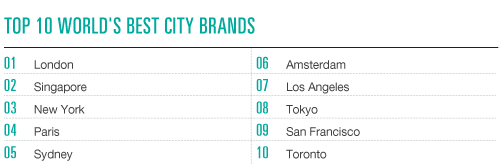
    The entire report is well done and worth a read. It’s also a free download (you’ll need to enter your contact info). But below are the top 10 world’s best city brands. Not really any surprises for me. What about for you?

    image

  • Mapping of global migration

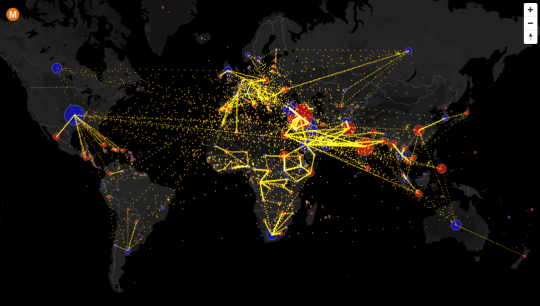
    Max Galka has created an incredible visualization of country-to-country net migration (from 2010 to 2015) on his blog, Metrocosm.

    Here’s a screenshot:

    image

    But you really need to view the full screen interactive version

    In that version, you can hover over a country to see the total net migration number (+/-) and you can click on a country to see where people are moving to and from. A blue circle indicates positive net migration (greater inflows) and a red circle indicates negative net migration (greater outflows).

    All of the data is from the United Nations Population Division. And though the numbers are estimates, it’s a fascinating look at global migration. For instance, look at the outflow from Syria.

    It would also be interesting to see these numbers on a per capita basis because some countries certainly punch above or below their weight in terms of migration. Off the top of my head, I’m thinking of Canada and Australia vis-à-vis the US.

  • Imagining the way things could be

    Photograph Old in new by Andrew Johnston on 500px

    Old in new by Andrew Johnston on 500px

    I was out for lunch with a colleague of mine yesterday afternoon and he said to me: “Brandon, I’m really surprised that you’re so interested in technology. It just seems so different compared to real estate and architecture.”

    And I’ve certainly heard that exact same comment from a number of people before. But I don’t see it that way and here are a few reasons why.

    The common thread for me between architecture, real estate development, and technology is that in all of these cases it is about imagining the way things could be in the future and then creating it. It’s about change. It’s about growth. It’s about creation. And I consider myself a builder in practically every sense of the word.

    At the same time, each of these disciplines is about creating engaging spaces for people. Architects and real estate developers do it in the physical world, but many technology products strive to do exactly the same thing in the online world.

    In fact, a couple of years ago I was fascinated to learn that Facebook has and continues to draw inspiration from many of the same books and philosophies that architects, planners, and developers rely on when it comes to creating engaging communities. The medium might be different, but it’s still about people.

    Finally, as I’ve said many times before here on Architect This City, I think that the distinction between tech and non-tech companies and industries is quickly evaporating. Is Airbnb a tech company or a hospitality company? Is Uber a tech company or a taxi company? Pretty soon we’ll be saying that about many other industries.

    Maybe it’s because I’ve always been interested in wading through the overlaps between disciplines, but this is just the way I see it.

  • Don’t forget that this is about people

    Yesterday I wrote about the High Line Park in New York and the tremendous success that it has seen since the first section opened in 2009. It attracts somewhere around 5 million visitors a year and is thought to be responsible for over $2 billion a year in economic activity.

    But the economic activity it’s generating and the future tax revenues it’s creating are really a byproduct of the fact that people, quite simply, love the High Line. It attracts people. And that reminded me of a short post I wrote earlier this year called: It’s all about people. Because if you think about it, that’s really the key metric for a lot of things in life and in business.

    When you build a park like the High Line in New York or Millennium Park in Chicago, you’re designing it to attract people. When you build a mall, you seek out anchor tenants, because you know they drive foot traffic. When you build a new neighborhood, you’re trying to create street life from scratch. When you run a bar, you want headcount. And when you build a web or mobile app (or write a blog for that matter), you want registered users and eyeballs on your platform.

    And you want these things because foot traffic, street life, eyeballs, impressions, users, and headcounts ultimately generate revenue. But here’s the thing: if you focus directly or too much on that end goal, you run the risk of missing an important step along the way, which is simply to delight real people.

    In his most recent essay, startup guru Paul Graham put it perfectly when he said:

    “The way to succeed in a startup is not to be an expert on startups, but to be an expert on your users and the problem you’re solving for them.

    He’s obviously talking about technology products, but the same could be said for parks, streets, malls, plazas, and so on. To design and build better cities, we need to be experts on people. And we need to create spaces and environments that people actually want to occupy. Spaces that improve people’s lives.

    Now, this may sound fairly obvious to some of you. But quite often I feel like we get sidetracked by things that don’t matter as much as people do.

    Image: Flickr

  • It’s all about people

    Yesterday evening I met up with a talented Toronto-based technology entrepreneur who also happens to be passionate about cities. The conversation meandered between both worlds, but we ended up coming back to one central theme: It’s all about people.

    Facebook didn’t just buy WhatsApp for the technology. It spent $19 billion on almost half a billion active users. That’s what matters. Do people want to occupy your (real or virtual) space? Have you created a community? Whether it’s an app, a building or a neighborhood, you’re useless without engaged participants.

    And to be perfectly honest with you, that’s my ultimate goal for this blog. Ideally I’d like each and every post to inspire conversation and debate (just like this one did on gentrification). A one-sided conversation can only take you so far. The real value happens within communities.